
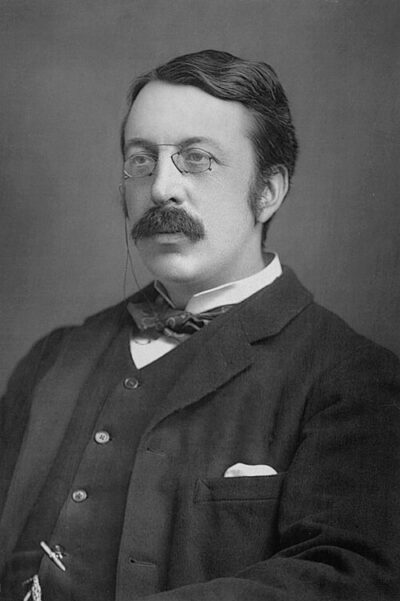
Charles Villiers Stanford
Charles Villiers Stanford was an Irish composer, music teacher, and conductor. Born September 30, 1852, in Dublin. Died March 29, 1924, in London. Positions held include conductor (1901–1910) and composer. Educated at Trinity College and Queens' College. Awards include Doctor of Music, Doctor of Civil Law and Legum Doctor.
Facts
29 facts · 2 confirmed by two sources · 13 cited · 14 from one source
Where this comes from
Papalocal keeps its own record. It started from these sources; what each one said is kept here as it was copied, so a change on their side never changes this page by itself. Tap one to read its version.
What Wikidata says · copied November 16, 2026 · revision 2559449479
- Described as
- Irish composer, music teacher, and conductor (1852–1924)
- Other names
- Sir Charles Villiers Stanford, Karel Drofnatski
- Born
- September 30, 1852 · 11 references
- Died
- March 29, 1924 · 11 references
- Born in
- Dublin · 2 references
- Died in
- London · 1 reference
- Buried in
- Westminster Abbey
- Name at birth
- Charles Villiers Stanford
- Citizen of
- Ireland · 1 reference; United Kingdom · 1 reference; United Kingdom of Great Britain and Ireland
- Occupation
- classical composer; music educator; university teacher; composer · 2 references; conductor · 1 reference; organist · 1 reference
- Positions held
- conductor (1901–1910); composer
- Worked for
- University of Cambridge; Royal College of Music
- Education
- Trinity College; Queens' College · 1 reference
- Genre
- opera; symphony
- Instrument
- organ
- Awards
- Doctor of Music (1883) · 1 reference; Doctor of Civil Law · 1 reference; Legum Doctor · 1 reference
- Father
- John James Stanford · 1 reference
- Mother
- Mary Henn · 1 reference
- Wikipedias with a page
- 33
Wikidata item Q368264 (wikidata.org/wiki/Q368264), public domain (CC0). Copied November 16, 2026.
What Wikipedia says · copied November 16, 2026 · revision 1370777012
Sir Charles Villiers Stanford (30 September 1852 – 29 March 1924) was an Anglo-Irish composer, music teacher, and conductor of the late Romantic era. Born to a well-off and highly musical family in Dublin, Stanford was educated at the University of Cambridge before studying music in Leipzig and Berlin. He was instrumental in raising the status of the Cambridge University Musical Society, attracting international stars to perform with it.
While still an undergraduate, Stanford was appointed organist of Trinity College, Cambridge. In 1882, aged 29, he was one of the founding professors of the Royal College of Music, where he taught composition for the rest of his life. From 1887 he was also Professor of Music at Cambridge. As a teacher, Stanford was sceptical about modernism, and based his instruction chiefly on classical principles as exemplified in the music of Brahms. Among his pupils were rising composers whose fame went on to surpass his own, such as Gustav Holst and Ralph Vaughan Williams. As a conductor, Stanford held posts with the Bach Choir and the Leeds Triennial Music Festival.
Stanford composed a substantial number of concert works, including seven symphonies, but his best-remembered pieces are his choral works for church performance, chiefly composed in the Anglican tradition. He was a dedicated composer of opera, but none of his nine completed operas has endured in the general repertory. Some critics regarded Stanford, together with Hubert Parry and Alexander Mackenzie, as responsible for a renaissance in music from the British Isles. However, despite his conspicuous success as a composer in the last two decades of the 19th century, his music was eclipsed in the 20th century by that of Edward Elgar as well as former pupils.
- Born, in its opening lines
- September 30, 1852
- Died, in its opening lines
- March 29, 1924
From the Wikipedia article “Charles Villiers Stanford” (en.wikipedia.org/wiki/Charles_Villiers_Stanford), by its contributors, under CC BY-SA 4.0 (creativecommons.org/licenses/by-sa/4.0/). Copied November 16, 2026; not changed.
Confirmed Two sources agree. Cited One source, and it names where it got it. One source One source, without a reference of its own. Sources disagree The sources disagree. We show the best-supported value and keep theirs below.
