
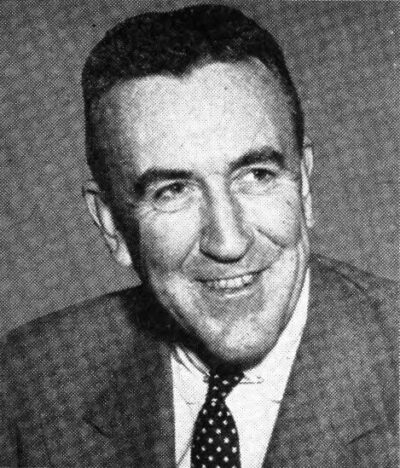
Chester Bowles
Chester Bowles was an American politician. Born April 5, 1901, in Springfield. Died May 25, 1986, in Essex. Positions held include United States representative (1959–1961), Governor of Connecticut (1949–1951) and United States Ambassador to India (2 times) (1951–1969). Educated at Yale University and Choate Rosemary Hall.
Facts
26 facts · 2 confirmed by two sources · 9 cited · 15 from one source
Where this comes from
Papalocal keeps its own record. It started from these sources; what each one said is kept here as it was copied, so a change on their side never changes this page by itself. Tap one to read its version.
What Wikidata says · copied November 18, 2026 · revision 2571576606
- Described as
- American politician (1901–1986)
- Other names
- Chester B. Bowles, Chester Bliss Bowles
- Born
- April 5, 1901 · 4 references
- Died
- May 25, 1986 · 4 references
- Born in
- Springfield · 1 reference
- Died in
- Essex · 1 reference
- Buried in
- River View Cemetery · 1 reference
- Citizen of
- United States · 1 reference
- Occupation
- politician · 1 reference; diplomat · 1 reference; ambassador · 1 reference; governor · 1 reference
- Positions held
- United States representative (1959–1961); Governor of Connecticut (1949–1951); United States Ambassador to India (2 times) (1951–1969); ambassador
- Political party
- Democratic Party
- Education
- Yale University; Choate Rosemary Hall; Yale School of Engineering and Applied Science; Cheshire Academy · 1 reference; Sheffield Scientific School
- Member of
- American Academy of Arts and Sciences
- Spouse
- Julia Mayo Fisk
- Children
- Samuel Bowles; Barbara Fisk Bowles
- Father
- Charles Allen Bowles · 1 reference
- Religion
- Congregational churches
- Wikipedias with a page
- 18
Wikidata item Q880817 (wikidata.org/wiki/Q880817), public domain (CC0). Copied November 18, 2026.
What Wikipedia says · copied November 18, 2026 · revision 1379614545
Chester Bliss Bowles (April 5, 1901 – May 25, 1986) was an American diplomat and ambassador, governor of Connecticut, congressman and co-founder of a major advertising agency, Benton & Bowles, now part of Publicis Groupe. Bowles is best known for his influence on American foreign policy during Cold War years, when he argued that economic assistance to the Third World was the best means to fight communism, and even more important, to create a more peaceable world order.
During World War II, Bowles held high office in Washington as director of the Office of Price Administration, and control of setting consumer prices. Just after the war, he was the chief of the Office of Economic Stabilization, but had great difficulty controlling inflation. Moving into state politics, he served a term as governor of Connecticut from 1949 to 1951. He promoted liberal programs in education and housing, but was defeated for reelection by conservative backlash.
As ambassador to India, he established a good relationship with Prime Minister Jawaharlal Nehru, an emerging leader of the non-aligned movement. Bowles promoted rapid economic industrialization in India, and repeatedly called on Washington to help finance it. However, Washington was angered by India's neutrality, and limited funding to literacy and health programs. During the Eisenhower years, 1953–1960, Bowles organized liberal Democratic opposition, and served as a foreign policy advisor to Adlai Stevenson and John F. Kennedy.
Bowles served as Kennedy's Under Secretary of State in 1961 which enabled him to staff American embassies with liberal intellectuals and activists. However, his liberalism proved too strong for Kennedy, who demoted him to a nominal job as roving ambassador to the Third World in 1961. Kennedy named him as ambassador to India again, 1963–1969, where he helped improve agricultural productivity and fight local famines.
- Born, in its opening lines
- April 5, 1901
- Died, in its opening lines
- May 25, 1986
From the Wikipedia article “Chester B. Bowles” (en.wikipedia.org/wiki/Chester_B._Bowles), by its contributors, under CC BY-SA 4.0 (creativecommons.org/licenses/by-sa/4.0/). Copied November 18, 2026; not changed.
Confirmed Two sources agree. Cited One source, and it names where it got it. One source One source, without a reference of its own. Sources disagree The sources disagree. We show the best-supported value and keep theirs below.
