
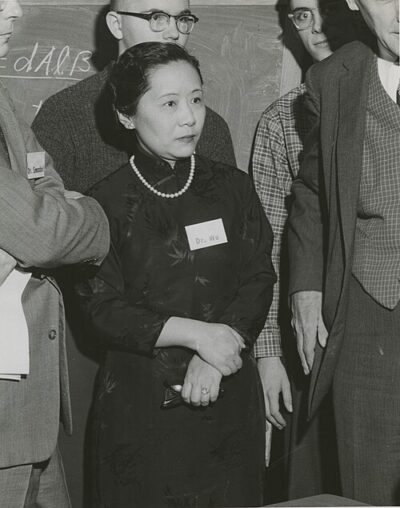
Chien-Shiung Wu
Chien-Shiung Wu was a Chinese-American physicist (1912–1997) (death at 85 years). Born May 31, 1912, in Taicang. Died February 16, 1997, in New York City. Known for Non-Conservation of Parity. Educated at National Central University (Nanjing) and University of California, Berkeley. Awards include John Price Wetherill Medal, Wolf Prize in Physics and National Women's Hall of Fame.
Facts
51 facts · 2 confirmed by two sources · 25 cited · 24 from one source
Where this comes from
Papalocal keeps its own record. It started from these sources; what each one said is kept here as it was copied, so a change on their side never changes this page by itself. Tap one to read its version.
What Wikidata says · copied November 13, 2026 · revision 2564760610
- Described as
- Chinese-American physicist (1912–1997) (death at 85 years)
- Other names
- Chieng-Shiung Wu, Wu Chien Shiung, Wu Jianxiong
- Born
- May 31, 1912 · 6 references
- Died
- February 16, 1997 · 7 references
- Born in
- Taicang
- Died in
- New York City · 2 references
- Cause of death
- stroke · 1 reference
- Citizen of
- Republic of China (–1949); United States (1954–) · 1 reference; Taiwan (1949–)
- Occupation
- nuclear physicist · 1 reference; university teacher; physicist · 1 reference; scientist · 1 reference
- Worked for
- Princeton University · 1 reference; Columbia University · 1 reference; Smith College · 1 reference; Zhejiang University · 1 reference
- Education
- National Central University (Nanjing); University of California, Berkeley (–1940) · 1 reference; Smith College; Zhejiang University · 1 reference; Nanjing University · 1 reference
- Member of
- National Academy of Sciences (1958–) · 1 reference; Chinese Academy of Sciences; American Physical Society; American Academy of Arts and Sciences; American Association for the Advancement of Science; Academia Sinica; Royal Society of Edinburgh; Committee of 100; The World Academy of Sciences; Graduate Women in Science
- Known for
- Non-Conservation of Parity · 1 reference
- Awards
- John Price Wetherill Medal (1962) · 1 reference; Wolf Prize in Physics (1978) · 1 reference; National Women's Hall of Fame (1998) · 1 reference; National Medal of Science (1975) · 1 reference; Tom W. Bonner Prize in Nuclear Physics (1975) · 1 reference; honorary doctorate from Princeton University; Fellow of the American Physical Society; Comstock Prize in Physics (1963) · 1 reference; Women in Technology Hall of Fame (1996) · 1 reference; Honorary doctor at the Nanjing University (1986) · 1 reference; honorary doctor of the Chinese University of Hong Kong
- Field
- physics; physicalism; experimental physics · 1 reference; nuclear physics · 1 reference; particle physics · 1 reference; radioactivity · 1 reference
- Spouse
- Luke Chia-Liu Yuan (1942–1997) · 2 references
- Children
- Vincent Yuan · 2 references
- Wikipedias with a page
- 64
Wikidata item Q450317 (wikidata.org/wiki/Q450317), public domain (CC0). Copied November 13, 2026.
What Wikipedia says · copied November 13, 2026 · revision 1384697268
Chien-Shiung Wu (Chinese: 吳健雄; pinyin: Wú Jiànxióng; May 31, 1912 – February 16, 1997) was a Chinese-American particle and experimental physicist who made significant contributions in the fields of nuclear and particle physics. Wu worked on the Manhattan Project, where she helped develop the process for separating uranium into uranium-235 and uranium-238 isotopes by gaseous diffusion. She is best known for conducting the Wu experiment, which proved that parity is not conserved. This discovery resulted in her colleagues Tsung-Dao Lee and Chen-Ning Yang winning the 1957 Nobel Prize in Physics, while Wu herself was awarded the inaugural Wolf Prize in Physics in 1978. Her expertise in experimental physics evoked comparisons to Marie Curie. Her nicknames include the "First Lady of Physics", the "Chinese Marie Curie" and the "Queen of Nuclear Research".
- Born, in its opening lines
- May 31, 1912
- Died, in its opening lines
- February 16, 1997
From the Wikipedia article “Chien-Shiung Wu” (en.wikipedia.org/wiki/Chien-Shiung_Wu), by its contributors, under CC BY-SA 4.0 (creativecommons.org/licenses/by-sa/4.0/). Copied November 13, 2026; not changed.
Confirmed Two sources agree. Cited One source, and it names where it got it. One source One source, without a reference of its own. Sources disagree The sources disagree. We show the best-supported value and keep theirs below.
