
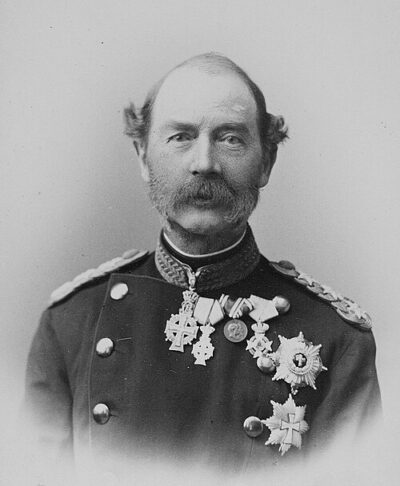
Christian IX of Denmark
Christian IX of Denmark was a King of Denmark from 1863 to 1906. Born April 8, 1818, in Gottorf Castle. Died January 29, 1906, in Amalienborg. Positions held include Monarch of Denmark (1863–1906), Duke of Schleswig (1863–1864) and Duke of Holstein (1863–1864). Educated at University of Bonn and Royal Danish Army Officers Academy. Awards include Knight of the Order of the Golden Fleece, Order of the Black Eagle and Honorary Knight Grand Cross of the Order of the Bath.
Facts
49 facts · 2 confirmed by two sources · 4 cited · 43 from one source
Where this comes from
Papalocal keeps its own record. It started from these sources; what each one said is kept here as it was copied, so a change on their side never changes this page by itself. Tap one to read its version.
What Wikidata says · copied November 16, 2026 · revision 2563322728
- Described as
- King of Denmark from 1863 to 1906
- Other names
- Kristian IX.a Danimarkakoa, King Christian IX of Denmark, Christian IX
- Born
- April 8, 1818 · 9 references
- Died
- January 29, 1906 · 8 references
- Born in
- Gottorf Castle
- Died in
- Amalienborg
- Buried in
- Roskilde Cathedral
- Citizen of
- Kingdom of Denmark
- Occupation
- monarch; military officer
- Positions held
- Monarch of Denmark (1863–1906); Duke of Schleswig (1863–1864); Duke of Holstein (1863–1864); Duke of Lauenburg (1863–1864)
- Education
- University of Bonn; Royal Danish Army Officers Academy
- Awards
- Knight of the Order of the Golden Fleece; Order of the Black Eagle; Honorary Knight Grand Cross of the Order of the Bath (1863) · 1 reference; Order of St. Andrew; Royal Victorian Chain (1904); Knight of the Order of the Elephant (1843) · 1 reference; Grand Cross of the Order of the Dannebrog (1840); Order of the Norwegian Lion; Order of the Most Holy Annunciation; Knight Grand Cross of the Order of Saints Maurice and Lazarus; Knight grand cross of the order of the crown of Italy; Order of the Garter; Knight of the Seraphim (1848) · 1 reference; Order of the Wendish Crown; Order of the Redeemer · 1 reference
- Spouse
- Louise of Hesse-Kassel (1842–1898) · 2 references
- Children
- Frederik VIII of Denmark; Alexandra of Denmark · 1 reference; George I of Greece; Maria Feodorovna (Dagmar of Denmark) · 1 reference; Thyra, Crown Princess of Hanover; Prince Valdemar of Denmark
- Father
- Friedrich Wilhelm, Duke of Schleswig-Holstein-Sonderburg-Glücksburg
- Mother
- Princess Louise Caroline of Hesse-Kassel
- Siblings
- Princess Marie of Schleswig-Holstein-Sonderburg-Glücksburg; Princess Friederike of Schleswig-Holstein-Sonderburg-Glücksburg; Karl, Duke of Schleswig-Holstein-Sonderburg-Glücksburg; Friedrich, Duke of Schleswig-Holstein-Sonderburg-Glücksburg; Prince Wilhelm of Schleswig-Holstein-Sonderburg-Glücksburg; Princess Luise of Schleswig-Holstein-Sonderburg-Glücksburg; Prince Julius of Schleswig-Holstein-Sonderburg-Glücksburg; Prince Johann of Schleswig-Holstein-Sonderburg-Glücksburg; Prince Nicholas of Schleswig-Holstein-Sonderburg-Glücksburg
- Religion
- Church of Denmark
- Military rank
- general
- Wikipedias with a page
- 65
Wikidata item Q151305 (wikidata.org/wiki/Q151305), public domain (CC0). Copied November 16, 2026.
What Wikipedia says · copied November 16, 2026 · revision 1385091399
Christian IX (8 April 1818 – 29 January 1906) was King of Denmark from 15 November 1863 until his death in 1906. From 1863 to 1864, he was concurrently Duke of Schleswig, Holstein and Lauenburg. He became one of the most influential monarchs of 19th-century Europe through the dynastic marriages of his children, earning the sobriquet "father-in-law of Europe". Because many later European monarchs descended from him, he is also sometimes informally described as the "grandfather of Europe".
A younger son of Frederick William, Duke of Schleswig-Holstein-Sonderburg-Glücksburg, Christian grew up in the Duchy of Schleswig as a prince of Schleswig-Holstein-Sonderburg-Glücksburg, a junior branch of the House of Oldenburg, which had ruled Denmark since 1448. Although having close family ties to the Danish royal family, he was originally not in the immediate line of succession to the Danish throne. Following the early death of his father in 1831, Christian grew up in Denmark and was educated at the Military Academy of Copenhagen. After unsuccessfully seeking the hand of Queen Victoria of the United Kingdom in marriage, he married his double second cousin, Princess Louise of Hesse-Kassel, in 1842.
In 1852, Christian was chosen as heir presumptive to the Danish throne in light of the expected extinction of the senior line of the House of Oldenburg. Upon the death of King Frederick VII in 1863, Christian (who was Frederick's second cousin and husband of Frederick's paternal first cousin, Louise of Hesse-Kassel) acceded to the throne as the first Danish monarch of the House of Glücksburg.
The beginning of his reign was marked by the Danish defeat in the Second Schleswig War and the subsequent loss of the duchies of Schleswig, Holstein and Lauenburg which made the king immensely unpopular. The following years of his reign were dominated by political disputes, for Denmark had only become a constitutional monarchy in 1849 and the balance of power between the sovereign and parliament was still in dispute. In spite of his initial unpopularity and the many years of political strife, in which the king was in conflict with large parts of the population, his popularity recovered towards the end of his reign, and he became a national icon due to the length of his reign and the high standards of personal morality with which he was identified.
Christian's six children with Louise married into other European royal families. Among his descendants are King Frederik X, King Philippe of Belgium, King Haakon VIII of Norway, Grand Duke Guillaume V of Luxembourg, King Charles III of the United Kingdom, and King Felipe VI of Spain.
- Born, in its opening lines
- April 8, 1818
- Died, in its opening lines
- January 29, 1906
From the Wikipedia article “Christian IX” (en.wikipedia.org/wiki/Christian_IX), by its contributors, under CC BY-SA 4.0 (creativecommons.org/licenses/by-sa/4.0/). Copied November 16, 2026; not changed.
Confirmed Two sources agree. Cited One source, and it names where it got it. One source One source, without a reference of its own. Sources disagree The sources disagree. We show the best-supported value and keep theirs below.
