
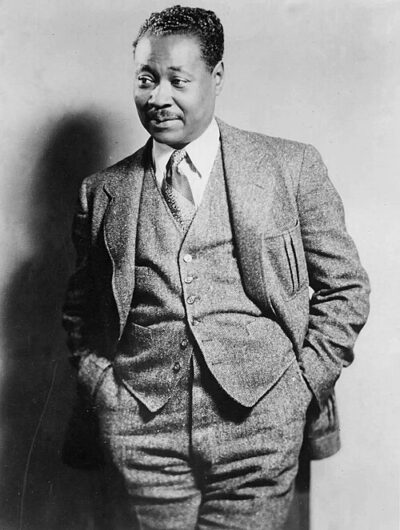
Claude McKay
Claude McKay was a Jamaican American writer, poet. Born September 15, 1889, in Clarendon Parish. Died May 22, 1948, in Chicago. Known for Songs of Jamaica and If We Must Die. Educated at Tuskegee University and Kansas State University. Awards include William E. Harmon Foundation award for distinguished achievement among Negroes.
Facts
17 facts · 1 confirmed by two sources · 9 cited · 6 from one source · 1 where the sources disagree
What’s different
- Born: we show September 15, 1889 (Sources disagree). Wikipedia says September 15, 1890
Where this comes from
Papalocal keeps its own record. It started from these sources; what each one said is kept here as it was copied, so a change on their side never changes this page by itself. Tap one to read its version.
What Wikidata says · copied November 17, 2026 · revision 2564416008
- Described as
- Jamaican American writer, poet (1889–1948)
- Other names
- Hugh Hope, Festus Claudius McKay, C. E. Edwards
- Born
- September 15, 1889 · 6 references
- Died
- May 22, 1948 · 8 references
- Born in
- Clarendon Parish · 1 reference
- Died in
- Chicago · 2 references
- Buried in
- Calvary Cemetery · 1 reference
- Cause of death
- myocardial infarction
- Citizen of
- Colony of Jamaica
- Occupation
- poet · 2 references; writer · 1 reference; novelist · 1 reference
- Worked for
- Workers' Dreadnought · 1 reference
- Education
- Tuskegee University · 1 reference; Kansas State University · 1 reference
- Known for
- Songs of Jamaica; If We Must Die
- Awards
- William E. Harmon Foundation award for distinguished achievement among Negroes
- Religion
- Catholicism · 3 references
- Wikipedias with a page
- 26
Wikidata item Q1096967 (wikidata.org/wiki/Q1096967), public domain (CC0). Copied November 17, 2026.
What Wikipedia says · copied November 17, 2026 · revision 1381336587
Festus Claudius "Claude" McKay (September 15, 1890 – May 22, 1948) was a Jamaican-American writer and poet. He was a central figure in the Harlem Renaissance.
Born in Jamaica, McKay first travelled to the United States to attend college, and encountered W. E. B. Du Bois's The Souls of Black Folk which stimulated McKay's interest in political involvement. He moved to New York City in 1914 and, in 1919, he wrote "If We Must Die", one of his best known works, a widely reprinted sonnet responding to the wave of white-on-black race riots and lynchings following the conclusion of the First World War.
McKay also wrote five novels, Home to Harlem (1928), a best-seller that won the Harmon Gold Award for Literature, Banjo (1929), Banana Bottom (1933), Harlem Glory (written in 1938–1940, published in 1990), Amiable With Big Teeth: A Novel of the Love Affair Between the Communists and the Poor Black Sheep of Harlem (written in 1941, published in 2017), and a novella, Romance in Marseille (written in 1933, published in 2020).
Besides these novels and four published collections of poetry, McKay also authored a collection of short stories, Gingertown (1932); two autobiographical books, A Long Way from Home (1937) and My Green Hills of Jamaica (published posthumously in 1979); and Harlem: Negro Metropolis (1940), consisting of eleven essays on the contemporary social and political history of Harlem and Manhattan, concerned especially with political, social and labor organizing. His 1922 poetry collection, Harlem Shadows, was among the first books published during the Harlem Renaissance and his novel Home To Harlem was a watershed contribution to its fiction. His Selected Poems was published posthumously, in 1953. His Complete Poems (2004) includes almost ninety pages of poetry written between 1923 and the late 1940s, most of it previously unpublished, a crucial addition to his poetic oeuvre.
McKay was introduced to British Fabian socialism in his teens by his elder brother and tutor Uriah Theodore, and after moving to the United States in his early 20s he encountered the American socialist left in the work of W. E. B. Du Bois and through his membership in the Industrial Workers of the World (IWW) — the only American left-labor organization of the era that was totally open to Black members (as he comments), continuing the tradition of the populist People's Party of the previous generation. In the course of the teens he became acquainted with the writings of Marx and the programs of a variety of activists. As a co-editor of The Liberator magazine, he came into conflict with its hard-line Leninist doctrinaire editor Mike Gold, a contention which contributed to his leaving the magazine. In 1922–1923, he traveled to the Soviet Union to attend a Congress of the International, there encountering his friend Liberator publisher Max Eastman, a delegate to the Congress. In Russia, McKay was widely feted by the Communist Party. While there, he worked with a Russian writer to produce two books which were published in Russian, The Negroes of America (1923), a critical examination of American black-white racism from a Marxist class-conflict perspective, and Trial By Lynching (1925); translations of these books back into English appeared in 1979 and 1977 respectively; McKay's original English texts are apparently lost. In the Soviet Union, McKay eventually concluded that, as he says of a character in Harlem Glory, he "saw what he was shown." Realizing that he was being manipulated and used by the Party apparatus, and responding critically to the authoritarian bent of the Soviet regime, he left for Western Europe in 1923, first for Hamburg, then Paris, then the South of France, Barcelona and Morocco.
After his return to Harlem in 1934, he found himself in frequent contention with the Stalinist New York City Communist Party which sought to dominate the left politics and writing community of the decade. His prose masterpiece, A Long Way From Home, was attacked in the New York City press on doctrinaire Stalinist grounds. This conflict is reflected in Harlem: Negro Metropolis and satirized in Amiable With Big Teeth. His sonnet sequence, "The Cycle," published posthumously in the Complete Poems, deals at length with McKay's confrontation with the left political machine of the time. Increasingly ill in the mid-40s, he was rescued from extremely impoverished circumstances by a Catholic Worker friend and installed in a communal living situation; later in the decade, he converted to Catholicism and died in 1948.
- Born, in its opening lines
- September 15, 1890
- Died, in its opening lines
- May 22, 1948
From the Wikipedia article “Claude McKay” (en.wikipedia.org/wiki/Claude_McKay), by its contributors, under CC BY-SA 4.0 (creativecommons.org/licenses/by-sa/4.0/). Copied November 17, 2026; not changed.
Confirmed Two sources agree. Cited One source, and it names where it got it. One source One source, without a reference of its own. Sources disagree The sources disagree. We show the best-supported value and keep theirs below.
