
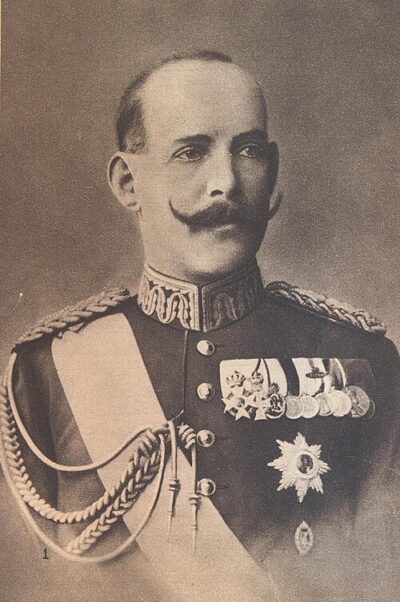
Constantine I of Greece
Constantine I of Greece was a King of Greece (r. 1913–17; 1920–22). Born August 2, 1868, in Athens. Died January 11, 1923, in Palermo. Positions held include King of the Hellenes (2 times) (1913–1922). Educated at Heidelberg University. Awards include Grand Cross of the Legion of Honour, Knight of the Order of the Golden Fleece and Royal Victorian Chain.
Facts
45 facts · 2 confirmed by two sources · 5 cited · 38 from one source
Where this comes from
Papalocal keeps its own record. It started from these sources; what each one said is kept here as it was copied, so a change on their side never changes this page by itself. Tap one to read its version.
What Wikidata says · copied November 16, 2026 · revision 2564636941
- Described as
- King of Greece (r. 1913–17; 1920–22)
- Other names
- Konstantinos I of Greece, Constantine Oldenburg I, King Constantine I of Greece, Constantine I, King Constantine I
- Born
- August 2, 1868 · 6 references
- Died
- January 11, 1923 · 6 references
- Born in
- Athens · 2 references
- Died in
- Palermo · 2 references
- Buried in
- Naples (1923–1935); Tatoi Royal Cemetery (1936–) · 1 reference
- Cause of death
- cerebral hemorrhage
- Citizen of
- Greece
- Occupation
- sovereign
- Positions held
- King of the Hellenes (2 times) (1913–1922)
- Education
- Heidelberg University
- Member of
- Hellenic Olympic Committee
- Awards
- Grand Cross of the Legion of Honour; Knight of the Order of the Golden Fleece; Royal Victorian Chain (1902); Knight grand cross of the order of the crown of Italy; Cross of Valour · 1 reference; Order of the Elephant · 1 reference; Royal Order of the Seraphim · 1 reference; Order of the Black Eagle · 1 reference; Order of the Most Holy Annunciation · 1 reference; Order of the Golden Fleece · 1 reference; Order of Saint Alexander Nevsky · 1 reference; Honorary Knight Grand Cross of the Order of the Bath (1895) · 1 reference; Order of the Redeemer · 1 reference; Order of Saint Stephen of Hungary · 1 reference; Order of the Dannebrog · 1 reference
- Spouse
- Sophia of Prussia (1889–1923) · 1 reference
- Children
- George II of Greece · 1 reference; Alexander of Greece; Helen of Greece and Denmark; Paul of Greece; Princess Irene, Duchess of Aosta; Princess Katherine of Greece and Denmark
- Father
- George I of Greece
- Mother
- Olga Constantinovna of Russia
- Siblings
- Prince George of Greece and Denmark; Princess Alexandra of Greece and Denmark; Prince Nicholas of Greece and Denmark; Princess Maria of Greece and Denmark; Princess Olga of Greece and Denmark; Prince Andrew of Greece and Denmark; Prince Christopher of Greece and Denmark
- Religion
- Church of Greece
- Military rank
- Generalfeldmarschall
- Wikipedias with a page
- 60
Wikidata item Q152099 (wikidata.org/wiki/Q152099), public domain (CC0). Copied November 16, 2026.
What Wikipedia says · copied November 16, 2026 · revision 1383655327
Constantine I (Greek: Κωνσταντίνος Αʹ, romanized: Konstantínos I; 2 August [O.S. 21 July] 1868 – 11 January 1923) was King of Greece from 18 March 1913 to 11 June 1917 and again from 19 December 1920 to 27 September 1922. The eldest son of George I of Greece, he succeeded to the throne following his father's assassination in 1913.
Educated in Greece and later in Germany, Constantine was an admirer of Prussian militarism. As the crown prince, he was commander-in-chief of the Hellenic Army during the unsuccessful Greco-Turkish War of 1897. Later and under the leadership of Prime Minister Eleftherios Venizelos, he led successfully the Greek forces in the Balkan Wars of 1912–1913, in which Greece expanded, doubling in area and population.
He was married to Sophia of Prussia, a younger sister of Wilhelm II, the Emperor of Germany. During his reign, Constantine's pro-German aligned interests led him to twice refuse Venizelos' popular elected mandates for Greece to join World War I on the side of the Allies. Constantine unconstitutionally dismissed his Prime Minister, causing the National Schism. The country was split between the pro-Venizelos New Greece (lands of recently liberated in the Balkan Wars) and the royalist Old Greece, driving deep social cleavages and brought Greece to the brink of civil war. In late 1916, his pro-German policies led to the unconditional surrender of Fort Roupel and the loss of much of newly conquered Macedonian territories to Bulgaria. Also his military staff organized paramilitary units to terrorize Venizelos' supporters, and these groups opened fire against Allied troops in Athens in an incident later known as the Noemvriana. After a five-month naval blockade of Athens by France and Great Britain that caused famine, Constantine abdicated, despite strong popular support for continued resistance. His second son, Alexander, succeeded him. After Alexander's death, Venizelos' defeat in the 1920 legislative elections, and a plebiscite in favor of his return, Constantine was reinstated.
The royalist governments that succeeded Venizelos, continued the unsuccessful Greco-Turkish War of 1919–1922 that ended in the irrevocable destruction of Greek communities in Asia Minor. Constantine I abdicated the throne in favor of his eldest son George II in September 1922, after an army revolt of Venizelist officers. He went to exile, dying in Sicily, Italy on 11 January 1923.
- Born, in its opening lines
- August 2, 1868
- Died, in its opening lines
- January 11, 1923
From the Wikipedia article “Constantine I of Greece” (en.wikipedia.org/wiki/Constantine_I_of_Greece), by its contributors, under CC BY-SA 4.0 (creativecommons.org/licenses/by-sa/4.0/). Copied November 16, 2026; not changed.
Confirmed Two sources agree. Cited One source, and it names where it got it. One source One source, without a reference of its own. Sources disagree The sources disagree. We show the best-supported value and keep theirs below.
