
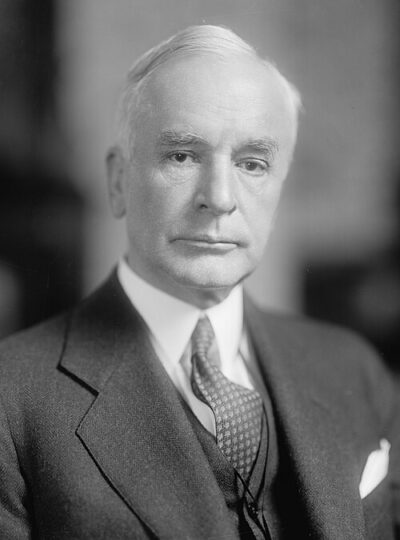
Cordell Hull
Cordell Hull was an American politician, U.S. Secretary of State from 1933 to 1944. Born October 2, 1871, in Olympus. Died July 23, 1955, in Bethesda. Positions held include United States representative (1923–1931), member of the Tennessee House of Representatives and United States Secretary of State (1933–1944). Educated at Cumberland School of Law and National Normal University. Awards include Nobel Peace Prize and Medal for Merit.
Facts
26 facts · 2 confirmed by two sources · 9 cited · 14 from one source · 1 where the sources disagree
What’s different
- Cause of death: we show myocardial infarction (Sources disagree). Wikidata also lists stroke
Where this comes from
Papalocal keeps its own record. It started from these sources; what each one said is kept here as it was copied, so a change on their side never changes this page by itself. Tap one to read its version.
What Wikidata says · copied November 13, 2026 · revision 2565598297
- Described as
- American politician, U.S. Secretary of State from 1933 to 1944
- Born
- October 2, 1871 · 10 references
- Died
- July 23, 1955 · 9 references
- Born in
- Olympus · 2 references
- Died in
- Bethesda · 1 reference
- Buried in
- Washington National Cathedral · 1 reference
- Cause of death
- myocardial infarction; stroke
- Citizen of
- United States
- Occupation
- politician · 1 reference; judge; lawyer; diplomat; jurist · 1 reference; foreign minister · 1 reference
- Positions held
- United States representative (1923–1931); member of the Tennessee House of Representatives; United States Secretary of State (1933–1944); United States senator (1931–1933) · 1 reference
- Political party
- Democratic Party
- Education
- Cumberland School of Law (1891) · 1 reference; National Normal University (–1890)
- Awards
- Nobel Peace Prize (1945) · 2 references; Medal for Merit
- Spouse
- Rose Frances Whitney Hull
- Religion
- Episcopal Church
- Military branch
- United States Army
- Military rank
- captain
- Wikipedias with a page
- 65
Wikidata item Q202979 (wikidata.org/wiki/Q202979), public domain (CC0). Copied November 13, 2026.
What Wikipedia says · copied November 13, 2026 · revision 1382985327
Cordell Hull (October 2, 1871 – July 23, 1955) was an American politician and diplomat who served as the United States secretary of state for nearly twelve years under President Franklin D. Roosevelt, from 1933 to 1944. A member of the Democratic Party, he is the longest-serving secretary of state in United States history. Hull previously represented Tennessee in both houses of the United States Congress for 24 years, first as a member of the U.S. House of Representatives from 1907 to 1921 and again from 1923 to 1931, and as a U.S. senator from 1931 to 1933. Hull also served as a member of the Tennessee House of Representatives from 1893 to 1897.
Born in a log cabin in what is now Pickett County, Tennessee, Hull's early career included service as a lawyer, military officer in the Spanish–American War, state legislator, and judge before his election to the House of Representatives in 1906. He served in Congress for over two decades, interrupted only briefly by a term as chairman of the Democratic National Committee. In 1933, Roosevelt appointed Hull as Secretary of State, a position in which he became a principal architect of the Good Neighbor policy toward Latin America and a key figure in shaping U.S. foreign policy during the lead-up to and early years of World War II.
Hull's legacy is most closely associated with his efforts to promote international cooperation through trade and diplomacy. He was instrumental in the passage of the Reciprocal Trade Agreements Act of 1934, which reduced U.S. tariffs and paved the way for more open global markets. He was also a driving force in the creation of the United Nations, earning him the Nobel Peace Prize in 1945 for his “pivotal role” in the organization's founding.
- Born, in its opening lines
- October 2, 1871
- Died, in its opening lines
- July 23, 1955
From the Wikipedia article “Cordell Hull” (en.wikipedia.org/wiki/Cordell_Hull), by its contributors, under CC BY-SA 4.0 (creativecommons.org/licenses/by-sa/4.0/). Copied November 13, 2026; not changed.
Confirmed Two sources agree. Cited One source, and it names where it got it. One source One source, without a reference of its own. Sources disagree The sources disagree. We show the best-supported value and keep theirs below.
