
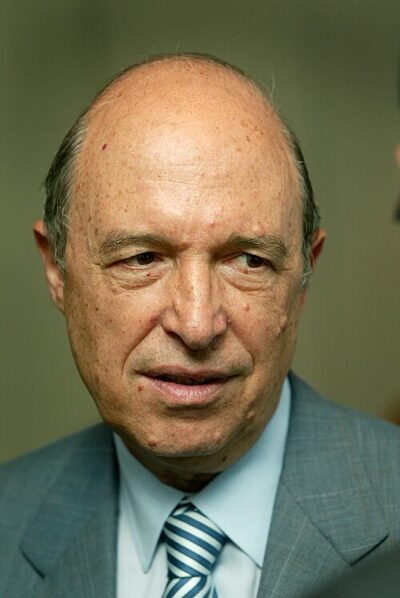
Costas Simitis
Costas Simitis was a Greek jurist, economist, academic and politician. Born June 23, 1936, in Piraeus. Died January 5, 2025, in Corinth General Hospital. Positions held include president (1996–2004), Prime Minister of Greece (1996–2004) and member of the Hellenic Parliament (1985–2009). Educated at University of Marburg and London School of Economics and Political Science. Awards include Order of the White Star, 1st Class and Grand Cross of the Order of Isabella the Catholic.
Facts
33 facts · 2 confirmed by two sources · 10 cited · 21 from one source
Where this comes from
Papalocal keeps its own record. It started from these sources; what each one said is kept here as it was copied, so a change on their side never changes this page by itself. Tap one to read its version.
What Wikidata says · copied November 16, 2026 · revision 2565570886
- Described as
- Greek jurist, economist, academic and politician (1936–2025)
- Other names
- Konstantínos Simítis, Kostas Simitis
- Born
- June 23, 1936 · 3 references
- Died
- January 5, 2025 · 3 references
- Born in
- Piraeus · 1 reference
- Died in
- Corinth General Hospital · 4 references
- Buried in
- First Cemetery of Athens
- Citizen of
- Greece · 1 reference
- Occupation
- politician · 1 reference; economist · 1 reference; university teacher · 1 reference; lawyer · 1 reference; statesperson · 1 reference; jurist · 1 reference
- Positions held
- president (1996–2004); Prime Minister of Greece (1996–2004); member of the Hellenic Parliament (1985–2009) · 1 reference; Minister of National Education and Religious Affairs of Greece (1989–1990); Minister of Agriculture of Greece (1981–1985); Minister of Trade of Greece (1993–1995); Minister of the National Economy of Greece (1985–1987)
- Political party
- Panhellenic Socialist Movement
- Worked for
- University of Giessen (1971–1975); University of Marburg (1961–1971); Panteion University (1977–2025)
- Education
- University of Marburg; London School of Economics and Political Science
- Member of
- Panhellenic Liberation Movement
- Awards
- Order of the White Star, 1st Class; Grand Cross of the Order of Isabella the Catholic (1998) · 1 reference
- Spouse
- Daphni Simitis (1964–2025) · 1 reference
- Father
- Georgios Simitis
- Siblings
- Spiros Simitis · 1 reference
- Religion
- Eastern Orthodoxy
- Website
- http://www.costas-simitis.gr
- Wikipedias with a page
- 48
Wikidata item Q155390 (wikidata.org/wiki/Q155390), public domain (CC0). Copied November 16, 2026.
What Wikipedia says · copied November 16, 2026 · revision 1378205086
Konstantinos Simitis (Greek: Κωνσταντίνος Σημίτης; 23 June 1936 – 5 January 2025) was a Greek politician who led the 'Modernization' movement of Greece. He succeeded in leadership Andreas Papandreou, the founder of the Panhellenic Socialist Movement (PASOK), and served as Prime Minister of Greece from 1996 to 2004.
Simitis, a former resistance figure against the Greek Junta (1967–1974) and economics professor in Germany, was a founding member of PASOK in 1974, and gained significant ministerial experience in Papandreou's governments. Simitis' reputation was marked when he became Minister of National Economy in 1985 when PASOK's profligacy needed a new financial 'stability' imposed through an economic adjustment programme. With stability achieved and the party's popularity waning, Papandreou distanced himself from Simitis' policies, and Simitis resigned. As Minister of Trade in 1995, Simitis became the first minister to resign in protest against Papandreou, who refused to resign the premiership despite ill health and who had criticised Simitis' policies.
In January 1996, Simitis won the leadership of PASOK after Papandreou's resignation. However, the leadership transition from Papandreou to Simitis was confrontational by Papandreou's loyalists, who wanted to prevent such a transition from being realized. Simitis lacked his predecessor's charisma, and the fractured party's support limited many of his actions in government. However, by the end of his tenure in 2004, Simitis had several significant achievements and reforms in the wider society and economy to proclaim. After two decades of financial stagnation, the Greek economy was put in order and became one of the fastest-growing economies in Europe through gradual privatization policies, with an average annual increase of 4.1% of gross domestic product (GDP). The performance of the Greek economy under Simitis sealed the Greek entry into the Euro currency, closing the journey of aligning Greece with the West, which started with Eleftherios Venizelos and continued with Constantine Karamanlis.
The successful completion of the Athens 2004 Summer Olympics also boosted Greece's positive image as a modern state capable of undertaking sophisticated tasks. Moreover, a variety of large-scale infrastructure projects were completed, like the Eleftherios Venizelos airport, the Athens Ring road, Athens Metro, and Rio–Antirrio Bridge. New institutions were also introduced, such as the Greek Ombudsman and several regulatory bodies to supervise market liberalization. In foreign policy, his government's reaction to the Imia crisis in 1996 and the capture of Abdullah Öcalan in 1999 were criticized, but his refusal to intervene in the NATO bombing of Yugoslavia and the invasion of Iraq proved popular. Simitis also succeeded in the Cypriot accession into the EU, a diplomatic priority for Greece, but the Annan Plan, which his government championed, was rejected in a referendum.
After the debt crisis erupted in Greece in 2009, the legacy of Simitis was re-interpreted by critics as insufficient or misleading. However, government institutions under Simitis were developed and strengthened in their capacity to reform, appearing both more 'modern' and 'European.'
- Born, in its opening lines
- June 23, 1936
- Died, in its opening lines
- January 5, 2025
From the Wikipedia article “Costas Simitis” (en.wikipedia.org/wiki/Costas_Simitis), by its contributors, under CC BY-SA 4.0 (creativecommons.org/licenses/by-sa/4.0/). Copied November 16, 2026; not changed.
Confirmed Two sources agree. Cited One source, and it names where it got it. One source One source, without a reference of its own. Sources disagree The sources disagree. We show the best-supported value and keep theirs below.
