
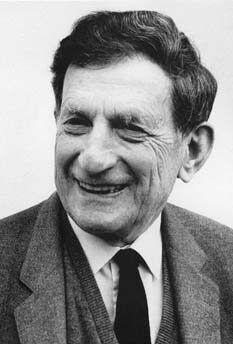
David Bohm
David Bohm was an American theoretical physicist. Born December 20, 1917, in Wilkes-Barre. Died October 27, 1992, in London. Educated at University of Bristol and California Institute of Technology. Awards include Fellow of the Royal Society and Elliott Cresson Medal.
Facts
29 facts · 2 confirmed by two sources · 10 cited · 17 from one source
Where this comes from
Papalocal keeps its own record. It started from these sources; what each one said is kept here as it was copied, so a change on their side never changes this page by itself. Tap one to read its version.
What Wikidata says · copied November 13, 2026 · revision 2568205868
- Described as
- American theoretical physicist (1917-1992)
- Other names
- David Joseph Bohm
- Born
- December 20, 1917 · 4 references
- Died
- October 27, 1992 · 4 references
- Born in
- Wilkes-Barre · 1 reference
- Died in
- London · 1 reference
- Cause of death
- myocardial infarction
- Citizen of
- United States; Brazil; United Kingdom
- Occupation
- physicist · 1 reference; philosopher · 1 reference; university teacher; nuclear physicist; plasma physicist
- Worked for
- University of São Paulo; Birkbeck, University of London; University of California, Berkeley · 1 reference; Princeton University · 1 reference; Technion – Israel Institute of Technology · 1 reference; University of Bristol · 1 reference
- Education
- University of Bristol; California Institute of Technology · 1 reference; University of California, Berkeley · 1 reference; G. A. R. Memorial Junior Senior High School · 1 reference
- Member of
- Royal Society of London (1990–) · 1 reference
- Awards
- Fellow of the Royal Society (1990) · 1 reference; Elliott Cresson Medal (1991) · 1 reference
- Field
- physics · 1 reference; quantum physics · 1 reference; quantum theory · 1 reference
- Wikipedias with a page
- 50
Wikidata item Q310765 (wikidata.org/wiki/Q310765), public domain (CC0). Copied November 13, 2026.
What Wikipedia says · copied November 13, 2026 · revision 1376991279
David Joseph Bohm (; 20 December 1917 – 27 October 1992) was an American-Brazilian physicist who has been described as one of the most significant theoretical physicists of the 20th century and who contributed unorthodox ideas to quantum theory, neuropsychology, and the philosophy of mind. Among his many contributions to physics is his causal and deterministic interpretation of quantum theory, known as De Broglie–Bohm theory.
Bohm advanced the view that quantum physics meant that the old Cartesian model of reality—that there are two kinds of substance, the mental and the physical, that somehow interact—was too limited. To complement it, he developed a mathematical and physical theory of "implicate" and "explicate" order. He also believed that the brain, at the cellular level, works according to the mathematics of some quantum effects, and postulated that thought is distributed and non-localised just as quantum entities are. Bohm's main concern was with understanding the nature of reality in general and of consciousness in particular as a coherent whole, which according to Bohm is never static or complete.
Bohm warned of the dangers of rampant reason and technology, advocating instead the need for genuine supportive dialogue, which he claimed could bridge and unify conflicting and troublesome divisions in the social world.
Born in the United States, Bohm obtained his Ph.D. under J. Robert Oppenheimer at the University of California, Berkeley. His Communist affiliations made him the subject of a federal government investigation in 1949, leading to his suspension from Princeton University and prompting him to leave the U.S. He pursued his career in several countries, becoming first a Brazilian and then a British citizen. He abandoned Marxism in the wake of the Hungarian Uprising in 1956.
- Born, in its opening lines
- December 20, 1917
- Died, in its opening lines
- October 27, 1992
From the Wikipedia article “David Bohm” (en.wikipedia.org/wiki/David_Bohm), by its contributors, under CC BY-SA 4.0 (creativecommons.org/licenses/by-sa/4.0/). Copied November 13, 2026; not changed.
Confirmed Two sources agree. Cited One source, and it names where it got it. One source One source, without a reference of its own. Sources disagree The sources disagree. We show the best-supported value and keep theirs below.
