
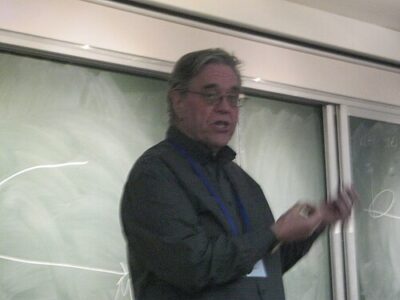
David J. Stevenson is a New Zealand planetary scientist. Born September 2, 1948, in New Zealand. Educated at Cornell University. Awards include Fellow of the Royal Society, Harry H. Hess Medal and Harold C. Urey Prize.
Facts
16 facts · 1 confirmed by two sources · 5 cited · 10 from one source
Where this comes from
Papalocal keeps its own record. It started from these sources; what each one said is kept here as it was copied, so a change on their side never changes this page by itself. Tap one to read its version.
What Wikidata says · copied November 19, 2026 · revision 2522056484
- Described as
- New Zealand planetary scientist
- Other names
- David John Stevenson, David Stevenson
- Born
- September 2, 1948
- Born in
- New Zealand
- Citizen of
- New Zealand; United States
- Occupation
- astronomer
- Worked for
- California Institute of Technology
- Education
- Cornell University
- Member of
- Royal Society of London (1993); National Academy of Sciences (2004–)
- Awards
- Fellow of the Royal Society; Harry H. Hess Medal (1998) · 1 reference; Harold C. Urey Prize (1984) · 1 reference; Whipple Award (1994) · 1 reference; William Bowie Medal (2022) · 1 reference; honorary doctor of Victoria University of Wellington (2002) · 1 reference
- Field
- planetary science · 1 reference
- Wikipedias with a page
- 10
Wikidata item Q629207 (wikidata.org/wiki/Q629207), public domain (CC0). Copied November 19, 2026.
What Wikipedia says · copied November 19, 2026 · revision 1372633882
David John Stevenson (born 2 September 1948) is a professor of planetary science at Caltech. Originally from New Zealand, he received his Ph.D. from Cornell University in physics, where he proposed a model for the interior of Jupiter. He is well known for applying fluid mechanics and magnetohydrodynamics to understand the internal structure and evolution of planets and moons.
- Born, in its opening lines
- September 2, 1948
From the Wikipedia article “David J. Stevenson” (en.wikipedia.org/wiki/David_J._Stevenson), by its contributors, under CC BY-SA 4.0 (creativecommons.org/licenses/by-sa/4.0/). Copied November 19, 2026; not changed.
Confirmed Two sources agree. Cited One source, and it names where it got it. One source One source, without a reference of its own. Sources disagree The sources disagree. We show the best-supported value and keep theirs below.
