
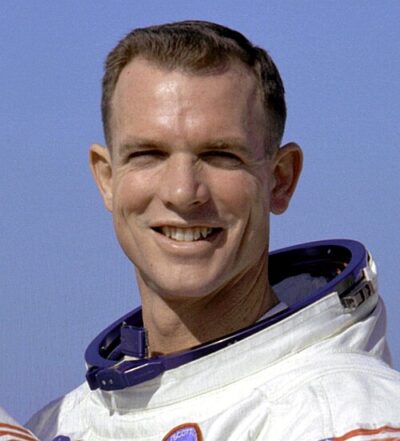
David Scott
David Scott is an American engineer, retired U.S. Air Force officer, former test pilot, and former NASA astronaut. Born June 6, 1932, in San Antonio. Educated at University of Michigan and Massachusetts Institute of Technology. Awards include Distinguished Flying Cross, NASA Exceptional Service Medal and United Nations Peace Medal.
Facts
24 facts · 1 confirmed by two sources · 5 cited · 18 from one source
Where this comes from
Papalocal keeps its own record. It started from these sources; what each one said is kept here as it was copied, so a change on their side never changes this page by itself. Tap one to read its version.
What Wikidata says · copied November 13, 2026 · revision 2565947395
- Described as
- American engineer, retired U.S. Air Force officer, former test pilot, and former NASA astronaut (born 1932)
- Other names
- David Randolph Scott
- Born
- June 6, 1932 · 2 references
- Born in
- San Antonio
- Name at birth
- David Randolph Scott · 1 reference
- Citizen of
- United States
- Occupation
- military officer; test pilot; astronaut · 1 reference; aircraft pilot
- Worked for
- National Aeronautics and Space Administration
- Education
- University of Michigan; Massachusetts Institute of Technology; U.S. Air Force Test Pilot School; United States Military Academy
- Member of
- U.S.-Japan Caucus · 1 reference; NASA Astronaut Group 3
- Awards
- Distinguished Flying Cross; NASA Exceptional Service Medal (1966); United Nations Peace Medal (1971); United States Astronaut Hall of Fame; NASA Distinguished Service Medal (1969) · 1 reference; International Space Hall of Fame (1982) · 2 references
- Father
- Tom William Scott
- Military branch
- United States Air Force
- Military rank
- Colonel
- Wikipedias with a page
- 49
Wikidata item Q278656 (wikidata.org/wiki/Q278656), public domain (CC0). Copied November 13, 2026.
What Wikipedia says · copied November 13, 2026 · revision 1378497877
David Randolph Scott (born June 6, 1932) is an American retired test pilot and NASA astronaut who was the seventh person to walk on the Moon. Selected as part of the third group of astronauts in 1963, Scott flew to space three times and commanded Apollo 15, the fourth lunar landing; he is one of four surviving Moon walkers and the only living commander of a spacecraft that landed on the Moon.
Before becoming an astronaut, Scott graduated from the United States Military Academy at West Point and joined the Air Force. After serving as a fighter pilot in Europe, he graduated from the Air Force Experimental Flight Test Pilot School (Class 62C) and the Aerospace Research Pilot School (Class IV). Scott retired from the Air Force in 1975 with the rank of colonel, and more than 5,600 hours of logged flying time.
As an astronaut, Scott made his first flight into space as a pilot of the Gemini 8 mission, along with Neil Armstrong, in March 1966, spending just under eleven hours in low Earth orbit. He would have been the second American astronaut to walk in space had Gemini 8 not made an emergency abort. Scott then spent ten days in orbit in March 1969 as Command Module Pilot of Apollo 9, a mission that extensively tested the Apollo spacecraft, along with Commander James McDivitt and Lunar Module Pilot Rusty Schweickart.
After backing up 1969's Apollo 12, Scott made his third and final flight into space in July 1971 as commander of the Apollo 15 mission, the fourth crewed lunar landing and the first J mission. Scott and James Irwin remained on the Moon for three days. Following their return to Earth, Scott and his crewmates fell from favor with NASA after it was disclosed that they had carried four hundred unauthorized postal covers to the Moon. After serving as director of NASA's Dryden Flight Research Center in California, Scott retired from the agency in 1977. Since then, he has worked on space-related projects and served as a consultant for several films about the space program, including Apollo 13.
- Born, in its opening lines
- June 6, 1932
From the Wikipedia article “David Scott” (en.wikipedia.org/wiki/David_Scott), by its contributors, under CC BY-SA 4.0 (creativecommons.org/licenses/by-sa/4.0/). Copied November 13, 2026; not changed.
Confirmed Two sources agree. Cited One source, and it names where it got it. One source One source, without a reference of its own. Sources disagree The sources disagree. We show the best-supported value and keep theirs below.
