
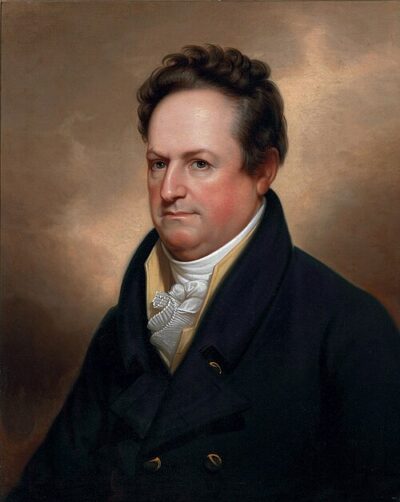
DeWitt Clinton
DeWitt Clinton was an American politician. Born March 2, 1769, in Little Britain. Died February 11, 1828, in Albany. Positions held include Governor of New York (2 times) (1817–1828), Mayor of New York City (1803–1815) and member of the State Senate of New York. Educated at Fu Foundation School of Engineering and Applied Science. Awards include Fellow of the American Academy of Arts and Sciences.
Facts
27 facts · 2 confirmed by two sources · 6 cited · 19 from one source
Where this comes from
Papalocal keeps its own record. It started from these sources; what each one said is kept here as it was copied, so a change on their side never changes this page by itself. Tap one to read its version.
What Wikidata says · copied November 15, 2026 · revision 2558175010
- Described as
- American politician (1769–1828)
- Born
- March 2, 1769 · 6 references
- Died
- February 11, 1828 · 6 references
- Born in
- Little Britain · 1 reference
- Died in
- Albany · 1 reference
- Buried in
- Green-Wood Cemetery
- Cause of death
- heart failure
- Citizen of
- United States
- Occupation
- politician · 1 reference; writer · 1 reference
- Positions held
- Governor of New York (2 times) (1817–1828); Mayor of New York City (1803–1815); member of the State Senate of New York; member of the New York State Assembly; United States senator (1802–1803) · 1 reference; Grand Master of the Grand Lodge of New York (1806–1819)
- Political party
- Democratic-Republican Party; Federalist Party
- Education
- Fu Foundation School of Engineering and Applied Science
- Member of
- American Academy of Arts and Sciences; American Antiquarian Society; American Philosophical Society (1814–)
- Awards
- Fellow of the American Academy of Arts and Sciences
- Spouse
- Maria Franklin Clinton (1796–1818)
- Children
- George W. Clinton
- Father
- James Clinton
- Mother
- Mary Clinton · 1 reference
- Religion
- Presbyterianism
- Wikipedias with a page
- 24
Wikidata item Q527462 (wikidata.org/wiki/Q527462), public domain (CC0). Copied November 15, 2026.
What Wikipedia says · copied November 15, 2026 · revision 1382256479
DeWitt Clinton (March 2, 1769 – February 11, 1828) was an American politician and naturalist. He served as a United States senator, as the mayor of New York City, and as the sixth governor of New York. In the last capacity, he was largely responsible for the construction of the Erie Canal. Clinton was a major candidate for the American presidency in the election of 1812, challenging incumbent James Madison.
A nephew of two-term U.S. vice president and New York governor George Clinton, DeWitt Clinton was his uncle's secretary before launching his own political career. As a Democratic-Republican, Clinton won election to the New York State Legislature in 1798 before briefly serving as a U.S. Senator. Returning to New York, Clinton served three terms as the appointed Mayor of New York City and the lieutenant governor of New York State. In the 1812 presidential election, Clinton won support from the Federalists as well as from a group of Democratic-Republicans who were dissatisfied with Madison. Though Madison won re-election, Clinton carried most of the Northeastern United States and fared significantly better than the previous two Federalist-supported tickets. After the presidential election, Clinton continued to be affiliated with the Democratic-Republican Party.
Clinton was governor of New York from 1817 to 1822 and from 1825 to 1828, and presided over the construction of the Erie Canal. Clinton believed that infrastructure improvements could transform American life, drive economic growth, and encourage political participation. He heavily influenced the development of infrastructure both in New York State and in the United States as a whole.
- Born, in its opening lines
- March 2, 1769
- Died, in its opening lines
- February 11, 1828
From the Wikipedia article “DeWitt Clinton” (en.wikipedia.org/wiki/DeWitt_Clinton), by its contributors, under CC BY-SA 4.0 (creativecommons.org/licenses/by-sa/4.0/). Copied November 15, 2026; not changed.
Confirmed Two sources agree. Cited One source, and it names where it got it. One source One source, without a reference of its own. Sources disagree The sources disagree. We show the best-supported value and keep theirs below.
