
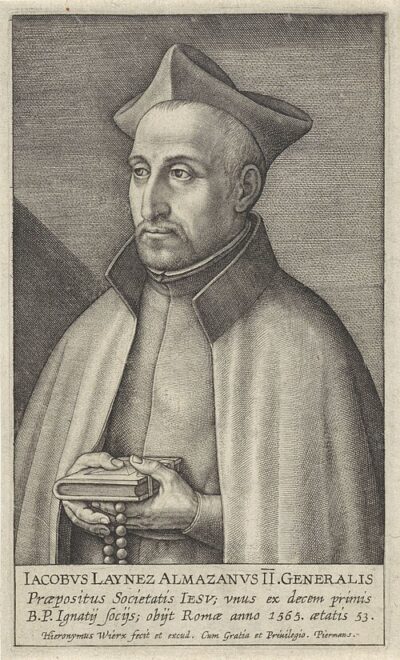
Diego Laynez
Diego Laynez was a (1512-1565) Superior General of the Society of Jesus. Born 1512, in Almazán. Died January 19, 1565, in Rome. Positions held include Superior General of the Society of Jesus (1558–1565) and superior general. Educated at University of Paris.
Facts
15 facts · 2 confirmed by two sources · 6 cited · 7 from one source
Where this comes from
Papalocal keeps its own record. It started from these sources; what each one said is kept here as it was copied, so a change on their side never changes this page by itself. Tap one to read its version.
What Wikidata says · copied November 18, 2026 · revision 2564327078
- Described as
- (1512-1565) Superior General of the Society of Jesus
- Born
- 1512 · 7 references
- Died
- January 19, 1565 · 3 references
- Born in
- Almazán · 1 reference
- Died in
- Rome · 1 reference
- Buried in
- Church of San Francisco de Borja, Madrid
- Citizen of
- Spain · 1 reference
- Occupation
- Catholic priest; Catholic theologian · 2 references
- Positions held
- Superior General of the Society of Jesus (1558–1565); superior general · 1 reference
- Worked for
- Sapienza University of Rome; University of Alcalá
- Education
- University of Paris
- Religion
- Catholicism · 1 reference
- Lived in
- Camere di San Ignazio (1558–1565)
- Wikipedias with a page
- 22
Wikidata item Q301664 (wikidata.org/wiki/Q301664), public domain (CC0). Copied November 18, 2026.
What Wikipedia says · copied November 18, 2026 · revision 1382996398
Diego Laynez, (1512 – 19 January 1565) was a Spanish Jesuit Catholic priest and theologian, a New Christian (of converted Jewish descent), and the second Superior General of the Society of Jesus after the founder Ignatius of Loyola.
- Born, in its opening lines
- 1512
- Died, in its opening lines
- January 19, 1565
From the Wikipedia article “Diego Laynez” (en.wikipedia.org/wiki/Diego_Laynez), by its contributors, under CC BY-SA 4.0 (creativecommons.org/licenses/by-sa/4.0/). Copied November 18, 2026; not changed.
Confirmed Two sources agree. Cited One source, and it names where it got it. One source One source, without a reference of its own. Sources disagree The sources disagree. We show the best-supported value and keep theirs below.
