
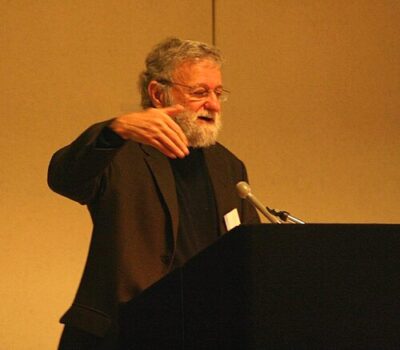
Donald Norman
Donald Norman is an American academic. Born December 25, 1935, in United States. Known for The Design of Everyday Things. Educated at Massachusetts Institute of Technology and University of Pennsylvania School of Engineering and Applied Science. Awards include Benjamin Franklin Medal, CHI Academy and ACM Fellow.
Facts
31 facts · 1 confirmed by two sources · 14 cited · 16 from one source
Where this comes from
Papalocal keeps its own record. It started from these sources; what each one said is kept here as it was copied, so a change on their side never changes this page by itself. Tap one to read its version.
What Wikidata says · copied November 15, 2026 · revision 2517823886
- Described as
- American academic
- Other names
- Donald Arthur Norman, Donald A. Norman, Don Norman
- Born
- December 25, 1935 · 2 references
- Born in
- United States · 1 reference
- Citizen of
- United States
- Occupation
- engineer; writer; researcher; consultant; university teacher; cognitive scientist · 1 reference; psychologist · 1 reference; computer scientist · 1 reference
- Worked for
- Harvard University (1962–1966); Northwestern University (2001–2010); Nielsen Norman Group (1998–); University of California, San Diego (1966–1993) · 1 reference; Apple Inc. (1993–1997) · 1 reference; Hewlett-Packard (1997–1998)
- Education
- Massachusetts Institute of Technology (–1957) · 1 reference; University of Pennsylvania School of Engineering and Applied Science (1959–1962) · 1 reference; University of Pennsylvania (–1959) · 1 reference
- Member of
- American Academy of Arts and Sciences; National Academy of Engineering; Association for Computing Machinery (2001–) · 1 reference; Cognitive Science Society
- Known for
- The Design of Everyday Things
- Awards
- Benjamin Franklin Medal (2006) · 1 reference; CHI Academy (2001); ACM Fellow (2001) · 1 reference; honorary doctor of the University of Padua · 2 references; The Sir Misha Black Awards (2021) · 1 reference
- Website
- http://jnd.org/
- Wikipedias with a page
- 26
Wikidata item Q92804 (wikidata.org/wiki/Q92804), public domain (CC0). Copied November 15, 2026.
What Wikipedia says · copied November 15, 2026 · revision 1378440982
Donald Arthur Norman (born December 25, 1935) is an American researcher, professor, and author. Norman is the founding director of The Design Lab at University of California, San Diego. He is best known for his books on design, especially The Design of Everyday Things. He is widely regarded for his expertise in the fields of design, usability engineering, and cognitive science, and has shaped the development of the field of cognitive systems engineering. He is a co-founder of the Nielsen Norman Group, along with Jakob Nielsen. He is also an IDEO fellow and a member of the Board of Trustees of IIT Institute of Design in Chicago. He also holds the title of Professor Emeritus of Cognitive Science at the University of California, San Diego. Norman is an active Distinguished Visiting Professor at the Korea Advanced Institute of Science and Technology (KAIST), where he spends two months a year teaching.
Much of Norman's work involves the advocacy of user-centered design. His books all have the underlying purpose of furthering the field of design, from doors to computers. Norman has taken a controversial stance in saying that the design research community has had little impact in the innovation of products, and that while academics can help in refining existing products, it is technologists that accomplish the breakthroughs. To this end, Norman named his website with the initialism JND (just-noticeable difference) to signify his endeavors to make a difference.
- Born, in its opening lines
- December 25, 1935
From the Wikipedia article “Don Norman” (en.wikipedia.org/wiki/Don_Norman), by its contributors, under CC BY-SA 4.0 (creativecommons.org/licenses/by-sa/4.0/). Copied November 15, 2026; not changed.
Confirmed Two sources agree. Cited One source, and it names where it got it. One source One source, without a reference of its own. Sources disagree The sources disagree. We show the best-supported value and keep theirs below.
