
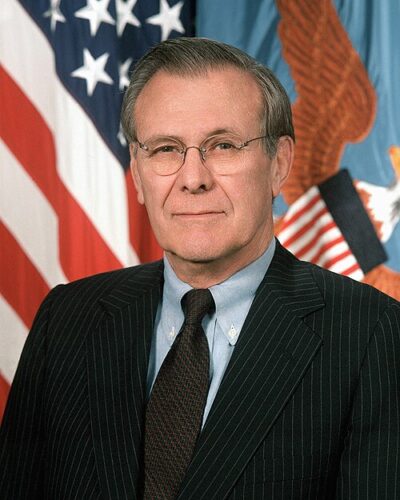
Donald Rumsfeld
Donald Rumsfeld was an American politician and diplomat. Born July 9, 1932, in St. Luke's Hospital. Died June 29, 2021, in Taos. Positions held include United States representative (1963–1969), United States Secretary of Defense (2 times) (1975–2006) and White House Chief of Staff (1974–1975). Educated at Princeton University and Georgetown University Law Center. Awards include Presidential Medal of Freedom, Grand Officer of the Order of the Star of Romania and Grand Cordon of the Order of the Rising Sun.
Facts
42 facts · 2 confirmed by two sources · 16 cited · 24 from one source
Where this comes from
Papalocal keeps its own record. It started from these sources; what each one said is kept here as it was copied, so a change on their side never changes this page by itself. Tap one to read its version.
What Wikidata says · copied November 13, 2026 · revision 2562961450
- Described as
- American politician and diplomat (1932–2021)
- Other names
- Donald Henry Rumsfeld, Donald H. Rumsfeld, Donald H Rumsfeld
- Born
- July 9, 1932 · 6 references
- Died
- June 29, 2021 · 1 reference
- Born in
- St. Luke's Hospital
- Died in
- Taos · 2 references
- Buried in
- Arlington National Cemetery · 1 reference
- Cause of death
- multiple myeloma
- Citizen of
- United States
- Occupation
- politician · 1 reference; military officer; diplomat; author; businessperson · 2 references; civil servant · 1 reference
- Positions held
- United States representative (1963–1969); United States Secretary of Defense (2 times) (1975–2006); White House Chief of Staff (1974–1975); United States Permanent Representative to NATO (1973–1974) · 2 references; Counselor to the President (1970–1971) · 1 reference; chief executive officer (1977–) · 1 reference; defence minister · 2 references
- Political party
- Republican Party
- Worked for
- G. D. Searle & Company (1977–) · 2 references
- Education
- Princeton University; Georgetown University Law Center · 1 reference
- Awards
- Presidential Medal of Freedom (1977) · 1 reference; Grand Officer of the Order of the Star of Romania (2003) · 1 reference; Grand Cordon of the Order of the Rising Sun (2015) · 1 reference; Grand Cross of the Order of Merit of the Republic of Poland; Order of Brilliant Star · 1 reference; Order of the Golden Fleece · 1 reference; Distinguished Eagle Scout Award · 1 reference
- Field
- state governance · 2 references; civil service · 1 reference; defence ministry · 1 reference
- Spouse
- Joyce Pierson (1954–) · 1 reference
- Mother
- Jeannette Husted · 1 reference
- Religion
- Presbyterianism
- Military branch
- United States Navy
- Military rank
- captain
- Lived in
- Westmoreland Hills · 1 reference
- Nickname
- Rummy · 1 reference
- Website
- https://rumsfeld.com
- Wikipedias with a page
- 90
Wikidata item Q184650 (wikidata.org/wiki/Q184650), public domain (CC0). Copied November 13, 2026.
What Wikipedia says · copied November 13, 2026 · revision 1384530629
Donald Henry Rumsfeld (July 9, 1932 – June 29, 2021) was an American politician, businessman, naval officer, and diplomat who served as the 13th United States secretary of defense from 1975 to 1977 under President Gerald Ford, and again as the 21st secretary of defense from 2001 to 2006 under President George W. Bush. He was both the youngest and the oldest secretary of defense. Additionally, Rumsfeld was a four-term U.S. Congressman from Illinois (1963–1969), director of the Office of Economic Opportunity (1969–1970), counselor to the president (1969–1973), the U.S. Representative to NATO (1973–1974), and the White House chief of staff (1974–1975). Between his terms as secretary of defense, he was the CEO and chairman of several companies.
Born in Chicago, Rumsfeld attended Princeton University, graduating in 1954 with a degree in political science. After serving in the Navy for three years, he mounted a campaign for Congress in Illinois's 13th Congressional District, winning in 1962 at the age of 30. Rumsfeld accepted an appointment by President Richard Nixon to head the Office of Economic Opportunity in 1969; appointed counsellor by Nixon and entitled to Cabinet-level status, he also headed up the Economic Stabilization Program before being appointed ambassador to NATO. Called back to Washington in August 1974, Rumsfeld was appointed chief of staff by President Ford. Rumsfeld recruited a young one-time staffer of his, Dick Cheney, to succeed him when Ford nominated him to be secretary of defense in 1975. When Ford lost the 1976 election, Rumsfeld returned to private business and financial life, and was named president and CEO of the pharmaceutical corporation G. D. Searle & Company. He was later named CEO of General Instrument from 1990 to 1993 and chairman of Gilead Sciences from 1997 to 2001.
Rumsfeld was appointed secretary of defense for a second time in January 2001 by President George W. Bush. As secretary of defense, Rumsfeld played a central role in the 2001 United States invasion of Afghanistan and 2003 invasion of Iraq. Before and during the Iraq War, he claimed that Iraq had an active weapons of mass destruction program; no stockpiles were ever found. A Pentagon Inspector General report found that Rumsfeld's top policy aide "developed, produced, and then disseminated alternative intelligence assessments on the Iraq and al-Qaeda relationship, which included some conclusions that were inconsistent with the consensus of the Intelligence Community, to senior decision-makers". Rumsfeld's tenure was controversial for its use of torture and the Abu Ghraib torture and prisoner abuse scandal. Rumsfeld gradually lost political support and resigned in late 2006. In his retirement years, he published an autobiography, Known and Unknown: A Memoir, as well as Rumsfeld's Rules: Leadership Lessons in Business, Politics, War, and Life.
- Born, in its opening lines
- July 9, 1932
- Died, in its opening lines
- June 29, 2021
From the Wikipedia article “Donald Rumsfeld” (en.wikipedia.org/wiki/Donald_Rumsfeld), by its contributors, under CC BY-SA 4.0 (creativecommons.org/licenses/by-sa/4.0/). Copied November 13, 2026; not changed.
Confirmed Two sources agree. Cited One source, and it names where it got it. One source One source, without a reference of its own. Sources disagree The sources disagree. We show the best-supported value and keep theirs below.
