
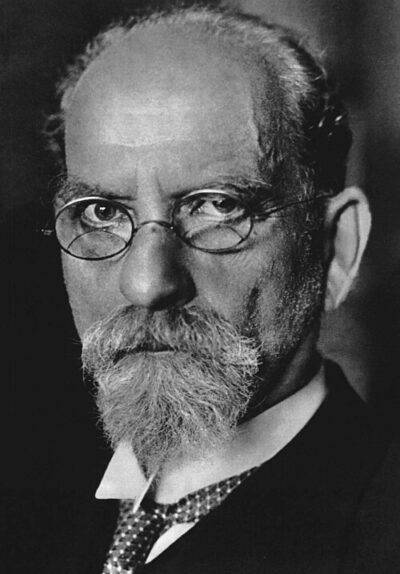
Edmund Husserl
Edmund Husserl was a German philosopher, known as the father of phenomenology. Born April 8, 1859, in Prostějov. Died April 27, 1938, in Freiburg im Breisgau. Known for legitimacy and Logical Investigations. Educated at University of Vienna and Leipzig University.
Facts
36 facts · 2 confirmed by two sources · 14 cited · 20 from one source
Where this comes from
Papalocal keeps its own record. It started from these sources; what each one said is kept here as it was copied, so a change on their side never changes this page by itself. Tap one to read its version.
What Wikidata says · copied November 16, 2026 · revision 2569964512
- Described as
- German philosopher, known as the father of phenomenology (1859–1938)
- Other names
- Edmund Gustav Albrecht Husserl, Husserl
- Born
- April 8, 1859 · 17 references
- Died
- April 27, 1938 · 11 references
- Born in
- Prostějov · 4 references
- Died in
- Freiburg im Breisgau · 3 references
- Buried in
- Günterstal Cemetery · 1 reference
- Name at birth
- Edmund Gustav Albrecht Husserl · 1 reference
- Citizen of
- Austrian Empire; German Reich
- Occupation
- mathematician; philosopher · 4 references; university teacher · 1 reference; phenomenologist · 1 reference
- Worked for
- University of Freiburg (1916–1928) · 1 reference; University of Göttingen (1901–1916) · 1 reference; Martin Luther University Halle-Wittenberg
- Education
- University of Vienna (1881–1883) · 1 reference; Leipzig University (–1878) · 1 reference; Humboldt-Universität zu Berlin (1878–1881) · 1 reference; Martin Luther University Halle-Wittenberg · 1 reference
- Member of
- Heidelberg Academy of Sciences and Humanities (1917–) · 1 reference; American Academy of Arts and Sciences
- Known for
- legitimacy; Logical Investigations
- Field
- philosophy; phenomenology; epistemology · 1 reference; transcendental philosophy · 1 reference; idealism · 1 reference
- Spouse
- Malvine Husserl · 1 reference
- Children
- Elisabeth Rosenberg · 1 reference; Gerhart Husserl · 1 reference
- Father
- Adolf Husserl
- Siblings
- Heinrich Husserl · 1 reference; Emil Husserl · 1 reference
- Religion
- Lutheranism (1887–) · 1 reference; Judaism (1859–1887) · 1 reference
- Wikipedias with a page
- 102
Wikidata item Q58586 (wikidata.org/wiki/Q58586), public domain (CC0). Copied November 16, 2026.
What Wikipedia says · copied November 16, 2026 · revision 1385757264
Edmund Gustav Albrecht Husserl (Austrian German: [ˈɛdmʊnd ˈhʊsɐl]; 8 April 1859 – 27 April 1938) was an Austrian and German philosopher and mathematician who established the school of phenomenology.
In his early work, he elaborated critiques of historicism and of psychologism in logic based on analyses of intentionality. In his mature work, he sought to develop a systematic foundational science based on the so-called phenomenological reduction. Arguing that transcendental consciousness sets the limits of all possible knowledge, Husserl redefined phenomenology as a transcendental idealist philosophy. Husserl's thought profoundly influenced 20th-century philosophy, and he remains a notable figure in contemporary philosophy and beyond.
Husserl studied mathematics, taught by Karl Weierstrass and Leo Königsberger, and philosophy taught by Franz Brentano and Carl Stumpf. He taught philosophy as a Privatdozent at Halle from 1887, then as professor, first at Göttingen from 1901, then at Freiburg from 1916 until he retired in 1928, after which he remained highly productive. In 1933, under racial laws of the Nazi Party, Husserl was banned from using the library of the University of Freiburg due to his Jewish family background and months later resigned from the Deutsche Akademie. Following an illness, he died in Freiburg in 1938.
- Born, in its opening lines
- April 8, 1859
- Died, in its opening lines
- April 27, 1938
From the Wikipedia article “Edmund Husserl” (en.wikipedia.org/wiki/Edmund_Husserl), by its contributors, under CC BY-SA 4.0 (creativecommons.org/licenses/by-sa/4.0/). Copied November 16, 2026; not changed.
Confirmed Two sources agree. Cited One source, and it names where it got it. One source One source, without a reference of its own. Sources disagree The sources disagree. We show the best-supported value and keep theirs below.
