
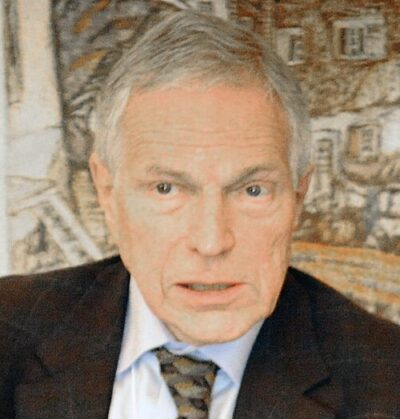
Edmund Phelps
Edmund Phelps was an American economist. Born July 26, 1933, in Evanston. Died May 15, 2026, in Manhattan. Educated at Yale University and Amherst College. Awards include Guggenheim Fellowship, Prize in Economic Sciences in Memory of Alfred Nobel and Global Economy Prize.
Facts
35 facts · 2 confirmed by two sources · 12 cited · 21 from one source
Where this comes from
Papalocal keeps its own record. It started from these sources; what each one said is kept here as it was copied, so a change on their side never changes this page by itself. Tap one to read its version.
What Wikipedia says · copied November 13, 2026 · revision 1373727797
Edmund Strother Phelps (July 26, 1933 – May 15, 2026) was an American economist and the recipient of the 2006 Nobel Memorial Prize in Economic Sciences.
Early in his career, he became known for his research at Yale's Cowles Foundation in the first half of the 1960s on the sources of economic growth. His demonstration of the golden rule savings rate, a concept related to work by John von Neumann, started a wave of research on how much a nation should spend on present consumption rather than save and invest for future generations.
Phelps was at the University of Pennsylvania from 1966 to 1971 and moved to Columbia University in 1971. His most seminal work inserted a microfoundation, one featuring imperfect information, incomplete knowledge and expectations about wages and prices, to support a macroeconomic theory of employment determination and price-wage dynamics. That led to his development of the natural rate of unemployment: its existence and the mechanism governing its size. In the early 2000s, he turned to the study of business innovation.
From 2001 he was the founding director of Columbia's Center on Capitalism and Society. He was McVickar Professor of Political Economy at Columbia from 1982 to 2021. On January 1, 2022, his title changed to McVickar Professor Emeritus of Political Economy.
- Born, in its opening lines
- July 26, 1933
- Died, in its opening lines
- May 15, 2026
From the Wikipedia article “Edmund Phelps” (en.wikipedia.org/wiki/Edmund_Phelps), by its contributors, under CC BY-SA 4.0 (creativecommons.org/licenses/by-sa/4.0/). Copied November 13, 2026; not changed.
What Wikidata says · copied November 14, 2026 · revision 2569097129
- Described as
- American economist
- Other names
- Edmund Strother Phelps, Jr., Edmund S. Phelps, Edmund Strother Phelps
- Born
- July 26, 1933 · 4 references
- Died
- May 15, 2026 · 1 reference
- Born in
- Evanston
- Died in
- Manhattan · 1 reference
- Citizen of
- United States
- Occupation
- economist · 1 reference; university teacher
- Worked for
- Columbia University (1971–) · 1 reference; University of Pennsylvania · 1 reference; Center on Capitalism and Society (2001–2024) · 1 reference
- Education
- Yale University · 1 reference; Amherst College (–1955) · 1 reference; University of Pennsylvania · 1 reference
- Member of
- National Academy of Sciences (1982–); American Academy of Arts and Sciences; Russian Academy of Sciences; Econometric Society (1967–) · 1 reference
- Awards
- Guggenheim Fellowship (1978) · 1 reference; Prize in Economic Sciences in Memory of Alfred Nobel (2006) · 2 references; Global Economy Prize (2008) · 1 reference; honorary doctor of Paris Dauphine University (2004); Distinguished Fellow of the American Economic Association; Fellow of the Econometric Society (1967) · 1 reference; Knight of the Legion of Honour (2008); Fellow of the American Academy of Arts and Sciences; honorary doctor from the NOVA University Lisbon; honorary doctorate at the University of Iceland (2004) · 1 reference; Friendship Award; Wilbur Cross Medal (2014); honorary doctorate from Sciences Po (2006) · 1 reference
- Field
- economics; economics and politics · 1 reference; macroeconomics
- Website
- https://www.edmundphelps.com/ (2010–) · 1 reference; https://www.columbia.edu/~esp2/
- Wikipedias with a page
- 58
Wikidata item Q192566 (wikidata.org/wiki/Q192566), public domain (CC0). Copied November 14, 2026.
Confirmed Two sources agree. Cited One source, and it names where it got it. One source One source, without a reference of its own. Sources disagree The sources disagree. We show the best-supported value and keep theirs below.
