
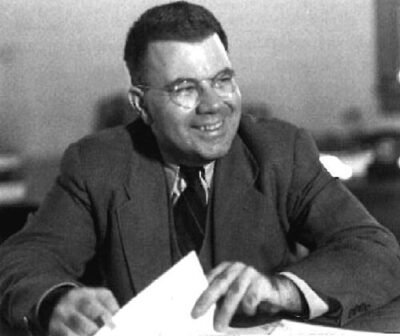
Edward Condon
Edward Condon was an American physicist. Born March 2, 1902, in Alamogordo. Died March 26, 1974, in Boulder. Educated at University of California, Berkeley. Awards include Frederic Ives Medal, Fellow of the American Physical Society and Fellow of the American Association for the Advancement of Science.
Facts
21 facts · 2 confirmed by two sources · 4 cited · 15 from one source
Where this comes from
Papalocal keeps its own record. It started from these sources; what each one said is kept here as it was copied, so a change on their side never changes this page by itself. Tap one to read its version.
What Wikidata says · copied November 16, 2026 · revision 2550196588
- Described as
- American physicist (1902-1974)
- Other names
- Edward Uhler Condon, E. U. Condon
- Born
- March 2, 1902 · 6 references
- Died
- March 26, 1974 · 6 references
- Born in
- Alamogordo
- Died in
- Boulder
- Name at birth
- Edward Uhler Condon
- Citizen of
- United States
- Occupation
- nuclear physicist; physicist · 1 reference
- Worked for
- Princeton University; Washington University in St. Louis; University of Colorado Boulder
- Education
- University of California, Berkeley
- Member of
- National Academy of Sciences; American Association for the Advancement of Science; American Academy of Arts and Sciences; American Philosophical Society (1949–) · 1 reference; American Physical Society · 1 reference
- Awards
- Frederic Ives Medal (1968) · 1 reference; Fellow of the American Physical Society; Fellow of the American Association for the Advancement of Science
- Field
- physics
- Wikipedias with a page
- 21
Wikidata item Q1291942 (wikidata.org/wiki/Q1291942), public domain (CC0). Copied November 16, 2026.
What Wikipedia says · copied November 16, 2026 · revision 1371989092
Edward Uhler Condon (March 2, 1902 – March 26, 1974) was an American nuclear physicist, a pioneer in quantum mechanics, and a participant during World War II in the development of radar and, very briefly, of nuclear weapons as part of the Manhattan Project. The Franck–Condon principle and the Slater–Condon rules are co-named after him.
He was the fourth director of the National Bureau of Standards (NIST) from 1945 to 1951. In 1946, Condon was president of the American Physical Society, and in 1953 was president of the American Association for the Advancement of Science.
During the McCarthy period, Condon was one of the first prominent scientists to become a target of the House Un-American Activities Committee, charged publicly in 1948 with being "one of the weakest links in our atomic security" on account of his extensive knowledge of classified information, his connections with the development of the atomic bomb, and his alleged sympathies for communism and the Soviet Union. His case became a cause célèbre among those who opposed McCarthyism, especially scientists, and was one of the most prominent cases of its time, and he was defended by many prominent scientists, as well as President Harry Truman.
Condon became widely known in 1968 as principal author of the Condon Report, an official review funded by the United States Air Force that concluded that unidentified flying objects (UFOs) have prosaic explanations. The lunar crater Condon is named for him.
- Born, in its opening lines
- March 2, 1902
- Died, in its opening lines
- March 26, 1974
From the Wikipedia article “Edward Condon” (en.wikipedia.org/wiki/Edward_Condon), by its contributors, under CC BY-SA 4.0 (creativecommons.org/licenses/by-sa/4.0/). Copied November 16, 2026; not changed.
Confirmed Two sources agree. Cited One source, and it names where it got it. One source One source, without a reference of its own. Sources disagree The sources disagree. We show the best-supported value and keep theirs below.
