
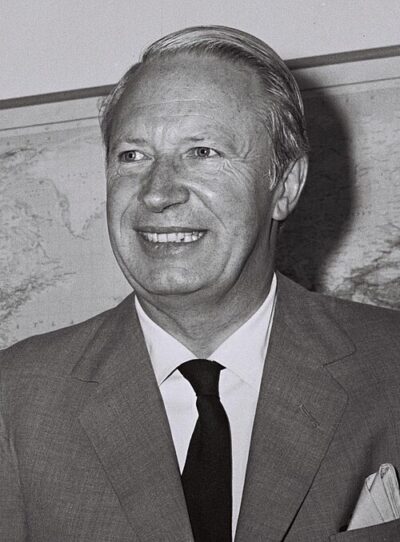
Edward Heath
Edward Heath was a Prime Minister of the United Kingdom from 1970 to 1974. Born July 9, 1916, in Broadstairs. Died July 17, 2005, in Salisbury. Positions held include Prime Minister of the United Kingdom (1970–1974), Leader of the Opposition (2 times) (1965–1975) and Leader of the Conservative Party (1965–1975). Educated at Balliol College and Chatham House Grammar School. Awards include Charlemagne Prize, doctor honoris causa from the Paris-Sorbonne University and Robert Schuman Medal.
Facts
46 facts · 2 confirmed by two sources · 24 cited · 20 from one source
Where this comes from
Papalocal keeps its own record. It started from these sources; what each one said is kept here as it was copied, so a change on their side never changes this page by itself. Tap one to read its version.
What Wikidata says · copied November 16, 2026 · revision 2563073860
- Described as
- Prime Minister of the United Kingdom from 1970 to 1974 (1916–2005)
- Other names
- Teddy, Ted Heath, Sir Edward Richard George Heath
- Born
- July 9, 1916 · 11 references
- Died
- July 17, 2005 · 10 references
- Born in
- Broadstairs · 1 reference
- Died in
- Salisbury · 1 reference
- Buried in
- Salisbury Cathedral
- Cause of death
- pneumonia
- Citizen of
- United Kingdom; United Kingdom of Great Britain and Ireland (–1927)
- Occupation
- politician · 1 reference; military personnel · 1 reference; journalist · 1 reference; conductor · 1 reference
- Positions held
- Prime Minister of the United Kingdom (1970–1974); Leader of the Opposition (2 times) (1965–1975); Leader of the Conservative Party (1965–1975); Shadow Chancellor of the Exchequer (1964–1965); Secretary of State for Business, Innovation, Science and Trade (1963–1964); Lord Privy Seal (1960–1963); Secretary of State for Employment (1959–1960); Member of the Privy Council of the United Kingdom (1955–) · 1 reference; member of the 52nd Parliament of the United Kingdom (1997–2001) · 1 reference; member of the 51st Parliament of the United Kingdom (1992–1997) · 1 reference; member of the 50th Parliament of the United Kingdom (1987–1992) · 1 reference; member of the 49th Parliament of the United Kingdom (1983–1987) · 1 reference; member of the 48th Parliament of the United Kingdom (1979–1983) · 1 reference; member of the 47th Parliament of the United Kingdom (1974–1979) · 1 reference; member of the 46th Parliament of the United Kingdom (1974) · 1 reference
- Political party
- Conservative Party · 1 reference
- Education
- Balliol College; Chatham House Grammar School · 1 reference; Chatham and Clarendon Grammar School
- Instrument
- organ · 1 reference; piano · 1 reference
- Awards
- Charlemagne Prize (1963) · 1 reference; doctor honoris causa from the Paris-Sorbonne University (1976) · 2 references; Robert Schuman Medal (1996); Member of the Order of the British Empire; Knight of the Garter (1992); honorary doctorate (1997) · 1 reference; Order of the British Empire · 1 reference
- Field
- politician · 1 reference
- Father
- William George Heath · 1 reference
- Mother
- Edith Anne Pantony · 1 reference
- Religion
- Anglicanism
- Military branch
- British Army · 1 reference
- Military rank
- Lieutenant Colonel · 1 reference
- Wikipedias with a page
- 81
Wikidata item Q128967 (wikidata.org/wiki/Q128967), public domain (CC0). Copied November 16, 2026.
What Wikipedia says · copied November 16, 2026 · revision 1383662372
Sir Edward Richard George Heath (9 July 1916 – 17 July 2005) was a British statesman who served as Prime Minister of the United Kingdom from 1970 to 1974 and Leader of the Conservative Party from 1965 to 1975. Heath also served as a Member of Parliament (MP) from 1950 to 2001. Outside politics, Heath was a yachtsman, musician and author.
Heath was born in Broadstairs, Kent to a chambermaid and a carpenter. He became a leader within student politics whilst studying PPE at Balliol College, Oxford. During World War II, Heath served with distinction in the Royal Artillery. Afterward, Heath briefly joined the civil service but resigned to stand for Parliament, and was elected for Bexley at the 1950 election. He was promoted to Chief Whip by Anthony Eden in 1955, and stayed in the cabinet of Harold Macmillan as Minister of Labour and Lord Privy Seal, as well as that of Alec Douglas-Home as President of the Board of Trade. After the Conservatives were defeated at the 1964 election, Heath was elected to succeed Douglas-Home in 1965 as party leader and Leader of the Opposition. Although he led the Conservatives to a landslide defeat to Labour's Harold Wilson at the 1966 election, Heath remained as leader, and in 1970 his party won an unexpected victory.
During his tenure, Heath oversaw the decimalisation of British coinage in 1971, and a sweeping reform of local government in 1972. He also successfully negotiated British entry into the European Economic Community (EEC). However, his premiership also coincided with heightened violence during the Troubles in Northern Ireland, in response to which he imposed direct rule and approved internment without trial. Unofficial talks with Provisional Irish Republican Army delegates broke down, as did the Sunningdale Agreement of 1973, which led the MPs of the Ulster Unionist Party to resign the Conservative whip. Heath's attempts to deregulate the economy, to reform British trade unionism with the unpopular Industrial Relations Act, and to transition from direct to indirect taxation, such as with the introduction of value-added tax in 1973, were undermined by a miners' strike at the start of 1974 that severely damaged the Government. In response, Heath introduced a Three-Day Week to conserve energy and called an election for February 1974 in an attempt to obtain a mandate to face down the miners' wage demands. Instead, the result was a hung parliament, with the Conservatives losing their majority. Despite receiving fewer votes, the Labour Party had four more seats than the Conservatives, and Heath resigned as Prime Minister on 4 March after talks with the Liberal Party to form a coalition government failed.
After losing a second successive election to Wilson in October 1974, Heath's leadership of the party was challenged by his former Education Secretary, Margaret Thatcher. On 4 February 1975, she unexpectedly outpolled him in the first round of votes. Heath withdrew from the race and returned to the backbenches. Although he campaigned with Thatcher for the successful "yes" side of the 1975 referendum on British membership in the EEC, Heath would become an embittered critic during her time as prime minister, speaking and writing against the policies of Thatcherism. Following the 1992 election, he became Father of the House, until his retirement from the Commons in 2001. Heath died in 2005, aged 89. He has been described by the BBC as "the first working-class meritocrat" to become Conservative leader in "the party's modern history" and "a One Nation Tory in the Disraeli tradition who rejected the laissez-faire capitalism that Thatcher would enthusiastically endorse."
- Born, in its opening lines
- July 9, 1916
- Died, in its opening lines
- July 17, 2005
From the Wikipedia article “Edward Heath” (en.wikipedia.org/wiki/Edward_Heath), by its contributors, under CC BY-SA 4.0 (creativecommons.org/licenses/by-sa/4.0/). Copied November 16, 2026; not changed.
Confirmed Two sources agree. Cited One source, and it names where it got it. One source One source, without a reference of its own. Sources disagree The sources disagree. We show the best-supported value and keep theirs below.
