
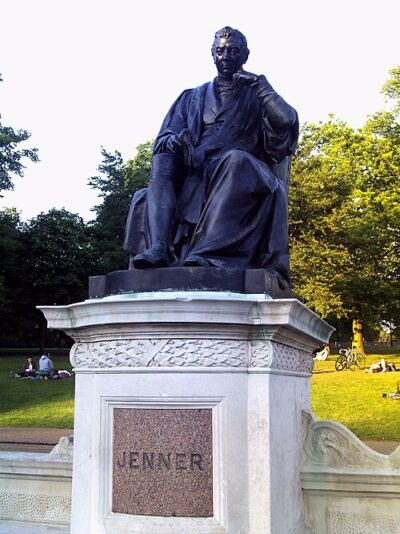
Edward Jenner
Edward Jenner was an English physician, scientist and pioneer of vaccination. Born May 17, 1749, in Berkeley. Died January 26, 1823, in Berkeley. Known for smallpox vaccine and vaccination. Educated at St George's, University of London and University of St Andrews. Awards include Fellow of the Royal Society, Fellow of the American Academy of Arts and Sciences and Fellow of the Linnean Society of London.
Facts
32 facts · 2 confirmed by two sources · 11 cited · 19 from one source
What’s different
- Born: we show May 17, 1749 (Confirmed). Wikidata also lists May 6, 1749
Where this comes from
Papalocal keeps its own record. It started from these sources; what each one said is kept here as it was copied, so a change on their side never changes this page by itself. Tap one to read its version.
What Wikidata says · copied November 16, 2026 · revision 2567355315
- Described as
- English physician, scientist and pioneer of vaccination (1749–1823)
- Other names
- Jenner
- Born
- May 17, 1749 · 8 references; May 6, 1749 · 1 reference
- Died
- January 26, 1823 · 6 references
- Born in
- Berkeley · 1 reference
- Died in
- Berkeley · 1 reference
- Buried in
- Church of St Mary the Virgin, Berkeley · 1 reference
- Cause of death
- stroke
- Citizen of
- United Kingdom of Great Britain and Ireland
- Occupation
- physician · 1 reference; naturalist · 1 reference; biologist · 1 reference
- Education
- St George's, University of London; University of St Andrews; Katharine Lady Berkeley's School; Cirencester Grammar School
- Member of
- Royal Society of London (1789–); Royal Swedish Academy of Sciences; American Academy of Arts and Sciences; Göttingen Academy of Sciences and Humanities in Lower Saxony
- Known for
- smallpox vaccine; vaccination
- Awards
- Fellow of the Royal Society (1789) · 1 reference; Fellow of the American Academy of Arts and Sciences; Fellow of the Linnean Society of London (1798) · 1 reference; Fellow of the Royal College of Physicians of Edinburgh
- Field
- medicine
- Spouse
- Catherine Kingscote (1788–) · 1 reference
- Children
- Edward Robert Jenner · 1 reference; Catherine Fitzhardinge Jenner · 1 reference; Robert Fitzhardinge Jenner · 1 reference
- Father
- Stephen Jenner · 1 reference
- Mother
- Sarah Head · 2 references
- Siblings
- Henry Jenner
- Wikipedias with a page
- 114
Wikidata item Q40852 (wikidata.org/wiki/Q40852), public domain (CC0). Copied November 16, 2026.
What Wikipedia says · copied November 16, 2026 · revision 1384610110
Edward Jenner (17 May 1749 – 26 January 1823) was an English physician and scientist who pioneered the concept of vaccines and created the smallpox vaccine, the world's first vaccine. The terms vaccine and vaccination are derived from Variolae vaccinae ("pustules of the cow"), the term devised by Jenner to denote cowpox. He used it in 1798 in the title of his Inquiry into the Variolae vaccinae known as the Cow Pox, in which Jenner described the protective effect of cowpox against smallpox.
Jenner is often called "the father of immunology", and his work is said to have saved "more lives than any other man". In Jenner's time, smallpox killed around 10% of the global population, with the number as high as 20% in towns and cities where infection spread more easily. In 1821, he was appointed physician to King George IV, and was also made mayor of Berkeley and justice of the peace. Jenner was a member of the Royal Society. In the field of zoology, he was among the first modern scholars to describe the brood parasitism of the cuckoo (Aristotle also noted this behaviour in his History of Animals). In 2002, Jenner was named in the BBC's list of the 100 Greatest Britons.
- Born, in its opening lines
- May 17, 1749
- Died, in its opening lines
- January 26, 1823
From the Wikipedia article “Edward Jenner” (en.wikipedia.org/wiki/Edward_Jenner), by its contributors, under CC BY-SA 4.0 (creativecommons.org/licenses/by-sa/4.0/). Copied November 16, 2026; not changed.
Confirmed Two sources agree. Cited One source, and it names where it got it. One source One source, without a reference of its own. Sources disagree The sources disagree. We show the best-supported value and keep theirs below.
