
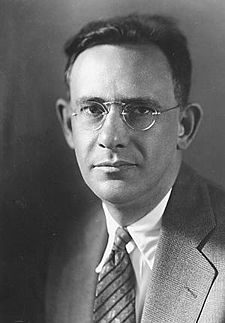
Edward Sapir
Edward Sapir was an American linguist and anthropologist. Born January 26, 1884, in Lębork. Died February 4, 1939, in New Haven. Positions held include president of the Linguistic Society of America. Educated at Columbia University and Stuyvesant High School. Awards include Sterling Professor and Person of National Historic Significance.
Facts
25 facts · 2 confirmed by two sources · 4 cited · 19 from one source
Where this comes from
Papalocal keeps its own record. It started from these sources; what each one said is kept here as it was copied, so a change on their side never changes this page by itself. Tap one to read its version.
What Wikidata says · copied November 13, 2026 · revision 2557861650
- Described as
- American linguist and anthropologist (1884-1939)
- Born
- January 26, 1884 · 8 references
- Died
- February 4, 1939 · 8 references
- Born in
- Lębork
- Died in
- New Haven · 2 references
- Citizen of
- United States
- Occupation
- anthropologist · 2 references; linguist · 1 reference; sociolinguist; university teacher; ethnologist; philosopher
- Positions held
- president of the Linguistic Society of America
- Worked for
- Yale University; University of Chicago
- Education
- Columbia University (–1909); Stuyvesant High School; DeWitt Clinton High School · 1 reference
- Member of
- American Academy of Arts and Sciences; National Academy of Sciences (1934–); American Philosophical Society (1937–)
- Awards
- Sterling Professor; Person of National Historic Significance · 1 reference
- Field
- linguistics; ethnology; volkerpsychologie
- Wikipedias with a page
- 70
Wikidata item Q191095 (wikidata.org/wiki/Q191095), public domain (CC0). Copied November 13, 2026.
What Wikipedia says · copied November 13, 2026 · revision 1379601215
Edward Sapir (; January 26, 1884 – February 4, 1939) was an American anthropologist-linguist, and one of the most important figures in the development of the discipline of linguistics in the United States. Born in German Pomerania, in what is now northern Poland, his family emigrated to the United States of America when he was a child. He studied Germanic linguistics at Columbia, where he came under the influence of Franz Boas, who inspired him to work on Native American languages. While finishing his Ph.D. he went to California to work with Alfred Kroeber documenting the indigenous languages there. He was employed by the Geological Survey of Canada for fifteen years, where he came into his own as one of the most significant linguists in North America, the other being Leonard Bloomfield. He was offered a professorship at the University of Chicago, and stayed for several years continuing to work for the professionalization of the discipline of linguistics. By the end of his life he was professor of anthropology at Yale. Among his many students were the linguists Mary Haas and Morris Swadesh, and anthropologists such as Fred Eggan and Hortense Powdermaker.
With his linguistic background, Sapir became the one student of Boas to develop most completely the relationship between linguistics and anthropology. Sapir studied the ways in which language and culture influence each other, and he was interested in the relation between linguistic differences, and differences in cultural world views. This part of his thinking was developed by his student Benjamin Lee Whorf into the principle of linguistic relativity or the "Sapir–Whorf" hypothesis. In anthropology Sapir is known as an early proponent of the importance of psychology to anthropology, maintaining that studying the nature of relationships between different individual personalities is important for the ways in which culture and society develop.
Among his major contributions to linguistics is his classification of Indigenous languages of the Americas, upon which he elaborated for most of his professional life. He played an important role in developing the modern concept of the phoneme, greatly advancing the understanding of phonology. Before Sapir it was generally considered impossible to apply the methods of historical linguistics to languages of indigenous peoples because they were believed to be more primitive than the Indo-European languages. Sapir was the first to prove that the methods of comparative linguistics were equally valid when applied to indigenous languages. In the 1929 edition of Encyclopædia Britannica he published what was then the most authoritative classification of Native American languages, and the first based on evidence from modern comparative linguistics. He was the first to produce evidence for the classification of the Algic, Uto-Aztecan, and Na-Dene languages. He proposed some language families that are not considered to have been adequately demonstrated, but which continue to generate investigation such as Hokan and Penutian.
He specialized in the study of Athabascan languages, Chinookan languages, and Uto-Aztecan languages, producing important grammatical descriptions of Takelma, Wishram, and Southern Paiute. Later in his career he also worked with Yiddish, Hebrew, and Chinese, as well as Germanic languages, and he also was invested in the development of an International Auxiliary Language.
- Born, in its opening lines
- January 26, 1884
- Died, in its opening lines
- February 4, 1939
From the Wikipedia article “Edward Sapir” (en.wikipedia.org/wiki/Edward_Sapir), by its contributors, under CC BY-SA 4.0 (creativecommons.org/licenses/by-sa/4.0/). Copied November 13, 2026; not changed.
Confirmed Two sources agree. Cited One source, and it names where it got it. One source One source, without a reference of its own. Sources disagree The sources disagree. We show the best-supported value and keep theirs below.
