
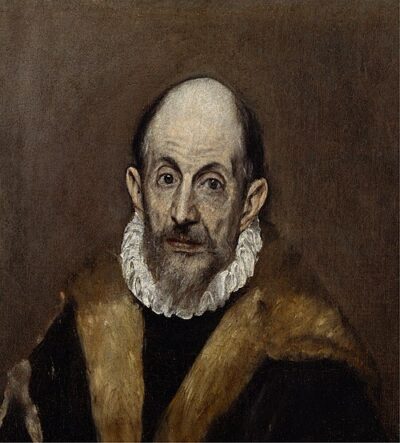
El Greco
El Greco was a Greek artist, painter, sculptor and architect. Born October 1, 1541, in Heraklion. Died April 7, 1614, in Toledo. Known for The Resurrection, View of Toledo and The Burial of the Count of Orgaz.
Facts
30 facts · 2 confirmed by two sources · 10 cited · 18 from one source
Where this comes from
Papalocal keeps its own record. It started from these sources; what each one said is kept here as it was copied, so a change on their side never changes this page by itself. Tap one to read its version.
What Wikidata says · copied November 16, 2026 · revision 2569840547
- Described as
- Greek artist, painter, sculptor and architect (1541–1614)
- Other names
- Greco Domenicos Theotocopuli, Domenico Theocopuli, Doménico Theotocopoulis, Domenico Theotocopuly, Domenico Teoscopoli, Dominico Theotocopuli, Dom Thoepotuli, Domingo Theotocópuli, Teotocopuli, Domingo de Theotocopuli, Domingo de Theotocópuli, Doménico Theotocopoulos
- Born
- October 1, 1541 · 2 references
- Died
- April 7, 1614 · 11 references
- Born in
- Heraklion · 2 references
- Died in
- Toledo · 3 references
- Buried in
- Monastery of Saint Dominic of Silos
- Citizen of
- Crown of Castile; Republic of Venice · 1 reference
- Occupation
- painter · 4 references; sculptor · 2 references; architect · 1 reference; architectural drafter · 1 reference
- Genre
- portrait painting; mythological painting; religious painting · 1 reference; icon painting; genre painting · 1 reference; history painting · 1 reference
- Known for
- The Resurrection; View of Toledo; The Burial of the Count of Orgaz; The Nobleman with his Hand on his Chest; Dormition of the Virgin; Modena Triptych; The Martyrdom of St. Maurice; Opening of the Fifth Seal; Laocoön; Saints John the Evangelist and Francis of Assisi · 1 reference
- Field
- painting · 1 reference
- Children
- Jorge Manuel Theocupulus
- Religion
- Catholic Church
- Wikipedias with a page
- 115
Wikidata item Q301 (wikidata.org/wiki/Q301), public domain (CC0). Copied November 16, 2026.
What Wikipedia says · copied November 16, 2026 · revision 1384328914
Doménikos Theotokópoulos (Greek: Δομήνικος Θεοτοκόπουλος, pronounced [ðoˈminikos θeotoˈkopulos]; 1 October 1541 – 7 April 1614), most widely known as El Greco (Spanish pronunciation: [el ˈɣɾeko]; "The Greek"), was a Greek painter, sculptor and architect of the Spanish Renaissance, regarded as one of the greatest artists of all time. El Greco was a nickname, and the artist normally signed his paintings with his full birth name in Greek letters often adding the word Κρής (Krḗs), which means "Cretan" in Ancient Greek.
El Greco was born in the Kingdom of Candia (modern Crete), which was at that time part of the Republic of Venice, and the center of Post-Byzantine art. He trained and became a master within that tradition before traveling at age 26 to Venice, as other Greek artists had done. In 1570, he moved to Rome, where he opened a workshop and executed a series of works. During his stay in Italy, El Greco enriched his style with elements of Mannerism and of the Venetian Renaissance taken from a number of great artists of the time, notably Tintoretto and Titian. In 1577, he moved to Toledo, Spain, where he lived and worked until his death. In Toledo, El Greco received several major commissions and produced his best-known paintings, such as View of Toledo and Opening of the Fifth Seal.
El Greco's dramatic and expressionistic style was met with puzzlement by his contemporaries but found appreciation by the 20th century. El Greco is regarded as a precursor of both Expressionism and Cubism, while his personality and works were a source of inspiration for poets and writers such as Rainer Maria Rilke and Nikos Kazantzakis. El Greco has been characterized by modern scholars as an artist so individual that he belongs to no conventional school. He is best known for tortuously elongated figures and often fantastic or phantasmagorical pigmentation, marrying Byzantine traditions with those of Western painting.
Although mostly ignored by his contemporaries, El Greco is considered one of the greatest painters in the history of art. Art critics have resolutely placed him among the best artists of all time, citing his originality, his power of expression, and his innovative use of form and colour. His works are seen as transcending and surpassing the artistic traditions from which they emerged and as having had a profound effect on generations of later artists, including Francisco Goya, Diego Velázquez, Eugène Delacroix, Édouard Manet, Salvador Dalí and Pablo Picasso, amongst many others.
- Born, in its opening lines
- October 1, 1541
- Died, in its opening lines
- April 7, 1614
From the Wikipedia article “El Greco” (en.wikipedia.org/wiki/El_Greco), by its contributors, under CC BY-SA 4.0 (creativecommons.org/licenses/by-sa/4.0/). Copied November 16, 2026; not changed.
Confirmed Two sources agree. Cited One source, and it names where it got it. One source One source, without a reference of its own. Sources disagree The sources disagree. We show the best-supported value and keep theirs below.
