
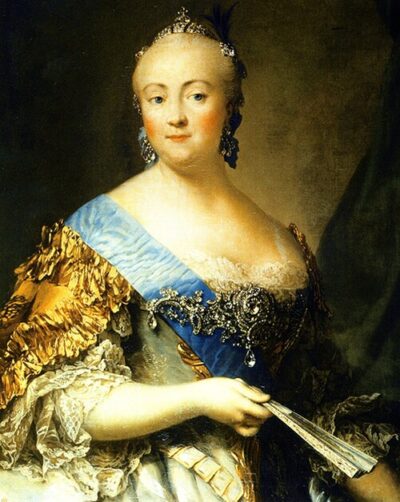
Elizabeth I of Russia
Elizabeth I of Russia was a sixth Empress of Russia from 1741 to 1762 (lived 1709-1762). Born December 29, 1709, in Kolomenskoye. Died January 5, 1762, in Saint Petersburg. Positions held include Emperor of all the Russias (1741–1762) and Head of the House of Romanov. Awards include Order of the Black Eagle, Order of the White Eagle and Order of Saint Alexander Nevsky.
Facts
27 facts · 2 confirmed by two sources · 3 cited · 22 from one source
Where this comes from
Papalocal keeps its own record. It started from these sources; what each one said is kept here as it was copied, so a change on their side never changes this page by itself. Tap one to read its version.
What Wikidata says · copied November 16, 2026 · revision 2569986818
- Described as
- sixth Empress of Russia from 1741 to 1762 (lived 1709-1762)
- Other names
- Elisabeth of Russia, Elizabeta Petrovna Romanov, Tsarina of Russia, Elizabeth, Empress of Russia, Yelisaveta of Russia, Elizaveta of Russia, Elisabeth Petrovna Romanova, Elizabeth Petrovna Romanova, Elizabeta Petrovna Romanova, Tsarina of Russia, Yelisaveta Petrovna Romanova, Elizaveta Petrovna Romanova, Elizabeth Romanova, Elizaveta Romanova
- Born
- December 29, 1709 · 3 references
- Died
- January 5, 1762 · 5 references
- Born in
- Kolomenskoye
- Died in
- Saint Petersburg · 2 references
- Buried in
- Peter and Paul Cathedral
- Citizen of
- Russian Empire; Tsardom of Russia
- Occupation
- monarch; politician; aristocrat
- Positions held
- Emperor of all the Russias (1741–1762); Head of the House of Romanov
- Member of
- children of Peter I of Russia
- Awards
- Order of the Black Eagle; Order of the White Eagle; Order of Saint Alexander Nevsky; Order of St. Andrew; Knight of the Order of St. Alexander Nevsky · 1 reference
- Spouse
- Alexey Razumovsky (1750–) · 1 reference; Charles Augustus of Holstein-Gottorp
- Father
- Peter the Great · 2 references
- Mother
- Catherine I of Russia · 2 references
- Siblings
- Anna Petrovna of Russia; Natalia Petrovna; Pyotr Petrovich; Alexei Petrovich, Tsarevich of Russia
- Religion
- Eastern Orthodoxy
- Wikipedias with a page
- 86
Wikidata item Q130752 (wikidata.org/wiki/Q130752), public domain (CC0). Copied November 16, 2026.
What Wikipedia says · copied November 16, 2026 · revision 1384714905
Elizabeth or Elizaveta Petrovna (Russian: Елизаве́та Петро́вна; 29 December [O.S. 18 December] 1709 – 5 January 1762 [O.S. 25 December 1761]) was Empress of Russia from 1741 until her death in 1762. She is notable among Russian monarchs for her decision not to execute a single person during her reign, her numerous construction projects, and her strong opposition to Prussian policies. She was the last person on the agnatic line of the Romanovs as her nephew ascended, thus creating the house of Holstein-Gottorp-Romanov.
The second-eldest daughter of Tsar Peter the Great (r. 1682–1725), Elizabeth lived through the confused successions of her father's descendants following her half-brother Alexei's death in 1718. The throne first passed to her mother Catherine I of Russia (r. 1725–1727), then to her nephew Peter II, who died in 1730 and was succeeded by Elizabeth's first cousin Anna (r. 1730–1740). After the brief rule of Anna's infant great-nephew, Ivan VI, Elizabeth seized the throne with the military's support and declared her own nephew, the future Peter III, her heir.
During her reign Elizabeth continued the policies of her father. Her domestic policies allowed the nobles to gain dominance in local government while shortening their terms of service to the state.
Elizabeth's early attempts to restore her father's institutions achieved limited legislative progress. According to historian Evgeny Anisimov, she lacked the preparation and inclination for sustained government work, frequently postponing decisions requiring new legislation for years. From the late 1740s, government reforms were increasingly driven by influential courtiers, particularly Pyotr Shuvalov and Ivan Shuvalov. The latter drafted imperial decrees and acted as Elizabeth's principal intermediary with ministers during her final years. Elizabeth rarely attended meetings of the Conference at the Highest Court, appearing only four times in 1756.
Moscow State University was established in 1755 largely through the efforts of Mikhail Lomonosov and Ivan Shuvalov, with Elizabeth signing its founding decree. The Academy of Arts was founded in 1757 on Shuvalov's initiative. Ivan Shuvalov's broader educational reform project of 1760–1761 remained unapproved, partly amid Elizabeth's declining health and the resulting loss of his political support. Elizabeth devoted considerable personal attention to hunting, court entertainments and fashion, issuing detailed decrees regulating courtiers' dress and masquerades.
Elizabeth led the Russian Empire during the two major European conflicts of her time: the War of Austrian Succession (1740–1748) and the Seven Years' War (1756–1763). She and diplomat Aleksey Bestuzhev-Ryumin solved the first event by forming an alliance with Austria and France, but indirectly caused the second. Russian troops enjoyed several victories against Prussia and briefly occupied Berlin, but when Frederick the Great was finally considering surrender in January 1762, the Russian Empress died. She was the last agnatic member of the House of Romanov to reign over the Russian Empire.
- Born, in its opening lines
- December 29, 1709
- Died, in its opening lines
- January 5, 1762
From the Wikipedia article “Elizabeth of Russia” (en.wikipedia.org/wiki/Elizabeth_of_Russia), by its contributors, under CC BY-SA 4.0 (creativecommons.org/licenses/by-sa/4.0/). Copied November 16, 2026; not changed.
Confirmed Two sources agree. Cited One source, and it names where it got it. One source One source, without a reference of its own. Sources disagree The sources disagree. We show the best-supported value and keep theirs below.
