
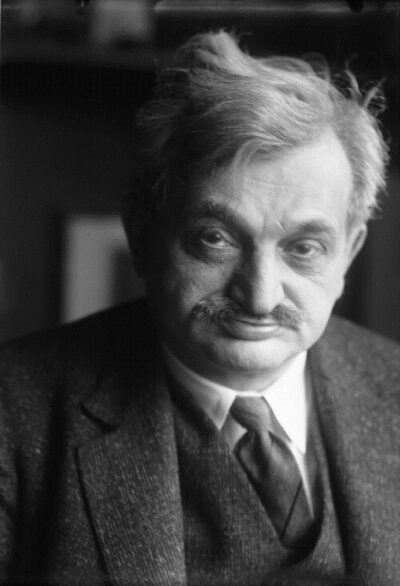
Emanuel Lasker
Emanuel Lasker was a Greman chess player, World Chess champion. Born December 24, 1868, in Barlinek. Died January 11, 1941, in New York City. Positions held include world chess champion (1894–1921). Known for Zur Theorie der moduln und Ideale, Albin Countergambit, Lasker Trap and Lasker Variation. Educated at Heidelberg University and University of Erlangen–Nuremberg. Awards include world chess champion and Germany's Sports Hall of Fame.
Facts
34 facts · 2 confirmed by two sources · 15 cited · 17 from one source
Where this comes from
Papalocal keeps its own record. It started from these sources; what each one said is kept here as it was copied, so a change on their side never changes this page by itself. Tap one to read its version.
What Wikidata says · copied November 16, 2026 · revision 2563978788
- Described as
- Greman chess player, World Chess champion (1868–1941)
- Born
- December 24, 1868 · 10 references
- Died
- January 11, 1941 · 10 references
- Born in
- Barlinek · 3 references
- Died in
- New York City · 3 references
- Buried in
- Beth Olam Cemetery · 1 reference
- Citizen of
- German Empire · 1 reference; Weimar Republic
- Occupation
- mathematician · 2 references; chess player · 1 reference; bridge player; philosopher · 1 reference; chess composer
- Positions held
- world chess champion (1894–1921) · 1 reference
- Worked for
- Tulane University
- Education
- Heidelberg University · 1 reference; University of Erlangen–Nuremberg (–1900) · 1 reference; Frederick William University Berlin · 1 reference; University of Göttingen · 1 reference
- Sport
- chess
- Known for
- Zur Theorie der moduln und Ideale; Albin Countergambit, Lasker Trap; Lasker Variation; Lasker's Manual of Chess; Common Sense in Chess; primary decomposition; Lasca
- Awards
- world chess champion (1894–1921); Germany's Sports Hall of Fame (2008–)
- Field
- algebra; chess · 1 reference; mathematics · 1 reference; philosophy · 1 reference
- Spouse
- Martha Lasker (1911–) · 1 reference
- Siblings
- Berthold Lasker
- Wikipedias with a page
- 87
Wikidata item Q57095 (wikidata.org/wiki/Q57095), public domain (CC0). Copied November 16, 2026.
What Wikipedia says · copied November 16, 2026 · revision 1383620823
Emanuel Lasker (German pronunciation: [eˈmaːnuɛl ˈlaskɐ] ; December 24, 1868 – January 11, 1941) was a German chess player, mathematician, and philosopher. He was the second World Chess Champion, holding the title for 27 years, from 1894 to 1921, the longest reign of any officially recognised World Chess Champion, winning 6 World Chess Championships. In his prime, Lasker was one of the most dominant champions.
His contemporaries used to say that Lasker used a "psychological" approach to the game, and even that he sometimes deliberately played inferior moves to confuse opponents. Recent analysis, however, indicates that he was ahead of his time and used a more flexible approach than his contemporaries, which mystified many of them. Lasker knew contemporary analyses of openings well but disagreed with many of them. He published chess magazines and five chess books, but later players and commentators found it difficult to draw lessons from his methods.
Lasker made contributions to the development of other games. He was a first-class contract bridge player and wrote about bridge, Go, and his own invention, Lasca. His books about games presented a problem that is still considered notable in the mathematical analysis of card games. Lasker was a research mathematician who was known for his contributions to commutative algebra, which included proving the primary decomposition of the ideals of polynomial rings. In addition to his better-known works, he also produced philosophical writings and co-authored a drama, both of which received limited contemporary attention.
- Born, in its opening lines
- December 24, 1868
- Died, in its opening lines
- January 11, 1941
From the Wikipedia article “Emanuel Lasker” (en.wikipedia.org/wiki/Emanuel_Lasker), by its contributors, under CC BY-SA 4.0 (creativecommons.org/licenses/by-sa/4.0/). Copied November 16, 2026; not changed.
Confirmed Two sources agree. Cited One source, and it names where it got it. One source One source, without a reference of its own. Sources disagree The sources disagree. We show the best-supported value and keep theirs below.
