
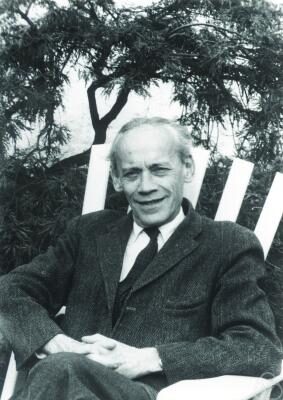
Emil Artin
Emil Artin was an Austrian-Armenian mathematician. Born March 3, 1898, in Vienna. Died December 20, 1962, in Hamburg. Known for Ankeny–Artin–Chowla congruence, Artin algebra and Artin billiard. Educated at University of Vienna and Leipzig University. Awards include Ackermann–Teubner Memorial Award, Fellow of the American Academy of Arts and Sciences and honorary doctorate of the Université de Clermont-Ferrand.
Facts
48 facts · 2 confirmed by two sources · 22 cited · 24 from one source
Where this comes from
Papalocal keeps its own record. It started from these sources; what each one said is kept here as it was copied, so a change on their side never changes this page by itself. Tap one to read its version.
What Wikidata says · copied November 15, 2026 · revision 2569159198
- Described as
- Austrian-Armenian mathematician (1898–1962)
- Born
- March 3, 1898 · 7 references
- Died
- December 20, 1962 · 7 references
- Born in
- Vienna · 2 references
- Died in
- Hamburg · 2 references
- Buried in
- Ohlsdorf Cemetery (1962–1988) · 1 reference; Weidling Cemetery (1989–) · 1 reference
- Cause of death
- myocardial infarction
- Citizen of
- Austria–Hungary; United States (1946–); Austria · 1 reference; Germany (1961–)
- Occupation
- mathematician · 2 references; university teacher
- Worked for
- Princeton University (1946–1958) · 1 reference; University of Hamburg (2 times) (1922–1962) · 1 reference; University of Notre Dame (1937–1938) · 1 reference; Indiana University (1938–1946) · 2 references; Austro-Hungarian Army (1917–1918) · 1 reference
- Education
- University of Vienna (1916–1917) · 1 reference; Leipzig University (1919–1921) · 1 reference; University of Göttingen (1921–1922) · 1 reference
- Member of
- German Academy of Sciences Leopoldina · 1 reference; American Academy of Arts and Sciences; National Academy of Sciences; Göttingen Academy of Sciences and Humanities in Lower Saxony
- Known for
- Ankeny–Artin–Chowla congruence; Artin algebra; Artin billiard; Artin group; Artin's theorem on induced characters; Artin–Wedderburn theorem; Artin–Zorn theorem; Artin's conjecture on primitive roots; Artin L-function; Artin conductor
- Awards
- Ackermann–Teubner Memorial Award (1932); Fellow of the American Academy of Arts and Sciences; honorary doctorate of the Université de Clermont-Ferrand (1962) · 1 reference
- Field
- algebra · 1 reference; mathematics · 1 reference; algebraic number theory · 1 reference; class field theory · 1 reference; abstract algebra · 1 reference; ring · 1 reference
- Spouse
- Natascha Artin Brunswick (1929–1959) · 1 reference
- Children
- Michael Artin; Thomas Artin
- Mother
- Emma Maria Hübner
- Wikipedias with a page
- 38
Wikidata item Q57283 (wikidata.org/wiki/Q57283), public domain (CC0). Copied November 15, 2026.
What Wikipedia says · copied November 15, 2026 · revision 1372184233
Emil Artin (German: [ˈaʁtiːn]; March 3, 1898 – December 20, 1962) was an Austrian mathematician of Armenian descent.
Artin was one of the leading mathematicians of the twentieth century. He is best known for his work on algebraic number theory, contributing largely to class field theory and a new construction of L-functions. He also contributed to the pure theories of rings, groups and fields.
Along with Emmy Noether, he is considered the founder of modern abstract algebra.
- Born, in its opening lines
- March 3, 1898
- Died, in its opening lines
- December 20, 1962
From the Wikipedia article “Emil Artin” (en.wikipedia.org/wiki/Emil_Artin), by its contributors, under CC BY-SA 4.0 (creativecommons.org/licenses/by-sa/4.0/). Copied November 15, 2026; not changed.
Confirmed Two sources agree. Cited One source, and it names where it got it. One source One source, without a reference of its own. Sources disagree The sources disagree. We show the best-supported value and keep theirs below.
