
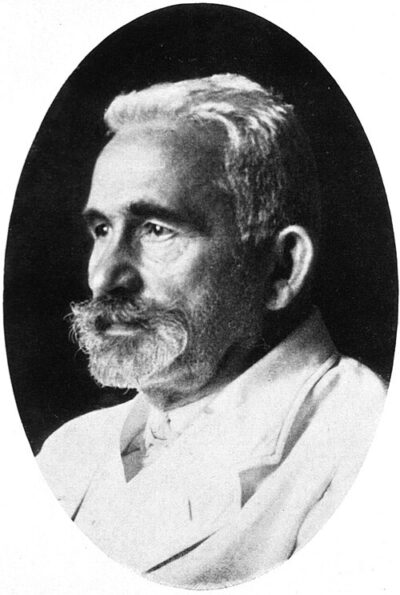
Emil Kraepelin
Emil Kraepelin was a German psychiatrist. Born February 15, 1856, in Neustrelitz. Died October 7, 1926, in Munich. Educated at Leipzig University and University of Würzburg.
Facts
23 facts · 2 confirmed by two sources · 9 cited · 12 from one source
Where this comes from
Papalocal keeps its own record. It started from these sources; what each one said is kept here as it was copied, so a change on their side never changes this page by itself. Tap one to read its version.
What Wikidata says · copied November 16, 2026 · revision 2569214954
- Described as
- German psychiatrist (1856–1926)
- Other names
- Emil Wilhelm Magnus Georg Kraepelin, Emil Wilhelm Georg Magnus Kraepelin
- Born
- February 15, 1856 · 6 references
- Died
- October 7, 1926 · 7 references
- Born in
- Neustrelitz · 1 reference
- Died in
- Munich · 1 reference
- Buried in
- Bergfriedhof · 1 reference
- Cause of death
- pneumonia
- Name at birth
- Emil Wilhelm Magnus Georg Kraepelin
- Citizen of
- Weimar Republic
- Occupation
- psychiatrist · 1 reference; university teacher · 1 reference
- Political party
- German Fatherland Party
- Worked for
- Imperial University of Dorpat; LMU Munich; University of Erlangen–Nuremberg; Heidelberg University
- Education
- Leipzig University; University of Würzburg
- Member of
- Royal Swedish Academy of Sciences; Royal Physiographic Society in Lund
- Spouse
- Ina Kraepelin · 1 reference
- Children
- Toni Schmidt-Kraepelin · 1 reference
- Father
- Karl Kraepelin · 1 reference
- Siblings
- Karl Kraepelin · 1 reference
- Wikipedias with a page
- 55
Wikidata item Q76828 (wikidata.org/wiki/Q76828), public domain (CC0). Copied November 16, 2026.
What Wikipedia says · copied November 16, 2026 · revision 1372442817
Emil Wilhelm Georg Magnus Kraepelin (; German: [ˈeːmiːl 'kʁɛːpəliːn]; 15 February 1856 – 7 October 1926) was a German psychiatrist. Fellow psychiatrist Hans Eysenck's Encyclopedia of Psychology identified him as partially responsible for laying the foundations of modern scientific psychiatry, psychopharmacology, and psychiatric genetics.
Kraepelin believed the chief origin of psychiatric disease to be a combination of biological process and genetic disorder or malfunction. Kraepelin's theories dominated psychiatry at the start of the 20th century and, despite the later psychodynamic influence of Sigmund Freud and his disciples, enjoyed a revival at the 20th century's end. While he proclaimed his own high clinical standards of gathering information "by means of expert analysis of individual cases", he also drew on reported observations of officials not trained in psychiatry.
Kraepelin's textbooks do not contain detailed medical case histories of individuals, instead offering mosaic-like compilations of typical statements and behaviors from patients with a specific diagnosis. Kraepelin has been described as a "scientific manager" and "political operator" who developed "a large-scale, clinically oriented, epidemiological research programme".
Some of Kraepelin's theories were considered racist or discriminatory by some.
- Born, in its opening lines
- February 15, 1856
- Died, in its opening lines
- October 7, 1926
From the Wikipedia article “Emil Kraepelin” (en.wikipedia.org/wiki/Emil_Kraepelin), by its contributors, under CC BY-SA 4.0 (creativecommons.org/licenses/by-sa/4.0/). Copied November 16, 2026; not changed.
Confirmed Two sources agree. Cited One source, and it names where it got it. One source One source, without a reference of its own. Sources disagree The sources disagree. We show the best-supported value and keep theirs below.
