
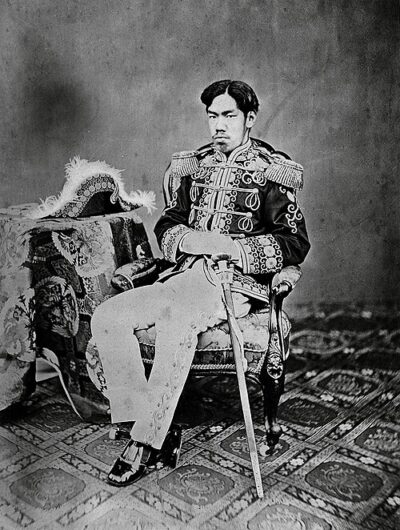
Emperor Meiji
Emperor Meiji was an Emperor of Japan from 1867 until 1912. Born November 3, 1852, in Site of the Nakayama Residence. Died July 30, 1912, in Meiji Palace. Positions held include Emperor of Japan (1867–1912). Awards include Knight of the Order of the Golden Fleece, Order of the Black Eagle and Order of the Rising Sun, 1st class.
Facts
42 facts · 1 confirmed by two sources · 0 cited · 38 from one source · 3 where the sources disagree
What’s different
- Died: we show July 30, 1912 (Sources disagree). Wikipedia says July 29, 1912
- Buried in: we show Fushimi Momoyama no Misasagi (Sources disagree). Wikidata also lists Tokyo
- Cause of death: we show diabetes (Sources disagree). Wikidata also lists uremia
Where this comes from
Papalocal keeps its own record. It started from these sources; what each one said is kept here as it was copied, so a change on their side never changes this page by itself. Tap one to read its version.
What Wikidata says · copied November 16, 2026 · revision 2568954315
- Described as
- Emperor of Japan from 1867 until 1912
- Other names
- Meiji-taitei, Meiji the Good, Prince Mutsuhito, Imperial Prince Mutsuhito, Meiji-seitei, Sachi-no-miya, Prince Sachi, Sachi-no-miya Mutsuhito-shinnou, Mutsu Hito, Meiji the Great, Sachi-no-miya Mutsuhito-shinnō, Mutsuhito, Prince Sachi
- Born
- November 3, 1852 · 1 reference
- Died
- July 30, 1912 · 1 reference
- Born in
- Site of the Nakayama Residence
- Died in
- Meiji Palace
- Buried in
- Fushimi Momoyama no Misasagi · 1 reference; Tokyo · 1 reference
- Cause of death
- diabetes; uremia
- Citizen of
- Japan
- Occupation
- monarch; aristocrat
- Positions held
- Emperor of Japan (1867–1912)
- Awards
- Knight of the Order of the Golden Fleece; Order of the Black Eagle; Order of the Rising Sun, 1st class; Order of St. Andrew; Grand Cordon of the Supreme Order of the Chrysanthemum; Collar of the Supreme Order of the Chrysanthemum; Knight grand cross of the order of the crown of Italy; Order of the Rising Sun with Paulownia Flowers, 1st class · 1 reference; Order of the Golden Kite · 1 reference; Order of the Sacred Treasure · 1 reference; Order of the Garter · 1 reference; Royal Order of the Seraphim · 1 reference; Order of the Elephant · 1 reference; Order of the Golden Fleece · 1 reference; Order of the Most Holy Annunciation · 1 reference
- Spouse
- Empress Shōken
- Children
- Wakamitsuteru-hiko no Mikoto; Wakatakayori-hime no Mikoto; Shigeko, Princess Ume; Yukihito, Prince Take; Emperor Taishō; Akiko, Princess Shige; Fumiko, Princess Masu; Shizuko, Princess Hisa; Michihito, Prince Aki; Princess Masako Takeda; Fusako Kitashirakawa; Princess Nobuko Asaka
- Father
- Emperor Kōmei
- Mother
- Nakayama Yoshiko
- Religion
- Shinto
- Military rank
- dai-gensui
- Wikipedias with a page
- 96
Wikidata item Q174231 (wikidata.org/wiki/Q174231), public domain (CC0). Copied November 16, 2026.
What Wikipedia says · copied November 16, 2026 · revision 1385832687
Emperor Meiji (3 November 1852 – 29 July 1912), personal name Mutsuhito, was Emperor of Japan from 30 January 1867 until his death in 1912. The Meiji Restoration proclaimed the Empire of Japan in 1868, beginning the Meiji era. During his reign, Japan transformed from a feudal state under the Tokugawa shogunate into a major imperial power.
At the time of Mutsuhito's birth, Japan was a feudal and pre-industrial country dominated by the isolationist Tokugawa shogunate and the daimyō subject to it, who ruled over Japan's 270 decentralized domains. The opening of Japan to the West from 1854 fueled domestic demands for modernization, and when Mutsuhito became emperor after the death of his father Emperor Kōmei in 1867, it triggered the Boshin War, in which samurai (mostly from the Chōshū and Satsuma Domains) defeated the shogunate and restored power in his name.
Documents issued during his reign include the Charter Oath of 1868, Meiji Constitution of 1889, Imperial Rescript to Soldiers and Sailors of 1882, and Imperial Rescript on Education of 1890, in which he was advised by a group of oligarchs known as the genrō. Other major events which occurred during his reign include the establishment of the Cabinet in 1885, Privy Council in 1888, Imperial Diet in 1890, and military victories over China in the First Sino-Japanese War and over Russia in the Russo-Japanese War. Taiwan and Korea were annexed in 1895 and 1910, respectively. Emperor Meiji died aged 59 at Meiji Palace in Tokyo, and was succeeded by his eldest son, Yoshihito.
- Born, in its opening lines
- November 3, 1852
- Died, in its opening lines
- July 29, 1912
From the Wikipedia article “Emperor Meiji” (en.wikipedia.org/wiki/Emperor_Meiji), by its contributors, under CC BY-SA 4.0 (creativecommons.org/licenses/by-sa/4.0/). Copied November 16, 2026; not changed.
Confirmed Two sources agree. Cited One source, and it names where it got it. One source One source, without a reference of its own. Sources disagree The sources disagree. We show the best-supported value and keep theirs below.
