
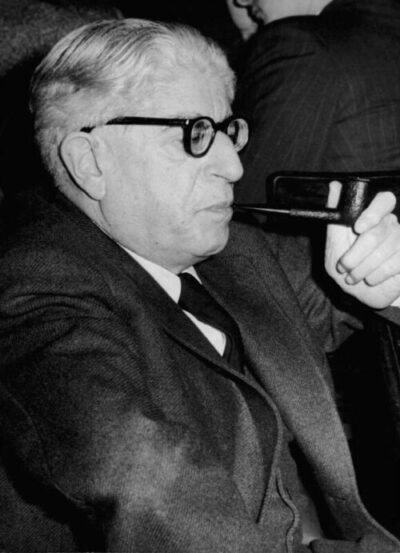
Ernst Bloch
Ernst Bloch was a German philosopher. Born July 8, 1885, in Ludwigshafen. Died August 4, 1977, in Tübingen. Known for The Principle of Hope, Atheism in Christianity and The Spirit of Utopia. Educated at University of Würzburg and LMU Munich. Awards include National Prize of East Germany, Patriotic Order of Merit in Silver and Peace Prize of the German Publishers' and Booksellers' Association.
Facts
33 facts · 2 confirmed by two sources · 17 cited · 14 from one source
Where this comes from
Papalocal keeps its own record. It started from these sources; what each one said is kept here as it was copied, so a change on their side never changes this page by itself. Tap one to read its version.
What Wikidata says · copied November 16, 2026 · revision 2569210977
- Described as
- German philosopher (1885–1977)
- Other names
- Ernst Simon Bloch, Karl Knerz
- Born
- July 8, 1885 · 11 references
- Died
- August 4, 1977 · 11 references
- Born in
- Ludwigshafen · 4 references
- Died in
- Tübingen · 4 references
- Buried in
- Berg cemetery
- Citizen of
- Germany · 1 reference; Switzerland · 1 reference; Czech Republic · 1 reference; United Kingdom · 1 reference
- Occupation
- philosopher · 2 references; university teacher · 1 reference; theologian · 1 reference
- Worked for
- Leipzig University; University of Tübingen
- Education
- University of Würzburg; LMU Munich
- Member of
- German Academy of Sciences at Berlin
- Known for
- The Principle of Hope · 1 reference; Atheism in Christianity; The Spirit of Utopia
- Awards
- National Prize of East Germany; Patriotic Order of Merit in Silver; Peace Prize of the German Publishers' and Booksellers' Association (1967) · 1 reference; Sigmund Freud Prize (1975) · 1 reference; Honorary doctor of the University of Zagreb; honorary doctor of the University of Paris 1 Pantheon-Sorbonne (1974) · 2 references
- Field
- philosophy · 1 reference; utopianism · 1 reference
- Spouse
- Karola Bloch (1934–) · 2 references; Else Bloch-von Stritzky · 1 reference
- Children
- Jan Robert Bloch · 1 reference; Mirjam Josephsohn
- Religion
- atheism
- Wikipedias with a page
- 62
Wikidata item Q57240 (wikidata.org/wiki/Q57240), public domain (CC0). Copied November 16, 2026.
What Wikipedia says · copied November 16, 2026 · revision 1382720194
Ernst Simon Bloch (; German: [ɛʁnst ˈblɔx]; 8 July 1885 – 4 August 1977) was a German Marxist philosopher. Bloch was influenced by Georg Wilhelm Friedrich Hegel and Karl Marx, as well as by apocalyptic and religious thinkers such as Thomas Müntzer, Paracelsus, and Jacob Böhme. He established friendships with György Lukács, Bertolt Brecht, Kurt Weill, Walter Benjamin, and Theodor W. Adorno. Bloch's work focuses on an optimistic teleology of the history of mankind.
- Born, in its opening lines
- July 8, 1885
- Died, in its opening lines
- August 4, 1977
From the Wikipedia article “Ernst Bloch” (en.wikipedia.org/wiki/Ernst_Bloch), by its contributors, under CC BY-SA 4.0 (creativecommons.org/licenses/by-sa/4.0/). Copied November 16, 2026; not changed.
Confirmed Two sources agree. Cited One source, and it names where it got it. One source One source, without a reference of its own. Sources disagree The sources disagree. We show the best-supported value and keep theirs below.
