
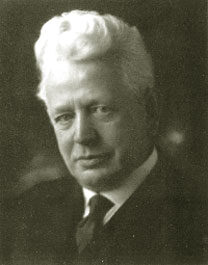
Ernst Cassirer
Ernst Cassirer was a German philosopher. Born July 28, 1874, in Wrocław. Died April 13, 1945, in New York City. Educated at Humboldt-Universität zu Berlin and University of Marburg. Awards include Kuno Fischer Award and honorary doctor of the University of Gothenburg.
Facts
30 facts · 2 confirmed by two sources · 11 cited · 17 from one source
What’s different
- Born: we show July 28, 1874 (Confirmed). Wikidata also lists May 28, 1874
Where this comes from
Papalocal keeps its own record. It started from these sources; what each one said is kept here as it was copied, so a change on their side never changes this page by itself. Tap one to read its version.
What Wikidata says · copied November 16, 2026 · revision 2569004122
- Described as
- German philosopher (1874–1945)
- Other names
- Ernst Alfred Cassirer
- Born
- May 28, 1874 · 6 references; July 28, 1874 · 2 references
- Died
- April 13, 1945 · 15 references
- Born in
- Wrocław · 2 references
- Died in
- New York City · 2 references
- Buried in
- Cedar Park Cemetery · 1 reference
- Cause of death
- myocardial infarction
- Citizen of
- Kingdom of Prussia (–1918); Weimar Republic (1918–1933); Nazi Germany (1933–1939); Sweden (1939–)
- Occupation
- philosopher · 2 references; university teacher · 1 reference; art historian · 2 references
- Worked for
- University of Oxford (1933–1935); All Souls College · 1 reference; War Press Office (German Reich) · 1 reference; University of Hamburg (1919–1933); Yale University (1941–1944); Columbia University (1944–1945); University of Gothenburg (1935–1941); Humboldt-Universität zu Berlin · 1 reference
- Education
- Humboldt-Universität zu Berlin; University of Marburg · 1 reference
- Member of
- Royal Swedish Academy of Letters, History and Antiquities
- Awards
- Kuno Fischer Award (1914); honorary doctor of the University of Gothenburg
- Spouse
- Toni Cassirer (1902–1945) · 1 reference
- Children
- Heinz Cassirer; Anne Appelbaum · 1 reference
- Father
- Eduard Cassirer
- Wikipedias with a page
- 63
Wikidata item Q57188 (wikidata.org/wiki/Q57188), public domain (CC0). Copied November 16, 2026.
What Wikipedia says · copied November 16, 2026 · revision 1383723929
Ernst Alfred Cassirer ( kah-SEER-ər, kə-; German: [ˈɛʁnst kaˈsiːʁɐ]; July 28, 1874 – April 13, 1945) was a German philosopher and historian of philosophy. Trained within the Marburg school of neo-Kantianism, he initially followed his mentor Hermann Cohen in attempting to supply an idealistic philosophy of science.
After Cohen's death in 1918, Cassirer developed a theory of symbolism and used it to expand the "logic and psychology of thought" into a more general "logic of the cultural sciences". Cassirer was one of the leading 20th-century advocates of philosophical idealism. His most famous work is the Philosophy of Symbolic Forms (1923–1929).
Though his work received a mixed reception shortly after his death, more recent scholarship has remarked upon Cassirer's role as a staunch defender of the moral idealism of the Enlightenment era and the cause of liberal democracy at a time when the rise of fascism had made such advocacy unfashionable. Within the international Jewish community, Cassirer's work has additionally been seen as part of a long tradition of thought on ethical philosophy.
- Born, in its opening lines
- July 28, 1874
- Died, in its opening lines
- April 13, 1945
From the Wikipedia article “Ernst Cassirer” (en.wikipedia.org/wiki/Ernst_Cassirer), by its contributors, under CC BY-SA 4.0 (creativecommons.org/licenses/by-sa/4.0/). Copied November 16, 2026; not changed.
Confirmed Two sources agree. Cited One source, and it names where it got it. One source One source, without a reference of its own. Sources disagree The sources disagree. We show the best-supported value and keep theirs below.
