
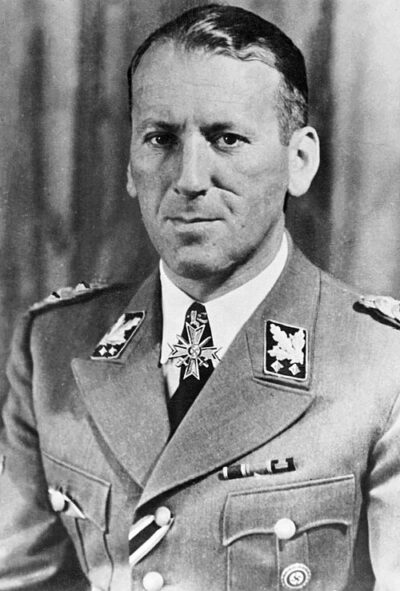
Ernst Kaltenbrunner
Ernst Kaltenbrunner was an Austrian SS official, a major perpetrator of the Holocaust and convicted war criminal. Born October 4, 1903, in Ried im Innkreis. Died October 16, 1946, in Nuremberg Court Prison. Positions held include member of the Reichstag of Nazi Germany, President of Interpol (1943–1945) and Chef der Sicherheitspolizei und des SD (1943–1945). Educated at University of Graz and Khevenhüller Gymnasium Linz. Awards include German Cross in Silver, Blood Order and Knight's Cross of the War Merit Cross in Gold without Swords.
Facts
41 facts · 2 confirmed by two sources · 12 cited · 27 from one source
Where this comes from
Papalocal keeps its own record. It started from these sources; what each one said is kept here as it was copied, so a change on their side never changes this page by itself. Tap one to read its version.
What Wikidata says · copied November 16, 2026 · revision 2568781815
- Described as
- Austrian SS official, a major perpetrator of the Holocaust and convicted war criminal (1903-1946)
- Born
- October 4, 1903 · 7 references
- Died
- October 16, 1946 · 8 references
- Born in
- Ried im Innkreis · 1 reference
- Died in
- Nuremberg Court Prison · 1 reference
- Buried in
- Wenzbach · 1 reference
- Cause of death
- hanging to death · 1 reference
- Citizen of
- Austria; Nazi Germany
- Occupation
- politician · 1 reference; lawyer; military officer; Gestapo employee; Holocaust perpetrator · 1 reference; jurist · 1 reference
- Positions held
- member of the Reichstag of Nazi Germany; President of Interpol (1943–1945); Chef der Sicherheitspolizei und des SD (1943–1945)
- Political party
- Nazi Party (1930–)
- Worked for
- Reich Main Security Office; Gestapo
- Education
- University of Graz; Khevenhüller Gymnasium Linz (1913–1921); Bundesrealgymnasium Linz Fadingerstraße
- Member of
- Schutzstaffel (1931–)
- Awards
- German Cross in Silver (1943) · 1 reference; Blood Order (1942); Knight's Cross of the War Merit Cross in Gold without Swords (1944); War Merit Cross 1st Class with Swords (1943) · 2 references; Anschluss Medal; Sudetenland Medal; Memel Medal; Nazi Party Long Service Award; Golden Party Badge (1939); Reichsführer-SS; Honour Chevron for the Old Guard (1934) · 1 reference; SS-Ehrenring; War Merit Cross 2nd Class with Swords (1942) · 1 reference; SS Zivilabzeichen (1934) · 1 reference; Iron Cross (1939), 2nd class · 1 reference
- Military branch
- Schutzstaffel (1940–1945)
- Military rank
- Obergruppenführer
- Wikipedias with a page
- 61
Wikidata item Q78473 (wikidata.org/wiki/Q78473), public domain (CC0). Copied November 16, 2026.
What Wikipedia says · copied November 16, 2026 · revision 1380904089
Ernst Kaltenbrunner (4 October 1903 – 16 October 1946) was an Austrian lawyer, high-ranking SS official during the Nazi era, major perpetrator of the Holocaust, and convicted war criminal. After the assassination of Reinhard Heydrich in 1942, and a brief period under Heinrich Himmler, Kaltenbrunner was named the third director of the Reich Security Main Office (RSHA), which included the offices of Gestapo, Kripo and SD, serving from January 1943 until the end of World War II in Europe. He was also the president of Interpol during the same time period.
Kaltenbrunner obtained a doctorate in law from the University of Graz in 1926. He joined the Nazi Party in 1930 and the SS in 1931, and by 1935 he was considered a leader of the Austrian SS. In 1938, he assisted in the Anschluss and was given command of the SS and police force in Austria. In January 1943, Kaltenbrunner was appointed chief of the RSHA, succeeding Reinhard Heydrich, who had been assassinated in June 1942.
A committed antisemite, Kaltenbrunner played a pivotal role in orchestrating the Holocaust, which intensified under his leadership. He oversaw the coordination of security and law enforcement agencies involved in widespread extermination, the suppression of resistance movements in occupied territories, extensive arrests, deportations, and executions. He was the highest-ranking member of the SS to face trial (Himmler having committed suicide in May 1945) at the Nuremberg trials, where he was found guilty of war crimes and crimes against humanity. Kaltenbrunner was sentenced to death, and was executed by hanging on 16 October 1946.
- Born, in its opening lines
- October 4, 1903
- Died, in its opening lines
- October 16, 1946
From the Wikipedia article “Ernst Kaltenbrunner” (en.wikipedia.org/wiki/Ernst_Kaltenbrunner), by its contributors, under CC BY-SA 4.0 (creativecommons.org/licenses/by-sa/4.0/). Copied November 16, 2026; not changed.
Confirmed Two sources agree. Cited One source, and it names where it got it. One source One source, without a reference of its own. Sources disagree The sources disagree. We show the best-supported value and keep theirs below.
