
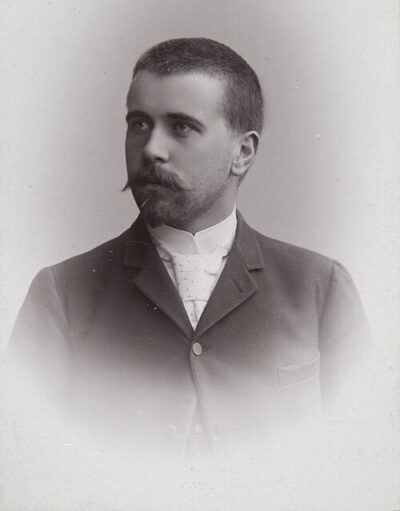
Ernst Leonard Lindelöf
Ernst Leonard Lindelöf was a Finnish mathematician who made contributions in real/complex analysis and topology. Born March 7, 1870, in Helsinki. Died June 4, 1946, in Helsinki. Known for Phragmén–Lindelöf principle, Lindelöf hypothesis and Picard–Lindelöf theorem. Educated at University of Helsinki and University of Göttingen. Awards include Grand Cross of the Order of the White Rose of Finland, Order of Saint Anna, 3rd class and Knight of the Order of the Polar Star.
Facts
33 facts · 2 confirmed by two sources · 14 cited · 17 from one source
Where this comes from
Papalocal keeps its own record. It started from these sources; what each one said is kept here as it was copied, so a change on their side never changes this page by itself. Tap one to read its version.
What Wikidata says · copied November 17, 2026 · revision 2565551320
- Described as
- Finnish mathematician who made contributions in real/complex analysis and topology (1870–1946)
- Other names
- Ernst Lindelöf
- Born
- March 7, 1870 · 6 references
- Died
- June 4, 1946 · 5 references
- Born in
- Helsinki · 2 references
- Died in
- Helsinki · 2 references
- Buried in
- Hietaniemi cemetery · 1 reference
- Citizen of
- Grand Duchy of Finland (–1917); Finland (1917–)
- Occupation
- mathematician · 1 reference; topologist; university teacher
- Worked for
- University of Helsinki (1896–1938) · 1 reference
- Education
- University of Helsinki (1887–1893) · 1 reference; University of Göttingen (1901) · 2 references; Stockholm University (1891) · 1 reference; University of Paris (1893–1894) · 1 reference
- Member of
- Royal Swedish Academy of Sciences; Finnish Society of Sciences and Letters; Royal Prussian Academy of Sciences; Göttingen Academy of Sciences and Humanities in Lower Saxony
- Instrument
- violin · 1 reference
- Known for
- Phragmén–Lindelöf principle; Lindelöf hypothesis; Picard–Lindelöf theorem; Lindelöf space; Lindelöf's theorem; Lindelöf's theorem
- Awards
- Grand Cross of the Order of the White Rose of Finland (1940) · 1 reference; Order of Saint Anna, 3rd class (1910) · 1 reference; Knight of the Order of the Polar Star (1907) · 1 reference
- Field
- topology
- Father
- Lorenz Lindelöf · 1 reference
- Siblings
- Uno Lindelöf; Carl Lindelöf
- Wikipedias with a page
- 26
Wikidata item Q924443 (wikidata.org/wiki/Q924443), public domain (CC0). Copied November 17, 2026.
What Wikipedia says · copied November 17, 2026 · revision 1380910710
Ernst Leonard Lindelöf (Swedish pronunciation: [ˈlɪ̂nːdɛˌløːv]; 7 March 1870 – 4 June 1946) was a Finnish mathematician, who made contributions in real analysis, complex analysis and topology. Lindelöf spaces are named after him. He was the son of mathematician Lorenz Leonard Lindelöf, whose chair he would eventually succeed through his cousin Edvard Rudolf Neovius, and brother of the philologist Uno Lorenz Lindelöf. He founded the Finnish school of function theory, which achieved lasting international renown.
He was secretary of the Finnish Society of Science and Letters (societas scientiarum Fennica) in its centenary year, 1938.
- Born, in its opening lines
- March 7, 1870
- Died, in its opening lines
- June 4, 1946
From the Wikipedia article “Ernst Leonard Lindelöf” (en.wikipedia.org/wiki/Ernst_Leonard_Lindelöf), by its contributors, under CC BY-SA 4.0 (creativecommons.org/licenses/by-sa/4.0/). Copied November 17, 2026; not changed.
Confirmed Two sources agree. Cited One source, and it names where it got it. One source One source, without a reference of its own. Sources disagree The sources disagree. We show the best-supported value and keep theirs below.
