
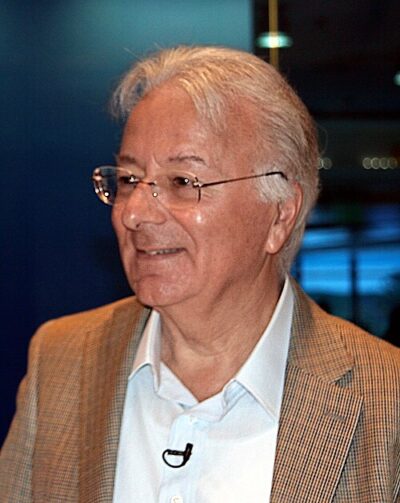
Federico Faggin
Federico Faggin is an Italian-American physicist, engineer, inventor and entrepreneur. Born December 1, 1941, in Vicenza. Educated at University of Padua. Awards include National Medal of Technology and Innovation, Marconi Prize and National Inventors Hall of Fame.
Facts
31 facts · 1 confirmed by two sources · 16 cited · 14 from one source
Where this comes from
Papalocal keeps its own record. It started from these sources; what each one said is kept here as it was copied, so a change on their side never changes this page by itself. Tap one to read its version.
What Wikidata says · copied November 16, 2026 · revision 2567561924
- Described as
- Italian-American physicist, engineer, inventor and entrepreneur (born 1941)
- Born
- December 1, 1941
- Born in
- Vicenza · 1 reference
- Citizen of
- Kingdom of Italy (–1946); Italy (1946–)
- Occupation
- physicist · 1 reference; inventor; computer scientist; electrical engineer; businessperson; engineer · 1 reference; entrepreneur · 1 reference
- Worked for
- Fairchild Semiconductor; Intel; Zilog; Synaptics; Foveon
- Education
- University of Padua · 1 reference
- Awards
- National Medal of Technology and Innovation (2009) · 2 references; Marconi Prize (1988) · 2 references; National Inventors Hall of Fame (1996) · 1 reference; Computer History Museum Fellow (2009) · 1 reference; Kyoto Prize in Advanced Technology (1997) · 1 reference; W. Wallace McDowell Award (1994) · 1 reference; Enrico Fermi Prize (2014) · 1 reference; Fellow of the American Association for the Advancement of Science (2018) · 1 reference; Grand Officer of the Order of Merit of the Italian Republic (1988); Knight Grand Cross of the Order of Merit of the Italian Republic (2019)
- Field
- physics · 1 reference; microprocessor · 1 reference; informatics · 1 reference
- Lived in
- United States (1968–)
- Wikipedias with a page
- 29
Wikidata item Q667095 (wikidata.org/wiki/Q667095), public domain (CC0). Copied November 16, 2026.
What Wikipedia says · copied November 16, 2026 · revision 1373498131
Federico Faggin (Italian pronunciation: [fedeˈriːko fadˈdʒin], Venetian: [faˈdʒiŋ]; born 1 December 1941) is an Italian-American physicist, engineer, inventor and entrepreneur. He is best known for designing the first commercial microprocessor, the Intel 4004. He led the 4004 (MCS-4) project and the design group during the first five years of Intel's microprocessor effort. Faggin also created, while working at Fairchild Semiconductor in 1968, the self-aligned MOS (metal–oxide–semiconductor) silicon-gate technology (SGT), which made possible MOS semiconductor memory chips, CCD image sensors, and the microprocessor. After the 4004, he led development of the Intel 8008 and 8080, using his SGT methodology for random logic chip design, which was essential to the creation of early Intel microprocessors. He was co-founder (with Ralph Ungermann) and CEO of Zilog, the first company solely dedicated to microprocessors, and led the development of the Zilog Z80 and Z8 processors. He was later the co-founder and CEO of Cygnet Technologies, and then Synaptics.
In 2010, he received the 2009 National Medal of Technology and Innovation, the highest honor the United States confers for achievements related to technological progress. In 2011, Faggin founded the Federico and Elvia Faggin Foundation to support the scientific study of consciousness at US universities and research institutes. In 2015, the Faggin Foundation helped to establish a $1 million endowment for the Faggin Family Presidential Chair in the Physics of Information at UC Santa Cruz to promote the study of "fundamental questions at the interface of physics and related fields including mathematics, complex systems, biophysics, and cognitive science, with the unifying theme of information in physics."
- Born, in its opening lines
- December 1, 1941
From the Wikipedia article “Federico Faggin” (en.wikipedia.org/wiki/Federico_Faggin), by its contributors, under CC BY-SA 4.0 (creativecommons.org/licenses/by-sa/4.0/). Copied November 16, 2026; not changed.
Confirmed Two sources agree. Cited One source, and it names where it got it. One source One source, without a reference of its own. Sources disagree The sources disagree. We show the best-supported value and keep theirs below.
