
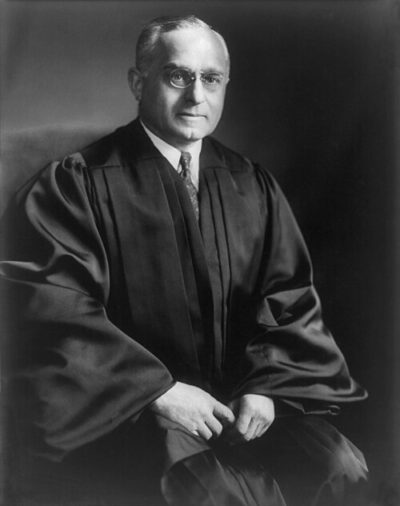
Felix Frankfurter
Felix Frankfurter was a former Associate Justice of the United States Supreme Court. Born November 15, 1882, in Vienna. Died February 22, 1965, in Washington, D.C.. Positions held include Associate Justice of the Supreme Court of the United States (1939–1962). Educated at Harvard Law School and City College of New York. Awards include Presidential Medal of Freedom and American Bar Association Medal.
Facts
26 facts · 2 confirmed by two sources · 11 cited · 13 from one source
Where this comes from
Papalocal keeps its own record. It started from these sources; what each one said is kept here as it was copied, so a change on their side never changes this page by itself. Tap one to read its version.
What Wikidata says · copied November 16, 2026 · revision 2567407842
- Described as
- former Associate Justice of the United States Supreme Court (1882–1965)
- Born
- November 15, 1882 · 4 references
- Died
- February 22, 1965 · 4 references
- Born in
- Vienna · 1 reference
- Died in
- Washington, D.C. · 1 reference
- Buried in
- Mount Auburn Cemetery · 1 reference
- Cause of death
- heart failure
- Citizen of
- United States
- Occupation
- lawyer; judge · 1 reference; politician; jurist · 1 reference
- Positions held
- Associate Justice of the Supreme Court of the United States (1939–1962)
- Political party
- independent politician · 1 reference
- Worked for
- Harvard University
- Education
- Harvard Law School; City College of New York
- Member of
- American Academy of Arts and Sciences; Phi Beta Kappa Society; American Philosophical Society (1939–) · 1 reference; Zionist Organization of America · 1 reference; Parushim · 1 reference
- Awards
- Presidential Medal of Freedom (1963) · 1 reference; American Bar Association Medal
- Field
- justice and judicial activities · 1 reference; law · 1 reference
- Spouse
- Marion Denman Frankfurter (1919–1965) · 1 reference
- Wikipedias with a page
- 23
Wikidata item Q1403472 (wikidata.org/wiki/Q1403472), public domain (CC0). Copied November 16, 2026.
What Wikipedia says · copied November 16, 2026 · revision 1381823514
Felix Frankfurter (November 15, 1882 – February 22, 1965) was an American jurist who served as an associate justice of the U.S. Supreme Court from 1939 until 1962, advocating judicial restraint.
Born in Vienna, Frankfurter immigrated with his family to New York City at age 12. He graduated from Harvard Law School and worked for Henry L. Stimson, the U.S. Secretary of War. Frankfurter served as Judge Advocate General during World War I. Afterward, he returned to Harvard and helped found the American Civil Liberties Union. He later became a friend and adviser of President Franklin D. Roosevelt. After Benjamin N. Cardozo died in 1938, Roosevelt nominated Frankfurter to the Supreme Court. Given his affiliations and alleged radicalism, the Senate confirmed Frankfurter's appointment only after its Judiciary Committee required him to testify in 1939, a practice that became routine in the 1950s.
His relations with colleagues were strained by ideological and personal differences, likely exacerbated by some antisemitism. His judicial restraint was first seen as relatively liberal, as conservative justices had used the derogation canon and plain meaning rule against Progressive economic legislation during the 1897–1937 Lochner era. It became seen as somewhat conservative in civil liberties dissents as the Court moved left. His dissent in West Virginia State Board of Education v. Barnette (1943) refers to his minority-group background as immaterial and was prompted by the new majority's repudiation of Minersville School District v. Gobitis (1940), in which he had penned the restrained majority opinion.
In 1948, he hired William Thaddeus Coleman Jr., the first black law clerk at the Court, though in 1960 Frankfurter declined to hire Ruth Bader Ginsburg, citing gender roles. In Brown II (1955), he suggested the phrase "all deliberate speed" to endorse gradual racial integration. He held that redistricting was nonjusticiable in Colegrove v. Green (1946) and Baker v. Carr (1962), and his majority opinion in Gomillion v. Lightfoot (1960) only upheld review under the Fifteenth Amendment. Frankfurter's other decisions include the majority opinion in Beauharnais v. Illinois (1952) and dissents in Glasser v. United States (1942) and Trop v. Dulles (1958). He retired after a 1962 stroke, and was replaced with Arthur Goldberg.
- Born, in its opening lines
- November 15, 1882
- Died, in its opening lines
- February 22, 1965
From the Wikipedia article “Felix Frankfurter” (en.wikipedia.org/wiki/Felix_Frankfurter), by its contributors, under CC BY-SA 4.0 (creativecommons.org/licenses/by-sa/4.0/). Copied November 16, 2026; not changed.
Confirmed Two sources agree. Cited One source, and it names where it got it. One source One source, without a reference of its own. Sources disagree The sources disagree. We show the best-supported value and keep theirs below.
