
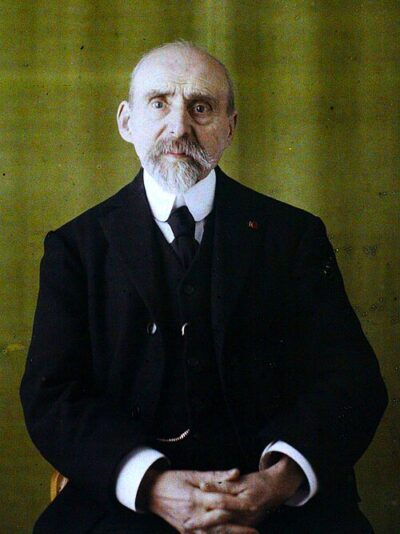
Ferdinand Buisson
Ferdinand Buisson was a French academic and politician. Born December 20, 1841, in Paris. Died February 16, 1932, in Thieuloy-Saint-Antoine. Positions held include Deputy of the French Third Republic (1902–1924) and president (2 times) (1902–1926). Educated at Lycée Condorcet and Faculty of Arts of Paris. Awards include Nobel Peace Prize, Grand Officer of the Legion of Honour and Marcelin Guérin Prize.
Facts
26 facts · 2 confirmed by two sources · 8 cited · 16 from one source
Where this comes from
Papalocal keeps its own record. It started from these sources; what each one said is kept here as it was copied, so a change on their side never changes this page by itself. Tap one to read its version.
What Wikidata says · copied November 16, 2026 · revision 2567936712
- Described as
- French academic and politician (1841-1932)
- Other names
- Ferdinand Edouard Buisson
- Born
- December 20, 1841 · 11 references
- Died
- February 16, 1932 · 9 references
- Born in
- Paris · 2 references
- Died in
- Thieuloy-Saint-Antoine · 2 references
- Buried in
- Thieuloy-Saint-Antoine
- Citizen of
- France
- Occupation
- politician; professor; pedagogue · 1 reference; philosopher; librarian · 1 reference
- Positions held
- Deputy of the French Third Republic (1902–1924) · 1 reference; president (2 times) (1902–1926) · 1 reference
- Political party
- Radical-Socialist and Radical Republican Party
- Worked for
- Faculty of Arts of Paris; University of Neuchâtel; University of Paris · 1 reference
- Education
- Lycée Condorcet; Faculty of Arts of Paris (–1891) · 2 references
- Member of
- Human Rights League
- Awards
- Nobel Peace Prize (1927) · 2 references; Grand Officer of the Legion of Honour (1924); Marcelin Guérin Prize (1892)
- Father
- Pierre Buisson
- Siblings
- Benjamin-Paul Buisson
- Religion
- reformed · 1 reference
- Wikipedias with a page
- 54
Wikidata item Q273607 (wikidata.org/wiki/Q273607), public domain (CC0). Copied November 16, 2026.
What Wikipedia says · copied November 16, 2026 · revision 1363228949
Ferdinand Édouard Buisson (French pronunciation: [fɛʁdinɑ̃ edwaʁ bɥisɔ̃]; 20 December 1841 – 16 February 1932) was a French educational public servant, pacifist, and Radical-Socialist (left liberal) politician. He presided over the League of Education from 1902 to 1906 and over the Human Rights League (LDH) from 1914 to 1926. In 1927, the Nobel Peace Prize was awarded to him jointly with Ludwig Quidde. A philosopher and educator, he was Director of Primary Education. He was the author of a thesis on Sebastian Castellio, in whom he saw a "liberal Protestant" in his image. Ferdinand Buisson was the president of the National Association of Freethinkers. In 1905, he chaired the parliamentary committee to implement the separation of church and state. Famous for his fight for secular education through the League of Education, he coined the term laïcité ("secularism").
- Born, in its opening lines
- December 20, 1841
- Died, in its opening lines
- February 16, 1932
From the Wikipedia article “Ferdinand Buisson” (en.wikipedia.org/wiki/Ferdinand_Buisson), by its contributors, under CC BY-SA 4.0 (creativecommons.org/licenses/by-sa/4.0/). Copied November 16, 2026; not changed.
Confirmed Two sources agree. Cited One source, and it names where it got it. One source One source, without a reference of its own. Sources disagree The sources disagree. We show the best-supported value and keep theirs below.
