
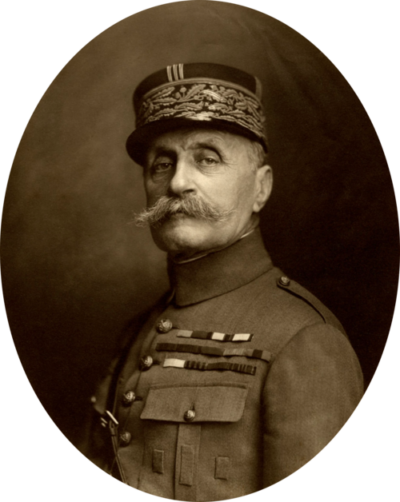
Ferdinand Foch
Ferdinand Foch was a French marchal and military theorist. Born October 2, 1851, in Tarbes. Died March 20, 1929, in Paris. Positions held include vice president (1919–1920), Member of the Académie française (1918–1929) and Supreme Allied Commander (1918–1920). Educated at École polytechnique. Awards include Grand Cross of the Legion of Honour, Croix de guerre 1914–1918 and Knight Grand Cross of the Order of the Bath.
Facts
43 facts · 2 confirmed by two sources · 9 cited · 32 from one source
Where this comes from
Papalocal keeps its own record. It started from these sources; what each one said is kept here as it was copied, so a change on their side never changes this page by itself. Tap one to read its version.
What Wikidata says · copied November 16, 2026 · revision 2569234375
- Described as
- French marchal and military theorist (1851–1929)
- Other names
- Foch, Ferdinand Jean Marie Foch
- Born
- October 2, 1851 · 14 references
- Died
- March 20, 1929 · 14 references
- Born in
- Tarbes · 2 references
- Died in
- Paris · 3 references
- Buried in
- Cathédrale Saint-Louis-des-Invalides
- Cause of death
- myocardial infarction
- Name at birth
- Ferdinand Jean Marie Foch
- Citizen of
- France · 1 reference
- Occupation
- army officer · 1 reference
- Positions held
- vice president (1919–1920); Member of the Académie française (1918–1929) · 1 reference; Supreme Allied Commander (1918–1920); Chief of Staff of the French Army (1917–1918)
- Education
- École polytechnique
- Member of
- Académie Française (1918–1929) · 1 reference; French Academy of Sciences; Académie de Stanislas (Nancy, France); American Academy of Arts and Sciences
- Awards
- Grand Cross of the Legion of Honour; Croix de guerre 1914–1918; Knight Grand Cross of the Order of the Bath; Grand Cross of the Order of Wissam Alaouite; Distinguished Service Order; Order of the White Eagle (1923); Godfather promotion of Special Military School of Saint-Cyr; Cross of the Order of Lāčplēšis, 3rd class; Médaille militaire; Grand Cordon of the Order of Leopold; Grand Cross of the Order of Military Virtue (1923); Officer of the French Order of Academic Palms · 1 reference; Distinguished Service Medal; Grand Cross of the Order of the Redeemer; Order of Rama
- Spouse
- Julie Bienvenüe · 1 reference
- Children
- Marie Foch; Anne Foch; Germain Jules Louis Foch
- Siblings
- Germain Foch · 1 reference
- Military branch
- French Army
- Military rank
- Marshal of France; Marshal of Poland (1923–); divisional general · 1 reference
- Lived in
- avenue de Saxe (1918)
- Wikipedias with a page
- 81
Wikidata item Q192615 (wikidata.org/wiki/Q192615), public domain (CC0). Copied November 16, 2026.
What Wikipedia says · copied November 16, 2026 · revision 1378158785
Ferdinand Foch ( FOSH, French: [fɛʁdinɑ̃ fɔʃ]; 2 October 1851 – 20 March 1929) was a French general, Marshal of France and a member of the Académie Française and Académie des Sciences. He distinguished himself as Supreme Allied Commander on the Western Front during the First World War in 1918.
A commander during the First Marne, Flanders and Artois campaigns of 1914–1916, Foch became Supreme Allied Commander in late March 1918 in the face of the all-out German spring offensive. He successfully coordinated the French, British and American efforts, deftly handling his strategic reserves. He stopped the German offensive and launched a war-winning counterattack. In November 1918, Marshal Foch accepted the German cessation of hostilities and was present at the Armistice of 11 November 1918.
At the outbreak of war in August 1914, Foch's XX Corps participated in the brief invasion of Germany before retreating in the face of a German counter-attack and successfully blocking the Germans short of Nancy. Ordered west to defend Paris, Foch's prestige soared as a result of the victory at the Marne, for which he was widely credited as a chief protagonist while commanding the French Ninth Army. He was then promoted again to assistant commander-in-chief for the Northern Zone, a role which evolved into command of Army Group North, and in which role he was required to cooperate with the British forces at Ypres and the Somme. At the end of 1916, partly owing to the disappointing results of the latter offensive and partly owing to wartime political rivalries, Foch was transferred to Italy. After being named the commander-in-chief of Western Front with the title Généralissime, Foch was appointed "Commander-in-Chief of the Allied Armies" on 26 March 1918. He played a decisive role in halting a renewed German advance on Paris in the Second Battle of the Marne, after which he was promoted to Marshal of France. Author Larry H. Addington says, "to a large extent the final Allied strategy which won the war on land in Western Europe in 1918 was Foch's alone."
On 11 November 1918, Foch accepted the German request for an armistice. Foch advocated peace terms that would make Germany unable to pose a threat to France ever again. He considered the Treaty of Versailles too lenient on Germany. Winston Churchill attributed this famous but apocryphal quote about the Peace Treaty of Versailles to Foch: "This is not Peace. It is an Armistice for twenty years." Indeed, the next war broke out 20 years later.
- Born, in its opening lines
- October 2, 1851
- Died, in its opening lines
- March 20, 1929
From the Wikipedia article “Ferdinand Foch” (en.wikipedia.org/wiki/Ferdinand_Foch), by its contributors, under CC BY-SA 4.0 (creativecommons.org/licenses/by-sa/4.0/). Copied November 16, 2026; not changed.
Confirmed Two sources agree. Cited One source, and it names where it got it. One source One source, without a reference of its own. Sources disagree The sources disagree. We show the best-supported value and keep theirs below.
