
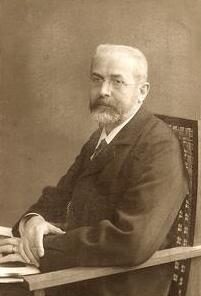
Ferdinand Georg Frobenius
Ferdinand Georg Frobenius was a German mathematician. Born October 26, 1849, in Charlottenburg. Died August 3, 1917, in Berlin. Known for Frobenius method, Frobenius matrix and Frobenius inner product. Educated at University of Göttingen and Frederick William University Berlin.
Facts
29 facts · 2 confirmed by two sources · 11 cited · 16 from one source
Where this comes from
Papalocal keeps its own record. It started from these sources; what each one said is kept here as it was copied, so a change on their side never changes this page by itself. Tap one to read its version.
What Wikidata says · copied November 16, 2026 · revision 2569210928
- Described as
- German mathematician (1849–1917)
- Other names
- Ferdinand Frobenius
- Born
- October 26, 1849 · 7 references
- Died
- August 3, 1917 · 5 references
- Born in
- Charlottenburg · 2 references
- Died in
- Berlin · 2 references
- Citizen of
- Kingdom of Prussia
- Occupation
- mathematician · 1 reference; university teacher · 1 reference
- Worked for
- Frederick William University Berlin (2 times) (1874–1917) · 1 reference; ETH Zurich (1875–1892) · 1 reference; Joachimsthalsches Gymnasium (1870–1872) · 1 reference
- Education
- University of Göttingen (1867–1868) · 1 reference; Frederick William University Berlin (1868–1870) · 1 reference; Joachimsthalsches Gymnasium (1860–1867) · 1 reference
- Member of
- Royal Prussian Academy of Sciences (1892–) · 1 reference; German Academy of Sciences Leopoldina; Göttingen Academy of Sciences and Humanities in Lower Saxony
- Known for
- Frobenius method; Frobenius matrix; Frobenius inner product; Perron–Frobenius theorem; Frobenius endomorphism; Frobenius algebra; Rouché–Capelli theorem; Frobenius theorem; Frobenius theorem; Frobenius normal form
- Field
- algebra; group theory; topology
- Wikipedias with a page
- 36
Wikidata item Q57228 (wikidata.org/wiki/Q57228), public domain (CC0). Copied November 16, 2026.
What Wikipedia says · copied November 16, 2026 · revision 1371993478
Ferdinand Georg Frobenius (26 October 1849 – 3 August 1917) was a German mathematician, best known for his contributions to the theory of elliptic functions, differential equations, number theory, and to group theory. He is known for the famous determinantal identities, known as Frobenius–Stickelberger formulae, governing elliptic functions, and for developing the theory of biquadratic forms. He was also the first to introduce the notion of rational approximations of functions (nowadays known as Padé approximants), and gave the first full proof for the Cayley–Hamilton theorem. He also lent his name to certain differential-geometric objects in modern mathematical physics, known as Frobenius manifolds.
- Born, in its opening lines
- October 26, 1849
- Died, in its opening lines
- August 3, 1917
From the Wikipedia article “Ferdinand Georg Frobenius” (en.wikipedia.org/wiki/Ferdinand_Georg_Frobenius), by its contributors, under CC BY-SA 4.0 (creativecommons.org/licenses/by-sa/4.0/). Copied November 16, 2026; not changed.
Confirmed Two sources agree. Cited One source, and it names where it got it. One source One source, without a reference of its own. Sources disagree The sources disagree. We show the best-supported value and keep theirs below.
