
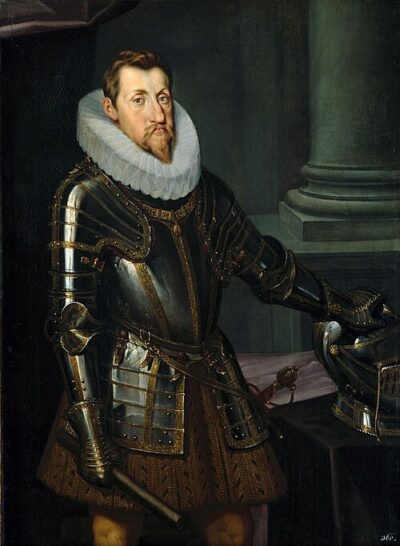
Ferdinand II, Holy Roman Emperor
Ferdinand II, Holy Roman Emperor was a Holy Roman Emperor. Born July 9, 1578, in Graz. Died February 15, 1637, in Vienna. Positions held include Holy Roman Emperor (1619–1637), Prince-Elector and King of Bohemia (1619–1637). Educated at University of Ingolstadt. Awards include Knight of the Order of the Golden Fleece.
Facts
34 facts · 2 confirmed by two sources · 10 cited · 21 from one source · 1 where the sources disagree
What’s different
- Buried in: we show Katharinenkirche und Mausoleum, Graz (Sources disagree). Wikidata also lists Herzgruft
Where this comes from
Papalocal keeps its own record. It started from these sources; what each one said is kept here as it was copied, so a change on their side never changes this page by itself. Tap one to read its version.
What Wikidata says · copied November 16, 2026 · revision 2565529995
- Described as
- Holy Roman Emperor
- Other names
- Emperor of Germany Ferdinand II, Holy Roman Emperor Ferdinand II, Ferdinand II
- Born
- July 9, 1578 · 5 references
- Died
- February 15, 1637 · 10 references
- Born in
- Graz · 3 references
- Died in
- Vienna · 4 references
- Buried in
- Katharinenkirche und Mausoleum, Graz; Herzgruft
- Citizen of
- Holy Roman Empire · 1 reference
- Occupation
- aristocrat
- Positions held
- Holy Roman Emperor (1619–1637); Prince-Elector; King of Bohemia (1619–1637); Apostolic King of Hungary (1619–1637) · 1 reference
- Education
- University of Ingolstadt
- Awards
- Knight of the Order of the Golden Fleece
- Spouse
- Maria Anna of Bavaria (1600–1616) · 1 reference; Eleonora Gonzaga (1622–1637) · 1 reference
- Children
- Ferdinand III, Holy Roman Emperor · 1 reference; Archduchess Maria Anna of Austria; Cecilia Renata of Austria; Archduke Leopold Wilhelm of Austria · 1 reference; Archduke Johann Karl of Austria · 1 reference; Christine von Habsburg · 1 reference; Karl von Habsburg · 1 reference
- Father
- Charles II, Archduke of Austria · 1 reference
- Mother
- Maria Anna of Bavaria · 1 reference
- Siblings
- Constance of Austria; Archduchess Gregoria Maximiliana of Austria; Maria Christina of Austria; Archduchess Catherine Renata of Austria; Archduchess Eleonore of Austria; Archduchess Maria Maddalena of Austria; Margaret of Austria, Queen of Spain; Anne of Austria, Queen of Poland; Leopold V, Archduke of Austria; Charles of Austria, Bishop of Wroclaw
- Wikipedias with a page
- 71
Wikidata item Q150599 (wikidata.org/wiki/Q150599), public domain (CC0). Copied November 16, 2026.
What Wikipedia says · copied November 16, 2026 · revision 1380894780
Ferdinand II (9 July 1578 – 15 February 1637) was Holy Roman Emperor, King of Bohemia, Hungary, and Croatia from 1619 until his death in 1637. He was the son of Archduke Charles II of Inner Austria and Maria of Bavaria, who were devout Catholics. In 1590, it was when Ferdinand was 11 years old, they sent him to study at the Jesuits' college in Ingolstadt because they wanted to isolate him from the Lutheran nobles. A few months later, his father died, and he inherited Inner Austria–Styria, Carinthia, Carniola and smaller provinces. His cousin, Rudolf II, Holy Roman Emperor, who was the head of the Habsburg family, appointed regents to administer these lands.
Ferdinand was installed as the actual ruler of the Inner Austrian provinces in 1596 and 1597. Rudolf II also charged him with the command of the defense of Croatia, Slavonia, and southeastern Hungary against the Ottoman Empire. Ferdinand regarded the regulation of religious issues as a royal prerogative and introduced strict Counter-Reformation measures from 1598. First, he ordered the expulsion of all Protestant pastors and teachers; next, he established special commissions to restore the Catholic parishes. The Ottomans captured Nagykanizsa in Hungary in 1600, which enabled them to invade Styria. A year later, Ferdinand tried to recapture the fortress, but the action ended in November 1601 with a defeat, due to the unprofessional command of his troops. During the first stage of the family feud known as the Brothers' Quarrel, Ferdinand initially supported Rudolph II's brother, Matthias, who wanted to convince the melancholic emperor to abdicate, but Matthias' concessions to the Protestants in Hungary, Austria, and Bohemia outraged Ferdinand. He planned an alliance to strengthen the position of the Catholic Church in the Holy Roman Empire, but the Catholic princes established the Catholic League without his participation in 1610.
Philip III of Spain, who was the childless Matthias' nephew, acknowledged Ferdinand's right to succeed Matthias in Bohemia and Hungary in exchange for territorial concessions in 1617. Spain also supported Ferdinand against the Republic of Venice during the Uskok War in 1617–1618. The Diets of Bohemia and Hungary confirmed Ferdinand's position as Matthias' successor only after he had promised to respect the Estates' privileges in both realms. The different interpretation of the Letter of Majesty, which summarized the Bohemian Protestants' liberties, gave rise to an uprising, known as the Second Defenestration of Prague on 23 May 1618. The Bohemian rebels established a provisional government, invaded Upper Austria, and sought assistance from the Habsburgs' opponents. Matthias II died on 20 March 1619. Ferdinand was elected Holy Roman Emperor on 28 August 1619 (Frankfurt), two days before the Protestant Bohemian Estates deposed Ferdinand (as king of Bohemia). News of his deposition arrived in Frankfurt on the 28th, but Ferdinand did not leave the city until he had been crowned. The rebel Bohemians offered their crown to the Calvinist Frederick V of the Palatinate on 26 August 1619.
The Thirty Years' War began in 1618 as a result of the inadequacies of his predecessors, Rudolf II and Matthias. However, Ferdinand's acts against Protestantism caused the war to engulf the whole empire. As a zealous Catholic, Ferdinand wanted to restore the Catholic Church as the only religion in the Holy Roman Empire and to wipe out any form of religious dissent. The war left the empire devastated and its population did not recover until 1710.
- Born, in its opening lines
- July 9, 1578
- Died, in its opening lines
- February 15, 1637
From the Wikipedia article “Ferdinand II, Holy Roman Emperor” (en.wikipedia.org/wiki/Ferdinand_II,_Holy_Roman_Emperor), by its contributors, under CC BY-SA 4.0 (creativecommons.org/licenses/by-sa/4.0/). Copied November 16, 2026; not changed.
Confirmed Two sources agree. Cited One source, and it names where it got it. One source One source, without a reference of its own. Sources disagree The sources disagree. We show the best-supported value and keep theirs below.
