
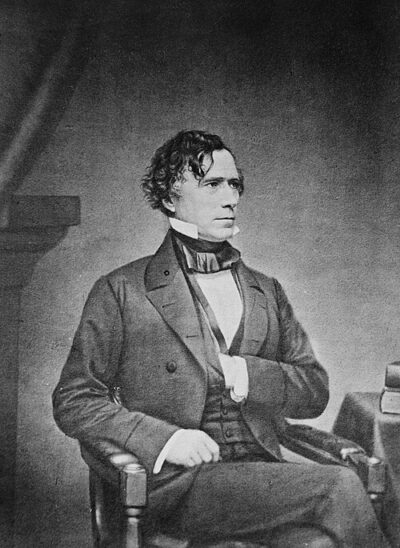
Franklin Pierce
Franklin Pierce was a president of the United States from 1853 to 1857. Born November 23, 1804, in Hillsborough. Died October 8, 1869, in Concord. Positions held include President of the United States (1853–1857), United States representative (1833–1837) and United States senator (1837–1842). Educated at Bowdoin College and Northampton Law School.
Facts
32 facts · 2 confirmed by two sources · 7 cited · 23 from one source
Where this comes from
Papalocal keeps its own record. It started from these sources; what each one said is kept here as it was copied, so a change on their side never changes this page by itself. Tap one to read its version.
What Wikidata says · copied November 13, 2026 · revision 2567582018
- Described as
- president of the United States from 1853 to 1857
- Other names
- F. Pierce, President Pierce
- Born
- November 23, 1804 · 11 references
- Died
- October 8, 1869 · 11 references
- Born in
- Hillsborough
- Died in
- Concord · 2 references
- Buried in
- Old North Cemetery
- Cause of death
- liver cirrhosis
- Citizen of
- United States
- Occupation
- politician · 1 reference; lawyer; statesperson; jurist · 1 reference; military officer · 1 reference
- Positions held
- President of the United States (1853–1857); United States representative (1833–1837); United States senator (1837–1842) · 1 reference; President-elect of the United States (1852–1853); member of the New Hampshire House of Representatives
- Political party
- Democratic Party
- Education
- Bowdoin College (–1824); Northampton Law School; Phillips Exeter Academy · 1 reference
- Spouse
- Jane Pierce (1834–1863) · 1 reference
- Children
- Benjamin Pierce; Franklin Pierce · 1 reference; Frank Robert Pierce · 1 reference
- Father
- Benjamin Pierce
- Mother
- Anna Kendrick Pierce
- Siblings
- Benjamin Kendrick Pierce
- Religion
- Episcopal Church
- Military rank
- general
- Lived in
- Concord
- Height
- 1.78 m (5 ft 10 in) · 1 reference
- Wikipedias with a page
- 139
Wikidata item Q12312 (wikidata.org/wiki/Q12312), public domain (CC0). Copied November 13, 2026.
What Wikipedia says · copied November 13, 2026 · revision 1384499611
Franklin Pierce (November 23, 1804 – October 8, 1869) was the 14th president of the United States, serving from 1853 to 1857. A northern Democrat who believed that the abolitionist movement was a fundamental threat to national unity, he alienated anti-slavery groups by signing the Kansas–Nebraska Act and enforcing the Fugitive Slave Act. Conflict between North and South continued after Pierce's presidency, and, following Abraham Lincoln's victory in the 1860 presidential election, the Southern states seceded, resulting in the American Civil War.
Pierce was born in New Hampshire; his father was state governor Benjamin Pierce. He served in the House of Representatives from 1833 until his election to the Senate, where he served from 1837 until his resignation in 1842. His private law practice was a success, and he was appointed New Hampshire's U.S. attorney in 1845. Pierce took part in the Mexican–American War as a brigadier general in the United States Army. Democrats saw him as a compromise candidate uniting Northern and Southern interests, and nominated him for president at the 1852 Democratic National Convention. He and running mate William R. King easily defeated the Whig Party ticket of Winfield Scott and William Alexander Graham in the 1852 presidential election.
As president, Pierce attempted to enforce neutral standards for civil service while also satisfying the Democratic Party's diverse elements with patronage, an effort that largely failed and turned many in his party against him. He was a Young America expansionist who signed the Gadsden Purchase of land from Mexico and led a failed attempt to acquire Cuba from Spain. He signed trade treaties with Britain and Japan and his Cabinet reformed its departments and improved accountability, but political strife during his presidency overshadowed these successes. His popularity declined sharply in the Northern states after he supported the Kansas–Nebraska Act, which nullified the Missouri Compromise, while many Southern whites continued to support him. The act's passage led to violent conflict over the expansion of slavery in the American West. Pierce's administration was further damaged when several of his diplomats issued the Ostend Manifesto calling for the annexation of Cuba, a document that was roundly criticized. He expected the Democrats to renominate him in the 1856 presidential election, but his bid failed. His reputation in the North suffered further during the American Civil War as he became a vocal critic of President Lincoln.
While Pierce was popular and outgoing, his family life was difficult; his three children died young, and his wife, Jane Pierce, suffered from illness and depression for much of her life. Their last surviving son was killed in a train accident while the family was traveling, shortly before Pierce's inauguration. A heavy drinker for much of his life, Pierce died in 1869 of cirrhosis. As a result of his support of the South, as well as failing to hold the Union together in time of strife, historians and scholars generally rank Pierce as one of the worst and least memorable U.S. presidents.
- Born, in its opening lines
- November 23, 1804
- Died, in its opening lines
- October 8, 1869
From the Wikipedia article “Franklin Pierce” (en.wikipedia.org/wiki/Franklin_Pierce), by its contributors, under CC BY-SA 4.0 (creativecommons.org/licenses/by-sa/4.0/). Copied November 13, 2026; not changed.
Confirmed Two sources agree. Cited One source, and it names where it got it. One source One source, without a reference of its own. Sources disagree The sources disagree. We show the best-supported value and keep theirs below.
