
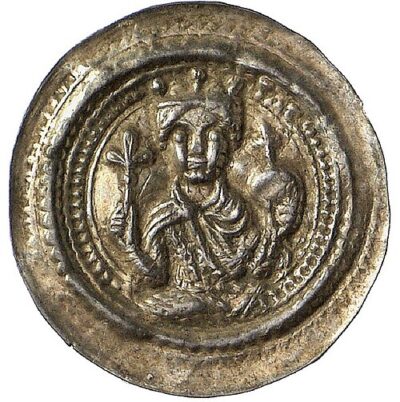
Frederick Barbarossa
Frederick Barbarossa was a Holy Roman Emperor from 1155 to 1190. Born December 1122, in Haguenau. Died June 10, 1190, in River Göksu. Positions held include King of the Romans (1152–1190), Holy Roman Emperor (1155–1190) and Duke of Swabia (1147–1152). Known for Königsmitteltor.
Facts
30 facts · 2 confirmed by two sources · 10 cited · 18 from one source
What’s different
- Died: we show June 10, 1190 (Confirmed). Wikidata also lists June 24, 1190
Where this comes from
Papalocal keeps its own record. It started from these sources; what each one said is kept here as it was copied, so a change on their side never changes this page by itself. Tap one to read its version.
What Wikidata says · copied November 16, 2026 · revision 2563976050
- Described as
- Holy Roman Emperor from 1155 to 1190
- Other names
- Frederick I Barbarossa, Holy Roman Emperor Frederick I, Barbarossa, Aënobarbus, Fridericus I Aënobarbus, Fridericus Aënobarbus
- Born
- December 1122 · 7 references
- Died
- June 10, 1190 · 2 references; June 24, 1190 · 1 reference
- Born in
- Haguenau
- Died in
- River Göksu · 1 reference
- Buried in
- Church of Saint Peter
- Cause of death
- drowning · 1 reference
- Citizen of
- Holy Roman Empire · 1 reference
- Occupation
- politician · 1 reference
- Positions held
- King of the Romans (1152–1190); Holy Roman Emperor (1155–1190); Duke of Swabia (1147–1152)
- Known for
- Königsmitteltor · 1 reference
- Spouse
- Adelaide of Vohburg (1147–1153) · 1 reference; Beatrice I, Countess of Burgundy (1156–1184) · 2 references
- Children
- Philip of Swabia · 1 reference; Henry VI · 1 reference; Frederick V, Duke of Swabia · 1 reference; Frederick VI, Duke of Swabia; Conrad II, Duke of Swabia · 1 reference; Otto I, Count of Burgundy; Beatrice Schwäbische; Sophie of Hohenstaufen; Agnes von Staufen
- Father
- Frederick II, Duke of Swabia · 1 reference
- Mother
- Judith of Bavaria, Duchess of Swabia · 1 reference
- Siblings
- Judith of Hohenstaufen; Bertha, duchess of Lorraine; Luitgard of Swabia; Conrad, Count Palatine of the Rhine
- Religion
- Catholicism
- Wikipedias with a page
- 101
Wikidata item Q79789 (wikidata.org/wiki/Q79789), public domain (CC0). Copied November 16, 2026.
What Wikipedia says · copied November 16, 2026 · revision 1385357421
Frederick Barbarossa (December 1122 – 10 June 1190), also known as Frederick I (German: Friedrich; Italian: Federico), was the Holy Roman Emperor from 1155 until his death in 1190. He was elected King of Germany in Frankfurt on 4 March 1152 and crowned in Aachen on 9 March 1152. He was crowned King of Italy on 24 April 1155 in Pavia and emperor by Pope Adrian IV on 18 June 1155 in Rome. Two years later, the term sacrum ("holy") first appeared in a document in connection with his empire. He was later formally crowned King of Burgundy, at Arles on 30 June 1178. His nickname of Barbarossa (meaning "Red Beard" in Italian) "was first used by the Florentines only in 1298 to differentiate the emperor from his grandson, Frederick II ... and was never employed in medieval Germany" (the colour red was "also associated in the Middle Ages with malice and a hot temper"; in reality, Frederick's hair was "blond", although his beard was described by a contemporary as "reddish"). In German, he was known as Kaiser Rotbart, which in English means "Emperor Redbeard". The prevalence of the Italian nickname, even in later German usage, reflects the centrality of the Italian campaigns under his reign, and "remains to this day one of the [most] powerful historical monikers."
Frederick was by inheritance Duke of Swabia (1147–1152, as Frederick III) before his imperial election in 1152. He was the son of Duke Frederick II of the Hohenstaufen dynasty and Judith, daughter of Henry IX, Duke of Bavaria, from the rival House of Welf. Frederick, therefore, descended from the two leading families in Germany, making him an acceptable choice for the Empire's prince-electors. Frederick joined the Third Crusade and opted to travel overland to the Holy Land. In 1190, Frederick drowned attempting to cross the Saleph River, leading to most of his army abandoning the Crusade before reaching Acre.
Historians consider him among the Holy Roman Empire's greatest medieval emperors. He combined qualities that made him appear almost superhuman to his contemporaries: his longevity, his ambition, his extraordinary skills at organization, his battlefield acumen, and his political perspicacity. His contributions to Central European society and culture include the re-establishment of the Corpus Juris Civilis, or the Roman rule of law, which counterbalanced the papal power that had dominated the German states since the conclusion of the Investiture controversy. Due to his popularity and fame, in the 19th and early 20th centuries, he was used as a political symbol by many movements and regimes: the Risorgimento, the Wilhelmine government in Germany (especially under Emperor Wilhelm I), and the Nazi movement (Operation Barbarossa, Barbarossa decree) resulting in mixed legacies.
- Born, in its opening lines
- December 1122
- Died, in its opening lines
- June 10, 1190
From the Wikipedia article “Frederick Barbarossa” (en.wikipedia.org/wiki/Frederick_Barbarossa), by its contributors, under CC BY-SA 4.0 (creativecommons.org/licenses/by-sa/4.0/). Copied November 16, 2026; not changed.
Confirmed Two sources agree. Cited One source, and it names where it got it. One source One source, without a reference of its own. Sources disagree The sources disagree. We show the best-supported value and keep theirs below.
