
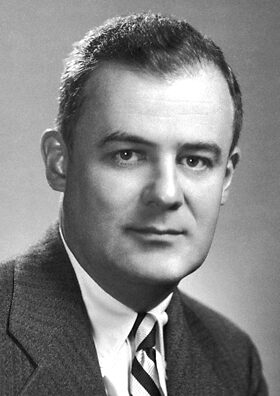
Frederick Chapman Robbins
Frederick Chapman Robbins was an American doctor. Born August 25, 1916, in Auburn. Died August 4, 2003, in Cleveland. Educated at Harvard Medical School and University of Missouri. Awards include Nobel Prize in Physiology or Medicine, Fellow of the American Academy of Arts and Sciences and E. Mead Johnson Award.
Facts
24 facts · 2 confirmed by two sources · 6 cited · 16 from one source
Where this comes from
Papalocal keeps its own record. It started from these sources; what each one said is kept here as it was copied, so a change on their side never changes this page by itself. Tap one to read its version.
What Wikidata says · copied November 13, 2026 · revision 2563200557
- Described as
- American doctor
- Other names
- Frederick C. Robbins, Frederick Robbins
- Born
- August 25, 1916 · 9 references
- Died
- August 4, 2003 · 8 references
- Born in
- Auburn · 2 references
- Died in
- Cleveland · 1 reference
- Citizen of
- United States
- Occupation
- physician; university teacher; virologist; physiologist · 1 reference; pediatrician · 1 reference; microbiologist · 1 reference
- Worked for
- Case Western Reserve University
- Education
- Harvard Medical School; University of Missouri; David H. Hickman High School · 1 reference
- Member of
- National Academy of Sciences (1972–) · 1 reference; American Academy of Arts and Sciences; American Philosophical Society (1972–)
- Awards
- Nobel Prize in Physiology or Medicine (1954) · 2 references; Fellow of the American Academy of Arts and Sciences; E. Mead Johnson Award (1953)
- Field
- virology
- Religion
- atheism
- Lived in
- Columbia · 1 reference
- Wikipedias with a page
- 55
Wikidata item Q309885 (wikidata.org/wiki/Q309885), public domain (CC0). Copied November 13, 2026.
What Wikipedia says · copied November 13, 2026 · revision 1381402896
Frederick Chapman Robbins (August 25, 1916 – August 4, 2003) was an American pediatrician and virologist. He was born in Auburn, Alabama, and grew up in Columbia, Missouri, attending David H. Hickman High School.
He received the Nobel Prize in Physiology or Medicine in 1954 along with John Franklin Enders and Thomas Huckle Weller, making Robbins the only Nobel laureate born in Alabama. The award was for breakthrough work in isolating and growing the poliovirus in tissue culture, paving the way for vaccines developed by Jonas Salk and Albert Sabin. He attended the University of Missouri and Harvard University.
In 1952, he was appointed professor of pediatrics at Case Western Reserve University. Robbins was elected a fellow of the American Academy of Arts and Sciences in 1962. From 1966 to 1980, Robbins was dean of the School of Medicine at Case Western. He was elected to the American Philosophical Society in 1972. In 1980, he assumed the presidency of the National Academy of Sciences' Institute of Medicine. He had been a member of the National Academy of Sciences since 1972. Five years later, in 1985, Robbins returned to Case Western Reserve as dean emeritus and distinguished university professor emeritus. He continued to be a fixture at the medical school until his death in 2003. The medical school's Frederick C. Robbins Society is named in his honor. His wife, Alice N. Robbins, died in 2016. She was the daughter of Nobel laureate John Howard Northrop.
Robbins received the Benjamin Franklin Medal for Distinguished Achievement in the Sciences of the American Philosophical Society in 1999.
- Born, in its opening lines
- August 25, 1916
- Died, in its opening lines
- August 4, 2003
From the Wikipedia article “Frederick Chapman Robbins” (en.wikipedia.org/wiki/Frederick_Chapman_Robbins), by its contributors, under CC BY-SA 4.0 (creativecommons.org/licenses/by-sa/4.0/). Copied November 13, 2026; not changed.
Confirmed Two sources agree. Cited One source, and it names where it got it. One source One source, without a reference of its own. Sources disagree The sources disagree. We show the best-supported value and keep theirs below.
