
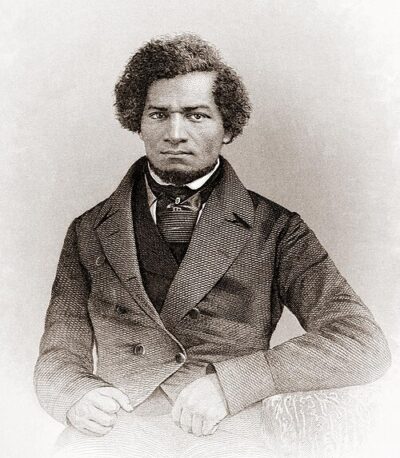
Frederick Douglass
Frederick Douglass was an African-American social reformer, writer, and abolitionist (c. 1818–1895). Born February 14, 1818, in Talbot County. Died February 20, 1895, in Washington, D.C.. Positions held include Washington, D.C. Recorder of Deeds (1881–), ambassador and United States Marshals Service. Known for Narrative of the Life of Frederick Douglass, an American Slave. Awards include National Association of Black Journalists Hall of Fame.
Facts
32 facts · 2 confirmed by two sources · 18 cited · 12 from one source
Where this comes from
Papalocal keeps its own record. It started from these sources; what each one said is kept here as it was copied, so a change on their side never changes this page by itself. Tap one to read its version.
What Wikidata says · copied November 13, 2026 · revision 2568288807
- Described as
- African-American social reformer, writer, and abolitionist (c. 1818–1895)
- Other names
- Frederick Augustus Washington Bailey, Frederick Augustus Washington Baly, Freddie Bailey, Fred Bailey
- Born
- February 14, 1818 · 4 references
- Died
- February 20, 1895 · 10 references
- Born in
- Talbot County · 2 references
- Died in
- Washington, D.C. · 5 references
- Buried in
- Mount Hope Cemetery · 3 references
- Cause of death
- myocardial infarction · 3 references
- Name at birth
- Frederick Augustus Washington Bailey · 2 references
- Citizen of
- United States · 1 reference
- Occupation
- journalist · 1 reference; diplomat · 2 references; writer · 4 references; editor; suffragist; abolitionist · 1 reference; orator; caulker · 1 reference
- Positions held
- Washington, D.C. Recorder of Deeds (1881–); ambassador; United States Marshals Service
- Political party
- Republican Party · 1 reference
- Member of
- Alpha Phi Alpha
- Known for
- Narrative of the Life of Frederick Douglass, an American Slave · 1 reference
- Awards
- National Association of Black Journalists Hall of Fame (2004)
- Field
- abolitionism · 2 references
- Spouse
- Anna Murray-Douglass (1838–1882); Helen Pitts Douglass (1884–1895)
- Children
- Rosetta Douglass · 2 references; Lewis Henry Douglass · 2 references; Frederick Douglass Jr. · 2 references; Charles Remond Douglass · 2 references
- Religion
- United Methodist Church
- Lived in
- Baltimore
- Wikipedias with a page
- 95
Wikidata item Q215562 (wikidata.org/wiki/Q215562), public domain (CC0). Copied November 13, 2026.
What Wikipedia says · copied November 13, 2026 · revision 1385101539
Frederick Douglass (born Frederick Augustus Washington Bailey, c. February 14, 1818 – February 20, 1895) was an American social reformer, abolitionist, orator, writer, and statesman. He was "the most important leader of the movement for African-American civil rights in the 19th century".
After escaping from slavery in Maryland in 1838, Douglass became a national leader of the abolitionist movement in Massachusetts and New York and gained fame for his oratory and incisive antislavery writings. Accordingly, he was described by abolitionists in his time as a living counterexample to claims by supporters of slavery that enslaved people lacked the intellectual capacity to function as independent American citizens. Northerners at the time found it hard to believe that such a great orator had once been enslaved. It was in response to this disbelief that Douglass wrote his first autobiography.
Douglass wrote three autobiographies, describing his experiences as an enslaved person first in his Narrative of the Life of Frederick Douglass, an American Slave (1845), which became a bestseller and was influential in promoting the cause of abolition, as was his second book, My Bondage and My Freedom (1855). Following the Civil War, Douglass was an active campaigner for the rights of freed slaves and wrote his last autobiography, Life and Times of Frederick Douglass. First published in 1881 and revised in 1892, three years before his death, the book covers his life up to those dates. Douglass also actively supported women's suffrage, and he held several public offices. In 1872, without his knowledge or consent, Douglass became the first African American nominated for vice president of the United States, as the running mate of Victoria Woodhull on the Equal Rights Party ticket.
Douglass believed in making alliances across racial and ideological divides, as well as in the anti-slavery interpretation of the U.S. Constitution, after he had broken with William Lloyd Garrison. When radical abolitionists, under the motto "No Union with Slaveholders", criticized Douglass's willingness to engage in dialogue with slave owners, he replied: "I would unite with anybody to do right and with nobody to do wrong."
- Born, in its opening lines
- February 14, 1818
- Died, in its opening lines
- February 20, 1895
From the Wikipedia article “Frederick Douglass” (en.wikipedia.org/wiki/Frederick_Douglass), by its contributors, under CC BY-SA 4.0 (creativecommons.org/licenses/by-sa/4.0/). Copied November 13, 2026; not changed.
Confirmed Two sources agree. Cited One source, and it names where it got it. One source One source, without a reference of its own. Sources disagree The sources disagree. We show the best-supported value and keep theirs below.
