
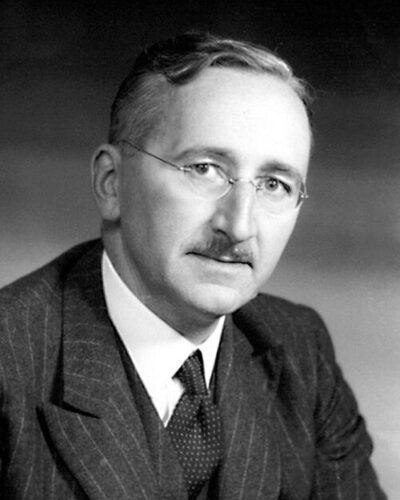
Friedrich Hayek
Friedrich Hayek was an Austrian and British economist. Born May 8, 1899, in Vienna. Died March 23, 1992, in Freiburg im Breisgau. Positions held include president (1947–1961). Known for The Road to Serfdom, Law, Legislation and Liberty and The Fatal Conceit: the Errors of Socialism. Educated at University of Vienna. Awards include Guggenheim Fellowship, Order of Merit of Baden-Württemberg and Ring of Honour of the City of Vienna.
Facts
51 facts · 2 confirmed by two sources · 17 cited · 32 from one source
Where this comes from
Papalocal keeps its own record. It started from these sources; what each one said is kept here as it was copied, so a change on their side never changes this page by itself. Tap one to read its version.
What Wikidata says · copied November 16, 2026 · revision 2569138628
- Described as
- Austrian and British economist (1899–1992)
- Other names
- Hayek, Friedrich A. Von Hayek, F. A. von Hayek, Friedrich A. von Hayek, F. A. Hayek, Friedrich August Von Hayek, Friedrich von Hayek, Friedrich August von Hayek
- Born
- May 8, 1899 · 13 references
- Died
- March 23, 1992 · 10 references
- Born in
- Vienna · 3 references
- Died in
- Freiburg im Breisgau · 3 references
- Buried in
- Neustifter Friedhof
- Citizen of
- Austria · 4 references; United Kingdom (1938–) · 4 references
- Occupation
- economist · 2 references; philosopher · 3 references; historian; political scientist; university teacher · 2 references
- Positions held
- president (1947–1961)
- Worked for
- University of Salzburg; University of Freiburg; New York University; University of Chicago; London School of Economics and Political Science
- Education
- University of Vienna (1918–1923)
- Member of
- Mont Pelerin Society; Econometric Society (1947–) · 1 reference
- Known for
- The Road to Serfdom (1944); Law, Legislation and Liberty (1974); The Fatal Conceit: the Errors of Socialism; The Constitution of Liberty
- Awards
- Guggenheim Fellowship (1954) · 1 reference; Order of Merit of Baden-Württemberg (1981); Ring of Honour of the City of Vienna; Presidential Medal of Freedom (1991) · 1 reference; Pour le Mérite for Sciences and Arts order; Hanns Martin Schleyer Prize (1984); Prize in Economic Sciences in Memory of Alfred Nobel (1974) · 1 reference; honorary doctorate of Salzburg University; Fellow of the Econometric Society (1947) · 1 reference; Fellow of the British Academy; Austrian Decoration for Science and Art (1974); Pour le Mérite · 1 reference; Companion of Honour (1984)
- Field
- economics · 1 reference; philosophy; political philosophy · 1 reference; economic theory · 1 reference; liberalism · 1 reference; social philosophy · 1 reference
- Spouse
- Helen Berta Maria von Fritsch; Helene Bitterlich
- Children
- Laurence Hayek; Christine von Hayek
- Father
- August von Hayek · 1 reference
- Religion
- Maronite Church
- Lived in
- Freiburg im Breisgau (1977–1992)
- Wikipedias with a page
- 113
Wikidata item Q1325 (wikidata.org/wiki/Q1325), public domain (CC0). Copied November 16, 2026.
What Wikipedia says · copied November 16, 2026 · revision 1384336547
Friedrich August von Hayek (8 May 1899 – 23 March 1992) was an Austrian economist and philosopher. He is known for his contributions to political economy, political philosophy and intellectual history. Hayek shared the 1974 Nobel Memorial Prize in Economic Sciences with Gunnar Myrdal for work on money and economic fluctuations, and the interdependence of economic, social and institutional phenomena. His account of how prices communicate information is widely regarded as an important contribution to economics that led to his receiving the prize. He was a notable member of the Austrian school of economics.
During his teenage years, Hayek fought in World War I. He later said this experience, coupled with his desire to help avoid the mistakes that led to the war, drew him into economics. He earned doctoral degrees in law in 1921 and political studies in 1923 from the University of Vienna. He subsequently lived and worked in Austria, Great Britain, the United States and Germany. He became a British national in 1938. He studied and taught at the London School of Economics and later at the University of Chicago, before returning to Europe late in life to teach at the Universities of Salzburg and Freiburg.
Hayek had considerable influence on a variety of political and economic movements of the 20th century, and his ideas continue to influence thinkers from a variety of political and economic backgrounds today. Although sometimes described as a conservative, Hayek himself rejected this label and preferred to be thought of as a classical liberal or libertarian. His most popular work, The Road to Serfdom (1944), has been republished many times over the eight decades since its original publication.
Hayek was appointed a Member of the Order of the Companions of Honour in 1984 for his academic contributions to economics. He was the first recipient of the Hanns Martin Schleyer Prize in 1984. He also received the Presidential Medal of Freedom in 1991 from President George H. W. Bush. In 2011, his article "The Use of Knowledge in Society" (1945) was selected as one of the top 20 articles published in the American Economic Review during its first 100 years.
- Born, in its opening lines
- May 8, 1899
- Died, in its opening lines
- March 23, 1992
From the Wikipedia article “Friedrich Hayek” (en.wikipedia.org/wiki/Friedrich_Hayek), by its contributors, under CC BY-SA 4.0 (creativecommons.org/licenses/by-sa/4.0/). Copied November 16, 2026; not changed.
Confirmed Two sources agree. Cited One source, and it names where it got it. One source One source, without a reference of its own. Sources disagree The sources disagree. We show the best-supported value and keep theirs below.
