
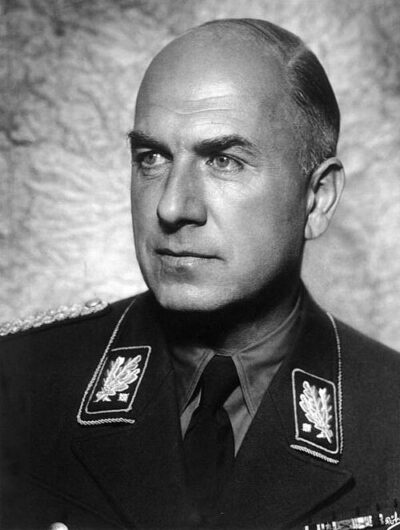
Fritz Todt
Fritz Todt was a German engineer, Holocaust perpetrator, and senior Nazi figure. Born September 4, 1891, in Pforzheim. Died February 8, 1942, in Kętrzyn. Educated at Technical University of Munich. Awards include German Order, Werner von Siemens Ring and Karmarsch Medal.
Facts
37 facts · 2 confirmed by two sources · 8 cited · 27 from one source
Where this comes from
Papalocal keeps its own record. It started from these sources; what each one said is kept here as it was copied, so a change on their side never changes this page by itself. Tap one to read its version.
What Wikidata says · copied November 16, 2026 · revision 2563998145
- Described as
- German engineer, Holocaust perpetrator, and senior Nazi figure (1891–1942)
- Other names
- Todt
- Born
- September 4, 1891 · 11 references
- Died
- February 8, 1942 · 11 references
- Born in
- Pforzheim · 3 references
- Died in
- Kętrzyn · 1 reference
- Buried in
- Invalids' Cemetery · 1 reference
- Cause of death
- aircraft crash
- Citizen of
- Grand Duchy of Baden; Weimar Republic; German Reich; Nazi Germany
- Occupation
- engineer · 1 reference; politician · 2 references; civil engineer; architect; military personnel · 1 reference; functionary · 1 reference; Holocaust perpetrator · 1 reference
- Political party
- Nazi Party (1922–) · 1 reference
- Education
- Technical University of Munich
- Member of
- Sturmabteilung; VDI – The Association of German Engineers (1939–) · 1 reference
- Awards
- German Order (1942); Werner von Siemens Ring (1937) · 1 reference; Karmarsch Medal (1941); Honour Cross of the World War 1914/1918; Sudetenland Medal; West Wall Medal; Golden Party Badge (1934); Anschluss Medal · 1 reference; Nazi Party Long Service Award (1940) · 1 reference; House Order of Hohenzollern · 1 reference; Iron Cross · 1 reference; Order of the Zähringer Lion · 1 reference; Military Merit Order (Bavaria) · 1 reference; Order of Saint Alexander · 1 reference; Order of St. Sava (1938) · 1 reference
- Military rank
- Obergruppenführer
- Wikipedias with a page
- 47
Wikidata item Q57149 (wikidata.org/wiki/Q57149), public domain (CC0). Copied November 16, 2026.
What Wikipedia says · copied November 16, 2026 · revision 1382869584
Fritz Todt ([fʁɪt͡s tɔt]; 4 September 1891 – 8 February 1942) was a German construction engineer and senior political figure of the Nazi Party. In 1938, he founded Organisation Todt (OT), a military-engineering organization that supplied German industry with forced labor, and he served as Reich Minister for Armaments and Ammunition in Nazi Germany early in World War II, directing the entire German wartime military economy from that position.
An engineer by training, Todt served in the Luftstreitkräfte during World War I and was a recipient of the Iron Cross. He joined the Nazi Party in 1922 and the Sturmabteilung (SA) in 1931. Steadily rising through the ranks, Todt became Inspector General for German Roadways after Adolf Hitler came to power. In that capacity, he was responsible for the construction of the German autobahns. Todt also directed large-scale engineering projects such as the construction of the Westwall (Siegfried Line) and the Atlantic Wall. In 1940, he was appointed Reich Minister of Armaments and War Production. During the war, OT made extensive use of upwards of 800,000 slave laborers from German-occupied territories. Todt's agency can be linked to the Holocaust as SS personnel collaborating with OT murdered many of the forced laborers (especially Jews) on the pretext of eliminating security risks or as a component of the Nazi genocidal programme.
Todt was killed along with four other people in February 1942 near Wilhelmsdorf when his aircraft crashed en route from Rastenburg to Berlin-Tempelhof. He was succeeded as Reichsminister and head of the OT by Albert Speer.
- Born, in its opening lines
- September 4, 1891
- Died, in its opening lines
- February 8, 1942
From the Wikipedia article “Fritz Todt” (en.wikipedia.org/wiki/Fritz_Todt), by its contributors, under CC BY-SA 4.0 (creativecommons.org/licenses/by-sa/4.0/). Copied November 16, 2026; not changed.
Confirmed Two sources agree. Cited One source, and it names where it got it. One source One source, without a reference of its own. Sources disagree The sources disagree. We show the best-supported value and keep theirs below.
