
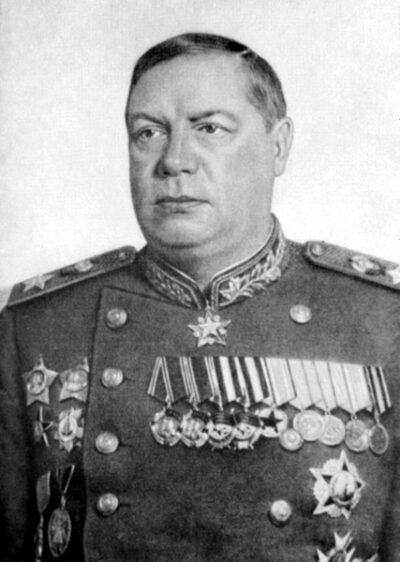
Fyodor Ivanovich Tolbukhin
Fyodor Ivanovich Tolbukhin was a Soviet military commander and Marshal of the Soviet Union. Born June 4, 1894. Died October 17, 1949, in Moscow. Positions held include deputy of the Supreme Soviet of the Soviet Union. Educated at M.V. Frunze Military Academy. Awards include Grand Officer of the Legion of Honour, Order of Lenin (3 times) and Medal "For the Victory over Germany in the Great Patriotic War 1941–1945".
Facts
35 facts · 1 confirmed by two sources · 5 cited · 28 from one source · 1 where the sources disagree
What’s different
- Born: we show June 4, 1894 (Sources disagree). Wikipedia says June 16, 1894
Where this comes from
Papalocal keeps its own record. It started from these sources; what each one said is kept here as it was copied, so a change on their side never changes this page by itself. Tap one to read its version.
What Wikidata says · copied November 16, 2026 · revision 2569026358
- Described as
- Soviet military commander and Marshal of the Soviet Union (1894-1949)
- Other names
- Fyodor Tolbukhin, Fyodor I. Tolbukhin, Tolbukhin
- Born
- June 4, 1894
- Died
- October 17, 1949 · 5 references
- Died in
- Moscow · 1 reference
- Buried in
- Kremlin Wall Necropolis
- Cause of death
- diabetes
- Citizen of
- Russian Empire; Soviet Union
- Occupation
- military officer · 1 reference; politician; soldier · 1 reference; marshal · 1 reference
- Positions held
- deputy of the Supreme Soviet of the Soviet Union
- Political party
- Communist Party of the Soviet Union
- Education
- M.V. Frunze Military Academy (–1934)
- Awards
- Grand Officer of the Legion of Honour; Order of Lenin (3 times) (1944, 1945, 1965); Medal "For the Victory over Germany in the Great Patriotic War 1941–1945"; Order of the Red Banner (3 times) (1922, 1943, 1944); Hero of the Soviet Union (1965); People's Hero of Yugoslavia (1945); Order of Victory (1945); Jubilee Medal "XX Years of the Workers' and Peasants' Red Army"; Order of Suvorov, 1st class (2 times) (1943, 1944); Order of Kutuzov, 1st class (1943); Order of the Red Star (1938); Medal "For the Defence of Sevastopol"; Medal "For the Defence of Stalingrad"; Medal "For the Defence of the Caucasus"; Medal "For the Liberation of Belgrade"
- Field
- military affairs · 1 reference
- Military branch
- Imperial Russian Army · 1 reference; infantry · 1 reference
- Military rank
- Marshal of the Soviet Union (1944–); shtabs-kapitan (1917); kombrig (1935–)
- Wikipedias with a page
- 44
Wikidata item Q48149 (wikidata.org/wiki/Q48149), public domain (CC0). Copied November 16, 2026.
What Wikipedia says · copied November 16, 2026 · revision 1379823086
Fyodor Ivanovich Tolbukhin (Russian: Фёдор Ива́нович Толбу́хин; 16 June 1894 – 17 October 1949) was a Soviet military commander and Marshal of the Soviet Union. He is regarded as one of the finest Soviet generals of World War II.
Born into a peasant family in Yaroslavl, Tolbukhin volunteered for the Imperial Russian Army during the First World War and served with distinction. He joined the Red Army in 1918 and fought in the Russian Civil War. After graduating from the Frunze Military Academy, he held a succession of commands, rising to the post of chief of staff of the Transcaucasian Military District by 1938. Tolbukhin rose further through the ranks following the German invasion of the Soviet Union, and was involved in the Battle of Stalingrad. As commander of the 4th Ukrainian Front, he assisted Rodion Malinovsky in the Lower Dnieper and Dnieper–Carpathian offensives. He then contributed to the Soviet drive into the Balkans and forced Romania's defection to the Allies, for which he was named a Marshal of the Soviet Union. Afterwards, Tolbukhin took part in the occupation of Bulgaria and liberated much of Yugoslavia after the Belgrade offensive. He commanded the Vienna offensive in May 1945 and helped set up the new Austrian government under Karl Renner.
After the war, Tolbukhin received command of the Southern Group of Forces in the Balkans before returning to the Transcaucasus. He held the post until his death in October 1949 from diabetes.
- Born, in its opening lines
- June 16, 1894
- Died, in its opening lines
- October 17, 1949
From the Wikipedia article “Fyodor Tolbukhin” (en.wikipedia.org/wiki/Fyodor_Tolbukhin), by its contributors, under CC BY-SA 4.0 (creativecommons.org/licenses/by-sa/4.0/). Copied November 16, 2026; not changed.
Confirmed Two sources agree. Cited One source, and it names where it got it. One source One source, without a reference of its own. Sources disagree The sources disagree. We show the best-supported value and keep theirs below.
