
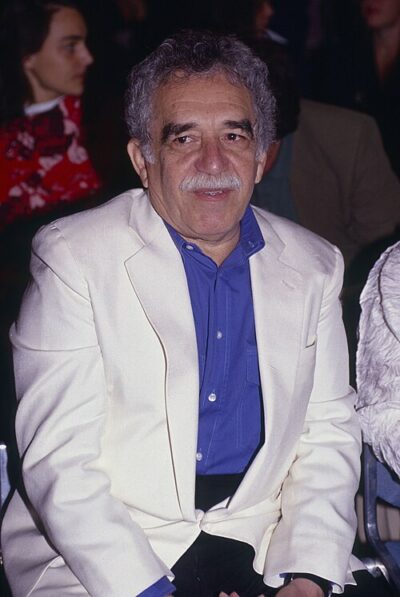
Gabriel García Márquez
Gabriel García Márquez was a Colombian writer and Nobel laureate. Born March 6, 1927, in Aracataca. Died April 17, 2014, in Mexico City. Known for One Hundred Years of Solitude, The Autumn of the Patriarch and Love in the Time of Cholera. Educated at National University of Colombia. Awards include Neustadt International Prize for Literature, Rómulo Gallegos Prize and Common Wealth Award of Distinguished Service.
Facts
43 facts · 1 confirmed by two sources · 15 cited · 25 from one source · 2 where the sources disagree
What’s different
- Born: we show March 6, 1927 (Sources disagree). Wikipedia says March 6, 1928
- Cause of death: we show lymphoma (Sources disagree). Wikidata also lists pneumonia
Where this comes from
Papalocal keeps its own record. It started from these sources; what each one said is kept here as it was copied, so a change on their side never changes this page by itself. Tap one to read its version.
What Wikidata says · copied November 16, 2026 · revision 2565594608
- Described as
- Colombian writer and Nobel laureate (1927–2014)
- Other names
- Gabriel José García Márquez, Gabriel Garcia Marquez, Gabriel Jose Garcia Marquez, Gabriel José de la Concordia García Márquez, Gabriel Jose de la Concordia Garcia Marquez, Gabo, Gabito
- Born
- March 6, 1927 · 13 references
- Died
- April 17, 2014 · 15 references
- Born in
- Aracataca · 3 references
- Died in
- Mexico City · 4 references
- Cause of death
- lymphoma; pneumonia
- Name at birth
- Gabriel José de la Concordia García Márquez
- Citizen of
- Colombia
- Occupation
- novelist; short story writer; journalist · 3 references; playwright; writer · 5 references; publisher; poet lawyer; autobiographer
- Education
- National University of Colombia · 1 reference
- Member of
- Academy of Arts of the GDR
- Known for
- One Hundred Years of Solitude; The Autumn of the Patriarch; Love in the Time of Cholera; Chronicle of a Death Foretold; The Story of a Shipwrecked Sailor; No One Writes to the Colonel
- Awards
- Neustadt International Prize for Literature (1971) · 1 reference; Rómulo Gallegos Prize (1972); Common Wealth Award of Distinguished Service (1980); Grand Officer of the Legion of Honour (1981); Nobel Prize in Literature (1982) · 1 reference; Simón Bolívar award; Order of the Aztec Eagle (1982); Orden al Mérito Docente y Cultural Gabriela Mistral (1993); Order of Honour (2012); Commander of the Legion of Honour (1980) · 1 reference
- Field
- novel · 1 reference; creative and professional writing · 1 reference; prose · 1 reference; short story · 1 reference; opinion journalism · 1 reference; journalism · 1 reference
- Spouse
- Mercedes Barcha (1958–2014) · 1 reference
- Children
- Rodrigo García Márquez · 2 references
- Father
- Gabriel Eligio García
- Siblings
- Eligio García Márquez
- Wikipedias with a page
- 209
Wikidata item Q5878 (wikidata.org/wiki/Q5878), public domain (CC0). Copied November 16, 2026.
What Wikipedia says · copied November 16, 2026 · revision 1385534841
Gabriel José García Márquez (Latin American Spanish: [ɡaˈβɾjel ɣaɾˈsi.a ˈmaɾ.kes] ; 6 March 1928 – 17 April 2014) was a Colombian writer and journalist, known affectionately as Gabo ([ˈɡaβo]) or Gabito ([ɡaˈβito]) throughout Latin America. Considered one of the most significant authors of the 20th century, particularly in the Spanish language, he was awarded the 1972 Neustadt International Prize for Literature and the 1982 Nobel Prize in Literature. He pursued a self-directed education that resulted in leaving law school for a career in journalism. From early on he showed no inhibitions in his criticism of Colombian and foreign politics. In 1958, he married Mercedes Barcha Pardo; they had two sons, Rodrigo and Gonzalo.
García Márquez started as a journalist and wrote many acclaimed non-fiction works and short stories. He is best known for his novels, such as No One Writes to the Colonel (1961); One Hundred Years of Solitude (1967), which has sold over fifty million copies worldwide; Chronicle of a Death Foretold (1981); and Love in the Time of Cholera (1985). His works have achieved significant critical acclaim and widespread commercial success, most notably for popularizing a literary style known as magic realism, which uses magical elements and events in otherwise ordinary and realistic situations. Some of his works are set in the fictional village of Macondo (mainly inspired by his birthplace, Aracataca), and most of them explore the theme of solitude. As of 2023, he is the most-translated Spanish-language author of the 21st century. In 1982, he was awarded the Nobel Prize in Literature, "for his novels and short stories, in which the fantastic and the realistic are combined in a richly composed world of imagination, reflecting a continent's life and conflicts". He was the fourth Latin American to receive the honor, following Chilean poets Gabriela Mistral (1945) and Pablo Neruda (1971), as well as Guatemalan novelist Miguel Ángel Asturias (1967). Alongside Jorge Luis Borges, García Márquez is regarded as one of the most renowned Latin American authors in history.
Upon García Márquez's death in April 2014, Juan Manuel Santos, the president of Colombia, called him "the greatest Colombian who ever lived".
- Born, in its opening lines
- March 6, 1928
- Died, in its opening lines
- April 17, 2014
From the Wikipedia article “Gabriel García Márquez” (en.wikipedia.org/wiki/Gabriel_García_Márquez), by its contributors, under CC BY-SA 4.0 (creativecommons.org/licenses/by-sa/4.0/). Copied November 16, 2026; not changed.
Confirmed Two sources agree. Cited One source, and it names where it got it. One source One source, without a reference of its own. Sources disagree The sources disagree. We show the best-supported value and keep theirs below.
