
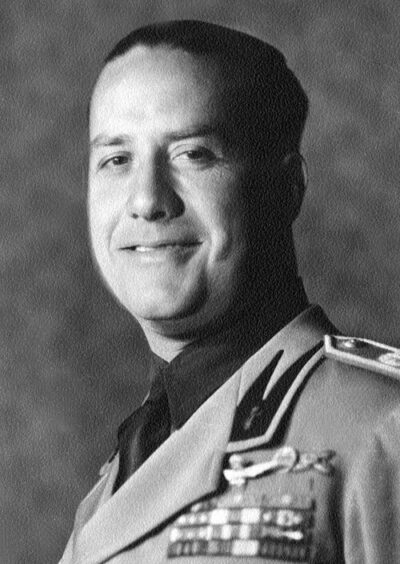
Galeazzo Ciano
Galeazzo Ciano was an Italian noble, diplomat and politician. Born March 18, 1903, in Livorno. Died January 11, 1944, in Verona. Positions held include minister of Foreign Affairs of the Kingdom of Italy (1936–1943), Undersecretary of State of the Council of Ministers of the Kingdom of Italy (1934–1935) and minister of Popular Culture of the Kingdom of Italy (1935–1936). Awards include Collar of the Order of Isabella the Catholic, Order of the White Eagle and Knight Grand Cross in the Order of the Holy Sepulchre.
Facts
41 facts · 2 confirmed by two sources · 8 cited · 31 from one source
Where this comes from
Papalocal keeps its own record. It started from these sources; what each one said is kept here as it was copied, so a change on their side never changes this page by itself. Tap one to read its version.
What Wikidata says · copied November 16, 2026 · revision 2565557219
- Described as
- Italian noble, diplomat and politician (1903-1944)
- Other names
- Gian Galeazzo Ciano, 2nd Count of Cortellazzo and Buccari, Gian Galeazzo Ciano
- Born
- March 18, 1903 · 10 references
- Died
- January 11, 1944 · 11 references
- Born in
- Livorno · 3 references
- Died in
- Verona · 3 references
- Buried in
- Cimitero della Purificazione · 1 reference
- Cause of death
- gunshot wound
- Name at birth
- Gian Galeazzo Ciano
- Citizen of
- Kingdom of Italy; Italian Social Republic
- Occupation
- diplomat · 1 reference; politician · 2 references; jurist; diarist; foreign minister · 1 reference
- Positions held
- minister of Foreign Affairs of the Kingdom of Italy (1936–1943); Undersecretary of State of the Council of Ministers of the Kingdom of Italy (1934–1935); minister of Popular Culture of the Kingdom of Italy (1935–1936); national councillor to the Chamber of Fasci and Corporations (1939–1943) · 1 reference
- Political party
- National Fascist Party
- Member of
- Grand Council of Fascism
- Awards
- Collar of the Order of Isabella the Catholic (1938) · 2 references; Order of the White Eagle; Knight Grand Cross in the Order of the Holy Sepulchre; Order of the Most Holy Annunciation; Knight Grand Cross of the Order of Saints Maurice and Lazarus; Knight grand cross of the order of the crown of Italy; Silver Medal of Military Valour; Order of the German Eagle; Order of the Golden Spur; Knight Grand Cross of the Order of Saint Stephen of Hungary; Knight Grand Cross of the Order of Pius IX; Sovereign Military Order of Malta; Knight of the Order of Saints Maurice and Lazarus; Collar of the Imperial Order of the Red Arrows (1939) · 1 reference; War Merit Cross (Italy)
- Spouse
- Edda Mussolini (1930–1944) · 1 reference
- Children
- Fabrizio Ciano; Marzio Ciano
- Father
- Costanzo Ciano
- Mother
- Carolina Pini
- Religion
- Catholic
- Wikipedias with a page
- 56
Wikidata item Q220105 (wikidata.org/wiki/Q220105), public domain (CC0). Copied November 16, 2026.
What Wikipedia says · copied November 16, 2026 · revision 1380868469
Gian Galeazzo Ciano, 2nd Count of Cortellazzo and Buccari ( CHAH-noh, Italian: [ɡaleˈattso ˈtʃaːno]; 18 March 1903 – 11 January 1944), was an Italian diplomat and politician who served as Minister of Foreign Affairs of the Kingdom of Italy under the government of his father-in-law, Benito Mussolini, from 1936 until 1943. During this period, he was widely seen as Mussolini's most probable successor as head of government.
He was the son of Admiral Costanzo Ciano, a founding member of the National Fascist Party; father and son both took part in Mussolini's March on Rome in 1922. Ciano saw action in the Italo-Ethiopian War (1935–36) and was appointed Foreign Minister on his return. Following a series of Axis defeats in the Second World War, Ciano began pushing for Italy's exit, and he was dismissed from his post as a result. He then served as ambassador to the Vatican.
In July 1943, Ciano was among the members of the Grand Council of Fascism that forced Mussolini's ousting and subsequent arrest. Ciano proceeded to flee to Germany but was arrested and handed over to Mussolini's new regime based in Salò, the Italian Social Republic. Mussolini ordered Ciano's death, and in January 1944, he was executed by firing squad.
Ciano wrote and left behind a diary that has been used as a source by several historians, including Winston Churchill in his six-volume work The Second World War, William Shirer in his 1960 book The Rise and Fall of the Third Reich and in the four-hour HBO documentary-drama Mussolini and I (1985).
- Born, in its opening lines
- March 18, 1903
- Died, in its opening lines
- January 11, 1944
From the Wikipedia article “Galeazzo Ciano” (en.wikipedia.org/wiki/Galeazzo_Ciano), by its contributors, under CC BY-SA 4.0 (creativecommons.org/licenses/by-sa/4.0/). Copied November 16, 2026; not changed.
Confirmed Two sources agree. Cited One source, and it names where it got it. One source One source, without a reference of its own. Sources disagree The sources disagree. We show the best-supported value and keep theirs below.
