
National Fascist Party
The National Fascist Party is an Italian political party, created by Benito Mussolini as the political expression of fascism. It was founded in 1921. Its headquarters are in Milan. It stands for Italian Fascism and clerical fascism.
- Country
- Kingdom of Italy
- Founded
- November 9, 1921
- Ideology
- fascism
All 15 facts, and where they come from
Facts
15 facts · 0 confirmed by two sources · 0 cited · 15 from one source
Where this comes from
Papalocal keeps its own record. It started from these sources; what each one said is kept here as it was copied, so a change on their side never changes this page by itself. Tap one to read its version.
What Wikidata says · copied November 17, 2026 · revision 2562918112
- Described as
- Italian political party, created by Benito Mussolini as the political expression of fascism
- Other names
- Partito Nazionale Fascista, PNF
- What it is
- political party; fascist party
- Comes after
- Fasci Italiani di Combattimento
- Followed by
- Republican Fascist Party
- Founded
- November 9, 1921
- Ended
- July 27, 1943
- Headquarters
- Milan
- Country
- Kingdom of Italy; Italy
- Chair
- Benito Mussolini (1921–1943)
- Ideology
- fascism; Italian Fascism; clerical fascism; corporatism
- Named after
- fasces
- Wikipedias with a page
- 63
Wikidata item Q139596 (wikidata.org/wiki/Q139596), public domain (CC0). Copied 2026-11-17.
What Wikipedia says · copied November 17, 2026 · revision 1383243891
The National Fascist Party (Italian: Partito Nazionale Fascista, PNF) was a far-right, ultranationalist, and fascist political party in Italy founded by politician Benito Mussolini in 1921 as a political expression of Italian fascism, and as a reorganisation of the previous Italian Fasces of Combat. The party ruled the Kingdom of Italy from 1922, when Fascists took power with the March on Rome, until the fall of the Fascist regime in 1943, when Mussolini was deposed by the Grand Council of Fascism. The National Fascist Party was succeeded by the Republican Fascist Party in the territories under the control of the Italian Social Republic, and it was ultimately dissolved at the end of World War II.
The National Fascist Party was rooted in Italian nationalism and the desire to restore and expand Italian territories, which Italian Fascists deemed necessary for a nation to assert its superiority and strength and to avoid succumbing to decay. Italian Fascists claimed that modern Italy was the heir to ancient Rome and its legacy and historically supported the idea of continued expansion of the Italian Empire to provide spazio vitale ("living space") for colonisation by Italian settlers and to establish control over the Mediterranean Sea. The party also supported social conservative stances.
Fascists promoted a corporatist economic system, whereby employer and employee syndicates are linked together in associations to collectively represent the nation's economic producers and work alongside the state to set national economic policy. This economic system intended to resolve class conflict through collaboration between the classes. Moreover, the PNF strongly advocated autarky.
Italian Fascism, similarly to German Nazism, opposed liberalism, but did not seek a reactionary restoration of the pre-French Revolutionary world, which it considered to have been flawed, and not in line with a forward-looking direction on policy. It was opposed to Marxist socialism because of its typical opposition to nationalism, but was also opposed to the reactionary conservatism developed by Joseph de Maistre. It believed the success of Italian nationalism required respect for tradition and a clear sense of a shared past among the Italian people alongside a commitment to a modernised Italy, as well as a solid belief that Italy was destined to become the hegemonic power in Europe.
The National Fascist Party along with its successor, the Republican Fascist Party, are the only parties whose re-formation is banned by the Constitution of Italy: "It shall be forbidden to reorganize, under any form whatsoever, the dissolved Fascist party."
From the Wikipedia article “National Fascist Party” (en.wikipedia.org/wiki/National_Fascist_Party), by its contributors, under CC BY-SA 4.0 (creativecommons.org/licenses/by-sa/4.0/). Copied 2026-11-17; not changed.
Confirmed Two sources agree. Cited One source, and it names where it got it. One source One source, without a reference of its own. Sources disagree The sources disagree. We show the best-supported value and keep theirs below.
People connected 17
Party members
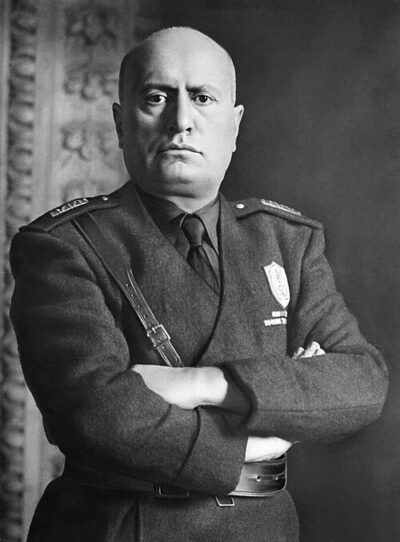 Benito Mussolini (1921–1943)Prime minister of Italy from 1922 to 1943
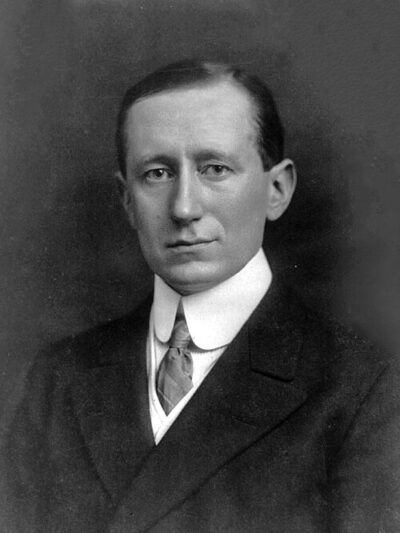 Guglielmo Marconi (1923–)Italian inventor and radio pioneer (1874–1937)
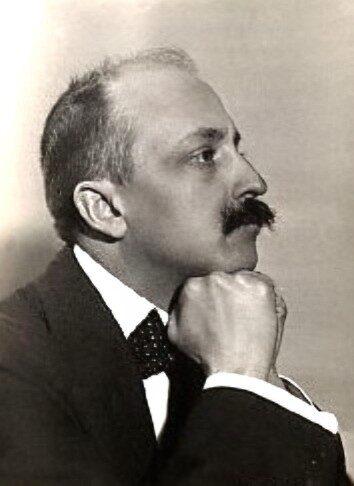 Filippo Tommaso MarinettiItalian poet and editor, founder of the Futurist movement (1876-1944)
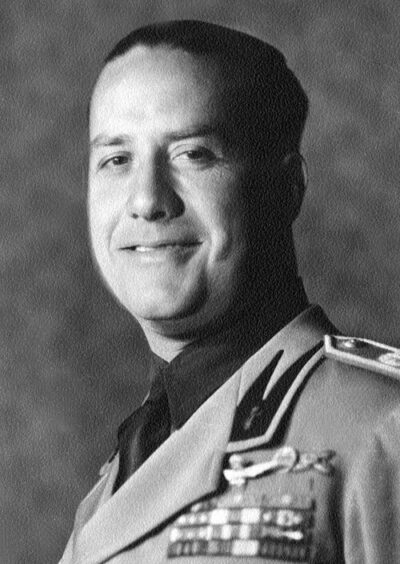 Galeazzo CianoItalian noble, diplomat and politician (1903-1944)
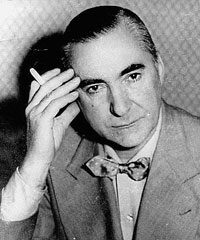 Curzio MalaparteItalian writer (1898-1957)
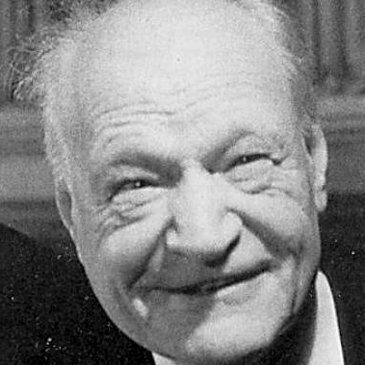 Giuseppe UngarettiItalian poet, writer and university teacher
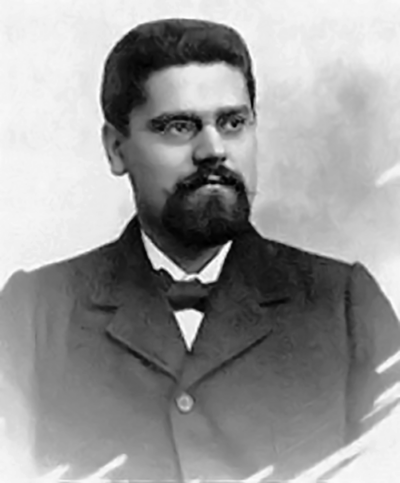 Giovanni GentileItalian philosopher, educator, fascist theoretician and politician (1875-1944)
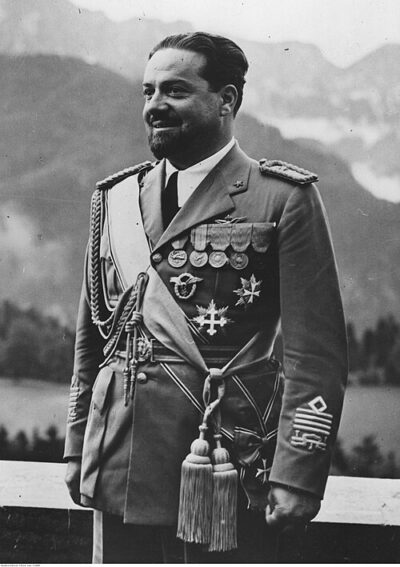 Italo BalboItalian Marshal of the Air Force and minister (1896–1940)
 Rodolfo GrazianiItalian general (1882-1955)
 Emilio De BonoItalian general and fascist activist (1866–1944)
 Giovanni AgnelliItalian entrepreneur (1866–1945)
 Robert MichelsGerman sociologist (1876–1936)
 Dino GrandiItalian politician (1895–1988)
 Ugo CavalleroItalian general (1880-1943)
 Italo GariboldiItalian general (1879-1970)
 Licio GelliItalian financier, liaison with Nazi Germany, P2 grandmaster, involved in many scandals (1919-2015)
 Ettore BasticoItalian general (1876-1972)
