
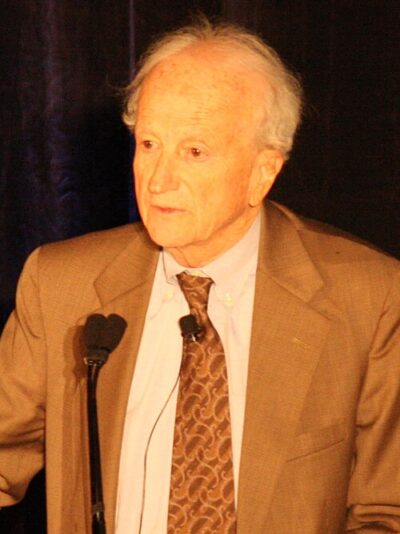
Gary S. Becker
Gary S. Becker was an American economist. Born December 2, 1930, in Pottsville. Died May 3, 2014, in Chicago. Positions held include senior advisor. Educated at Princeton University and University of Chicago. Awards include Adam Smith Award, John Bates Clark Medal and National Medal of Science.
Facts
43 facts · 2 confirmed by two sources · 23 cited · 18 from one source
Where this comes from
Papalocal keeps its own record. It started from these sources; what each one said is kept here as it was copied, so a change on their side never changes this page by itself. Tap one to read its version.
What Wikidata says · copied November 13, 2026 · revision 2568212604
- Described as
- American economist (1930-2014)
- Other names
- Gary Stanley Becker
- Born
- December 2, 1930 · 7 references
- Died
- May 3, 2014 · 6 references
- Born in
- Pottsville · 4 references
- Died in
- Chicago · 4 references
- Buried in
- Oak Woods Cemetery · 1 reference
- Cause of death
- surgical complications
- Citizen of
- United States · 2 references
- Occupation
- economist · 2 references; university teacher; criminologist · 1 reference; educator · 1 reference
- Positions held
- senior advisor
- Worked for
- University of Chicago · 1 reference; Columbia University · 1 reference
- Education
- Princeton University · 1 reference; University of Chicago (–1955) · 3 references; James Madison High School · 1 reference
- Member of
- Pontifical Academy of Sciences (1997–) · 1 reference; National Academy of Sciences (1975–); American Academy of Arts and Sciences (1972–); Mont Pelerin Society; American Philosophical Society (1986–) · 1 reference; Econometric Society (1967–) · 1 reference; American Economic Association (1964) · 1 reference; National Academy of Education (1965); National Academy of Sciences of Argentina (2000)
- Awards
- Adam Smith Award (1991); John Bates Clark Medal (1967); National Medal of Science (2000) · 1 reference; Presidential Medal of Freedom (2007) · 1 reference; Prize in Economic Sciences in Memory of Alfred Nobel (1992) · 2 references; John von Neumann Award (2004); Distinguished Fellow of the American Economic Association; Fellow of the Econometric Society (1967) · 1 reference; Fellow of the American Statistical Association (1965) · 1 reference; Fellow of the American Academy of Arts and Sciences; honorary doctor of the University of Miami (1995) · 1 reference; honorary doctor of the Paul Cézanne University (1999) · 1 reference; Hayek Medal (2003) · 1 reference
- Field
- economics
- Spouse
- Guity Nashat Becker · 1 reference
- Children
- Judy Becker
- Lived in
- Pottsville
- Wikipedias with a page
- 67
Wikidata item Q191020 (wikidata.org/wiki/Q191020), public domain (CC0). Copied November 13, 2026.
What Wikipedia says · copied November 13, 2026 · revision 1378846047
Gary Stanley Becker (; December 2, 1930 – May 3, 2014) was an American economist, professor of economics and sociology at the University of Chicago, and a leader of the third generation of the Chicago school of economics.
Becker was awarded the Nobel Memorial Prize in Economic Sciences in 1992 and received the United States Presidential Medal of Freedom in 2007. A 2011 survey of economics professors named Becker their favorite living economist over the age of 60, followed by Kenneth Arrow and Robert Solow. Economist Justin Wolfers called him "the most important social scientist in the past 50 years."
Becker was one of the first economists to analyze topics that had been researched in sociology, including racial discrimination, crime, family organization, and rational addiction. He argued that many different types of human behavior can be seen as rational and utility-maximizing, including those that are often regarded as self-destructive or irrational. His approach also extended to altruistic aspects of human behavior, which he showed to sometimes have self-serving ends (when individuals' utility is properly defined and measured, that is). He was also among the foremost exponents of the study of human capital. According to Milton Friedman, he was "the greatest social scientist who has lived and worked" in the second part of the twentieth century.
- Born, in its opening lines
- December 2, 1930
- Died, in its opening lines
- May 3, 2014
From the Wikipedia article “Gary Becker” (en.wikipedia.org/wiki/Gary_Becker), by its contributors, under CC BY-SA 4.0 (creativecommons.org/licenses/by-sa/4.0/). Copied November 13, 2026; not changed.
Confirmed Two sources agree. Cited One source, and it names where it got it. One source One source, without a reference of its own. Sources disagree The sources disagree. We show the best-supported value and keep theirs below.
