
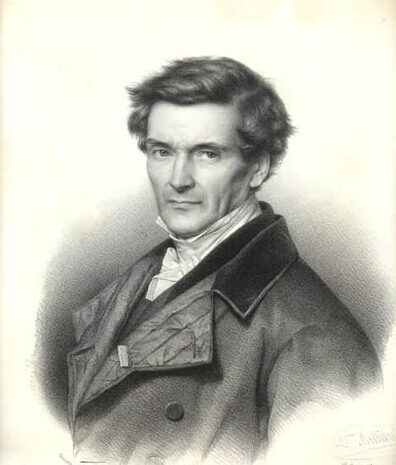
Gaspard-Gustave de Coriolis
Gaspard-Gustave de Coriolis was a French mathematician, mechanical engineer, and scientist. Born May 21, 1792, in Paris. Died September 19, 1843, in Paris. Known for Coriolis force, Coriolis acceleration and Coriolis frequency. Educated at École Nationale des Ponts et Chaussées and École polytechnique. Awards include 72 names on the Eiffel Tower.
Facts
26 facts · 2 confirmed by two sources · 12 cited · 12 from one source
What’s different
- Born: we show May 21, 1792 (Confirmed). Wikidata also lists May 22, 1792
Where this comes from
Papalocal keeps its own record. It started from these sources; what each one said is kept here as it was copied, so a change on their side never changes this page by itself. Tap one to read its version.
What Wikidata says · copied November 16, 2026 · revision 2559066756
- Described as
- French mathematician, mechanical engineer, and scientist (1792–1843)
- Other names
- Gustave Coriolis, Gaspard-Gustave Coriolis, Gustave Gaspard de Coriolis
- Born
- May 22, 1792 · 11 references; May 21, 1792 · 3 references
- Died
- September 19, 1843 · 11 references
- Born in
- Paris · 4 references
- Died in
- Paris · 4 references
- Buried in
- Montparnasse Cemetery · 1 reference
- Citizen of
- France
- Occupation
- mathematician · 2 references; physicist · 2 references; engineer · 2 references; university teacher
- Worked for
- École polytechnique (2 times) (1816–1843) · 1 reference; École Nationale des Ponts et Chaussées (1831–1838); École Centrale Paris (1829–1836) · 1 reference
- Education
- École Nationale des Ponts et Chaussées (1810–1811) · 1 reference; École polytechnique (1808–1810)
- Member of
- Société Philomathique de Paris · 1 reference; French Academy of Sciences (1836–); Academy of Sciences of Turin (1841–) · 1 reference; Académie de Stanislas (Nancy, France) · 1 reference
- Known for
- Coriolis force; Coriolis acceleration; Coriolis frequency; Rivals Theorem
- Awards
- 72 names on the Eiffel Tower · 1 reference
- Field
- mathematics; mechanics
- Wikipedias with a page
- 63
Wikidata item Q202827 (wikidata.org/wiki/Q202827), public domain (CC0). Copied November 16, 2026.
What Wikipedia says · copied November 16, 2026 · revision 1377997019
Gaspard-Gustave de Coriolis (French: [ɡaspaʁ ɡystav də kɔʁjɔlis]; 21 May 1792 – 19 September 1843) was a French mathematician, mechanical engineer and scientist. He is best known for his work on the supplementary forces that are detected in a rotating frame of reference, leading to the Coriolis effect. He was the first to apply the term travail (translated as "work") for the transfer of energy by a force acting through a distance, and he prefixed the factor +1⁄2 to Gottfried Wilhelm Leibniz's concept of vis viva, thus specifying today's kinetic energy.
- Born, in its opening lines
- May 21, 1792
- Died, in its opening lines
- September 19, 1843
From the Wikipedia article “Gaspard-Gustave de Coriolis” (en.wikipedia.org/wiki/Gaspard-Gustave_de_Coriolis), by its contributors, under CC BY-SA 4.0 (creativecommons.org/licenses/by-sa/4.0/). Copied November 16, 2026; not changed.
Confirmed Two sources agree. Cited One source, and it names where it got it. One source One source, without a reference of its own. Sources disagree The sources disagree. We show the best-supported value and keep theirs below.
