
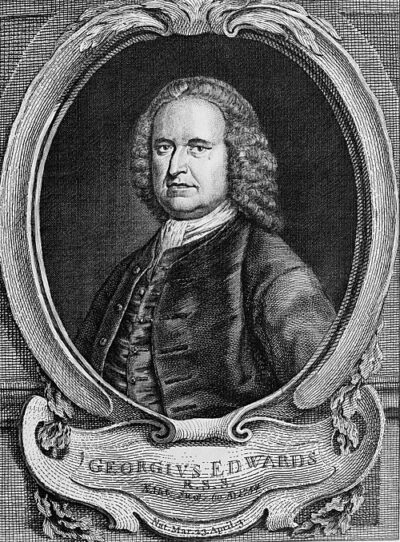
George Edwards
George Edwards was an English naturalist and ornithologist. Born April 3, 1694, in Stratford. Died July 23, 1773, in Plaistow. Awards include Copley Medal and Fellow of the Royal Society.
Facts
18 facts · 2 confirmed by two sources · 9 cited · 7 from one source
What’s different
- Born: we show April 3, 1694 (Confirmed). Wikidata also lists April 3, 1693
Where this comes from
Papalocal keeps its own record. It started from these sources; what each one said is kept here as it was copied, so a change on their side never changes this page by itself. Tap one to read its version.
What Wikidata says · copied November 18, 2026 · revision 2564322720
- Described as
- English naturalist and ornithologist (1694 – 1773)
- Other names
- G. Edwards, G.Edwards
- Born
- April 3, 1694 · 2 references; April 3, 1693 · 1 reference
- Died
- July 23, 1773 · 4 references
- Born in
- Stratford · 1 reference
- Died in
- Plaistow · 1 reference
- Citizen of
- Kingdom of Great Britain; United Kingdom · 1 reference
- Occupation
- ornithologist · 1 reference; entomologist; librarian · 1 reference; botanist · 1 reference; visual artist · 1 reference; etcher · 1 reference; copper engraver · 1 reference; draftsperson · 1 reference
- Member of
- Royal Society of London
- Awards
- Copley Medal (1750) · 1 reference; Fellow of the Royal Society · 1 reference
- Field
- ornithology · 1 reference
- Wikipedias with a page
- 23
Wikidata item Q257668 (wikidata.org/wiki/Q257668), public domain (CC0). Copied November 18, 2026.
What Wikipedia says · copied November 18, 2026 · revision 1380682000
George Edwards (3 April 1694 – 23 July 1773) was an English naturalist and ornithologist, known as the "father of British ornithology".
Edwards was born at West Ham, then in the county of Essex. In his early years, he travelled extensively through mainland Europe, studying natural history, and gained a reputation for his coloured drawings of animals, especially birds. He was appointed as beadle to the Royal College of Physicians in 1733.
Over a period of 21 years, Edwards published seven volumes containing descriptions and hand-coloured etchings of birds. In a few cases, he depicted other animals. None of the species were native to the British Isles. The first four volumes were published between 1743 and 1751 with the title A Natural History of Uncommon Birds. The three subsequent volumes were published between 1758 and 1764 with the title Gleanings Of Natural History. The volumes contain a total of 362 hand-coloured etchings of which 317 depict birds. The etchings were all drawn by Edwards. He numbered the plates consecutively through the seven volumes.
When the Swedish naturalist Carl Linnaeus updated his Systema Naturae for the tenth edition in 1758, he listed a binomial name for every plant and animal. For many of the birds he cited the description and illustration in A Natural History of Uncommon Birds. Later, when he updated the Systema Naturae for the 12th edition in 1766, he cited the Gleanings of Natural History.
Edwards was elected a member of the Royal Society in 1757. He never married and died aged 79 in 1773 in Plaistow, Essex.
- Born, in its opening lines
- April 3, 1694
- Died, in its opening lines
- July 23, 1773
From the Wikipedia article “George Edwards (naturalist)” (en.wikipedia.org/wiki/George_Edwards_(naturalist)), by its contributors, under CC BY-SA 4.0 (creativecommons.org/licenses/by-sa/4.0/). Copied November 18, 2026; not changed.
Confirmed Two sources agree. Cited One source, and it names where it got it. One source One source, without a reference of its own. Sources disagree The sources disagree. We show the best-supported value and keep theirs below.
